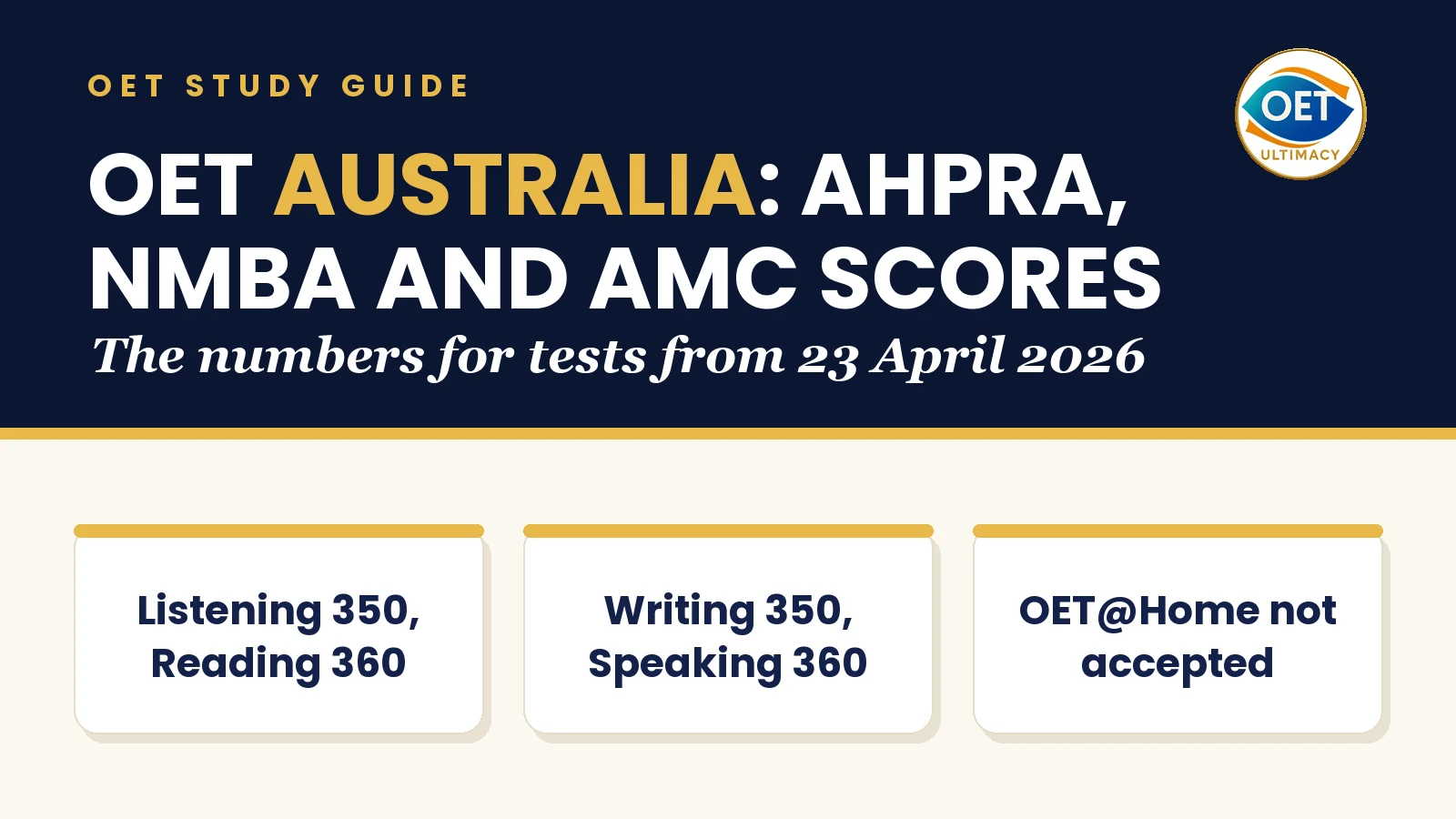
Short answer: For registration with AHPRA and the National Boards (including the NMBA for nurses and midwives and the Medical Board for doctors), an OET taken on or after 23 April 2026 needs at least 350 in Listening, 360 in Reading, 350 in Writing and 360 in Speaking. A test taken on or before 22 April 2026 is judged by the old rule: grade B in Listening, Reading and Speaking and C+ in Writing. AHPRA accepts OET on paper or on computer at a test centre, not OET@Home, and results from one sitting or two sittings no more than 12 months apart. Visas use different OET numbers set by the Department of Home Affairs.
Which OET scores do Australian bodies ask for?
Three different bodies may look at your OET result, and each publishes its own numbers. AHPRA decides registration, ANMAC assesses nurses' and midwives' qualifications for migration, and the Department of Home Affairs decides visas. As of November 2026:
| Body and purpose | Listening | Reading | Writing | Speaking |
|---|---|---|---|---|
| AHPRA registration, tests from 23 April 2026 | 350 | 360 | 350 | 360 |
| AHPRA registration, tests on or before 22 April 2026 | B | B | C+ | B |
| ANMAC skills assessment for migration | B | B | C+ | B |
| Home Affairs, Competent English | 290 | 310 | 290 | 330 |
| Home Affairs, Proficient English | 350 | 360 | 380 | 360 |
| Home Affairs, Superior English | 390 | 400 | 420 | 400 |
The Home Affairs numbers apply to tests taken from 7 August 2025, when its OET scoring changed to numbers. Which English level your visa needs depends on the visa, so check its own page.
Look at Writing in the table. A score of 350 is enough for AHPRA but not for Proficient English, which asks for 380. So a result that registers you may still fall short of a visa that needs Proficient English. ANMAC still writes its rule in letter grades, and its page notes that OET now reports scores as numbers. Grade B covers 350 to 440 and C+ covers 300 to 340, which our OET scores and grades guide explains alongside the other regulators.
Does the April 2026 change affect an OET you already took?
Only if you took it on or after 23 April 2026. AHPRA's rule goes by the date you sat the test, not the date you apply. A result from 22 April 2026 or earlier is checked against the old grades (B, B, C+, B), and a result from 23 April onwards against the new numbers.
The change matters most in Reading and Speaking. Under the old rule, 350 in Reading was a B and enough. On a test taken after 23 April, 350 in Reading is 10 points short. AHPRA says the update followed new score-comparison research and the Home Affairs numbers, and that it does not change the level of English required.
AHPRA's accepted tests page says every National Board except the Aboriginal and Torres Strait Islander Health Practice Board accepts the same English tests and requires the same minimum scores. The NMBA's English language skills page confirms that its standard applies to all nurses and midwives applying for initial registration, and that the 23 April 2026 score change applies to them.
How do two OET sittings work for AHPRA?
AHPRA accepts results from one sitting or from two sittings whose dates are no more than 12 months apart. Its FAQ and its standard give slightly different last days for that window (28 February and 1 March for a first sitting on 1 March), so book the second sitting well inside it. You must take all four sub-tests in each sitting, both sittings must be OET (you cannot mix OET with IELTS), and when you use two sittings, no score in either one may fall below a floor:
| Sub-test | Score needed (tests from 23 April 2026) | Floor in either sitting |
|---|---|---|
| Listening | 350 | 320 |
| Reading | 360 | 340 |
| Writing | 350 | 350 |
| Speaking | 360 | 350 |
For Writing the floor equals the score needed, so a Writing score under 350 in either sitting cannot be used for a two-sitting application.
Here is a worked example we wrote, with invented scores. A nurse sits OET in June 2026 and scores Listening 360, Reading 350, Writing 370, Speaking 380. Reading is 10 short of 360. The nurse sits all four again in November 2026 and scores Listening 340, Reading 370, Writing 350, Speaking 360. Across the two sittings the nurse has 360 in Listening, 370 in Reading, 370 in Writing and 380 in Speaking, and no score is under its floor (the lowest are 340, 350, 350 and 360). If the November Listening had been 310, below the 320 floor, the pair could not be used, even though June's Listening was fine.
For the other accepted tests, AHPRA's new table says you must reach the minimum scores "across the two sittings". The OET row does not repeat those words. The old OET row did, and AHPRA's own explanation of two sittings is the same for every test, but if your plan depends on combining two OET results, ask AHPRA to confirm before you book the second sitting.
If your first sitting was on or before 22 April 2026 and the second after it, AHPRA checks the first against the old grades and the second against the new numbers. Under the old grades, the floor in either sitting was C+.
Can you retake just one OET sub-test for Australia?
No. AHPRA accepts a single-skill resit only for IELTS (its One Skill Retake) and says this is not available for the other accepted tests. OET does sell resits of one, two or three sub-tests on paper at a venue, after a full test, but a partial OET resit does not count for AHPRA, so every retake you plan for registration is a full four-part test. Prices for full tests and resits are in our OET exam fees guide.
Which OET formats does Australia accept?
OET on paper and OET on computer, both at a test centre. AHPRA does not accept at-home versions of any English test, which rules out OET@Home. It makes one exception for remote supervision: the OET computer test at a test centre has one remotely supervised element, which the National Boards have assessed as acceptable. Home Affairs also refuses tests delivered completely online and names OET@Home among them.
For candidates in Australia, OET announced in July 2026 that computer-test candidates in Melbourne and Sydney will be able to choose between taking Speaking at home or at a test venue, with details sent by email as the change arrives.
If you are not a nurse or doctor, check the date. From January 2027, OET on paper is for Nursing and Medicine only, so a dentist, pharmacist or physiotherapist applying to AHPRA will take OET on computer at a venue. Our guide to OET on paper in 2027 covers what changes.
Do doctors need OET for the AMC?
The English requirement belongs to the Medical Board of Australia, not the AMC. The AMC's English language page says so and tells you to arrange proof of English before you apply through any AMC pathway. So the OET numbers a doctor needs are AHPRA's: 350, 360, 350 and 360 for a test from 23 April 2026.
The Medical Board also accepts two medical exams in place of an English test: passing the PLAB test or the New Zealand Registration Examination (NZREX), according to AHPRA's accepted tests page.
Which profession's OET should you take for AHPRA?
Usually your own, but AHPRA accepts any profession's OET. Its page says OET has not built a test for some of the professions it registers, so an OET from another registered profession that meets the standard is accepted. ANMAC's page lists "OET for nurses" for its skills assessment, so nurses planning to migrate should take the Nursing version. Listening and Reading are the same for every profession, as our guide on whether OET is the same for every profession shows.
How old can your OET result be?
Two years before the day you lodge your AHPRA application. If you use two sittings, the two years count from the earlier one. AHPRA accepts an older result only if, since the test, you have worked continuously in a recognised country as a registered health practitioner (or in a related health, disability or aged-care role where English was the main language), or studied continuously on a Board-approved programme, and you apply within 12 months of finishing. "Continuously" means at least 26 weeks of full-time-equivalent work per year.
For visas, Home Affairs says OET results from tests on or before 6 August 2025 can be used until 6 August 2028, depending on the visa.
Do you need OET at all for Australia?
Not always. The English language skills standard (nurses and midwives read the NMBA's version) has education pathways that replace a test when your education and qualification were taught and assessed solely in English, and most of them need some of that education to be in a recognised country. The list includes Australia, Canada, Ireland, New Zealand, the UK and the USA, and OET reported that the 2025 standard widened it to 30 countries and territories. Each pathway sets a minimum number of years of English-taught education, so read its conditions before deciding to skip the test.
Where can you practise for the Australian scores?
The two numbers that changed on 23 April 2026 are Reading and Speaking, both now 360, so give those more of your preparation time than an old B target would suggest. Sit a full OET Reading mock under the real 60 minutes and see whether you clear 360 with room to spare, and practise Speaking with our OET role-play cards. For Listening, the full OET Listening mocks show where your 350 stands.
Spelling decides marks in Listening Part A. OET explained in one of its live sessions that a common word any healthcare professional should know, such as gallbladder, is marked wrong if misspelt even by one letter. OET accepts British or American spelling, but only if you keep to one style for the whole test. The Listening Part A section lets you hear Part A words, type them and get your spelling checked at once.
Frequently asked questions
What OET score do nurses need for AHPRA?
For a test taken on or after 23 April 2026, nurses and midwives need 350 in Listening, 360 in Reading, 350 in Writing and 360 in Speaking, the same as every other National Board except the Aboriginal and Torres Strait Islander Health Practice Board. A test taken on or before 22 April 2026 needs B in Listening, Reading and Speaking and C+ in Writing.
Is OET grade B enough for Australia now?
For a test taken on or before 22 April 2026, yes, with C+ allowed in Writing. For a test taken from 23 April 2026, a B can fall short: Reading and Speaking now need 360, and grade B starts at 350. Writing needs 350, which is a B.
Does AHPRA accept OET@Home?
No. AHPRA accepts OET on paper and OET on computer at a test centre. It does not accept at-home or remotely proctored versions of any English test, except the one remotely supervised element of the OET computer test taken at a test centre.
Can I combine two OET results for Australian registration?
Yes, if the two sittings are no more than 12 months apart, you took all four sub-tests each time, and no score in either sitting is below 320 in Listening, 340 in Reading, 350 in Writing or 350 in Speaking (for tests from 23 April 2026). Because the new OET row in AHPRA's table is worded more briefly than the other tests' rows, confirm with AHPRA before relying on two sittings.
What OET score do I need for an Australian visa?
It depends on the English level your visa asks for. For tests from 7 August 2025, Home Affairs sets Competent English at 290, 310, 290 and 330 (Listening, Reading, Writing, Speaking) and Proficient English at 350, 360, 380 and 360. These are separate from AHPRA's registration numbers.
Does the AMC require OET?
No. The AMC says English proficiency is a Medical Board of Australia requirement, not an AMC one, but it asks you to arrange your English evidence before applying through an AMC pathway. The Medical Board accepts OET, other approved English tests, PLAB or NZREX.
How long is OET valid for AHPRA?
Two years before the date you lodge your application, counted from the earlier sitting if you use two. An older result can be accepted if you have worked or studied continuously in English since the test, as set out in AHPRA's rules, and you apply within 12 months of finishing.
OET Ultimacy is an independent OET preparation provider and is not affiliated with OET, Cambridge Boxhill Language Assessment, AHPRA or any National Board. Test rules, fees and requirements can change, so always check oet.com and the body you are applying to.