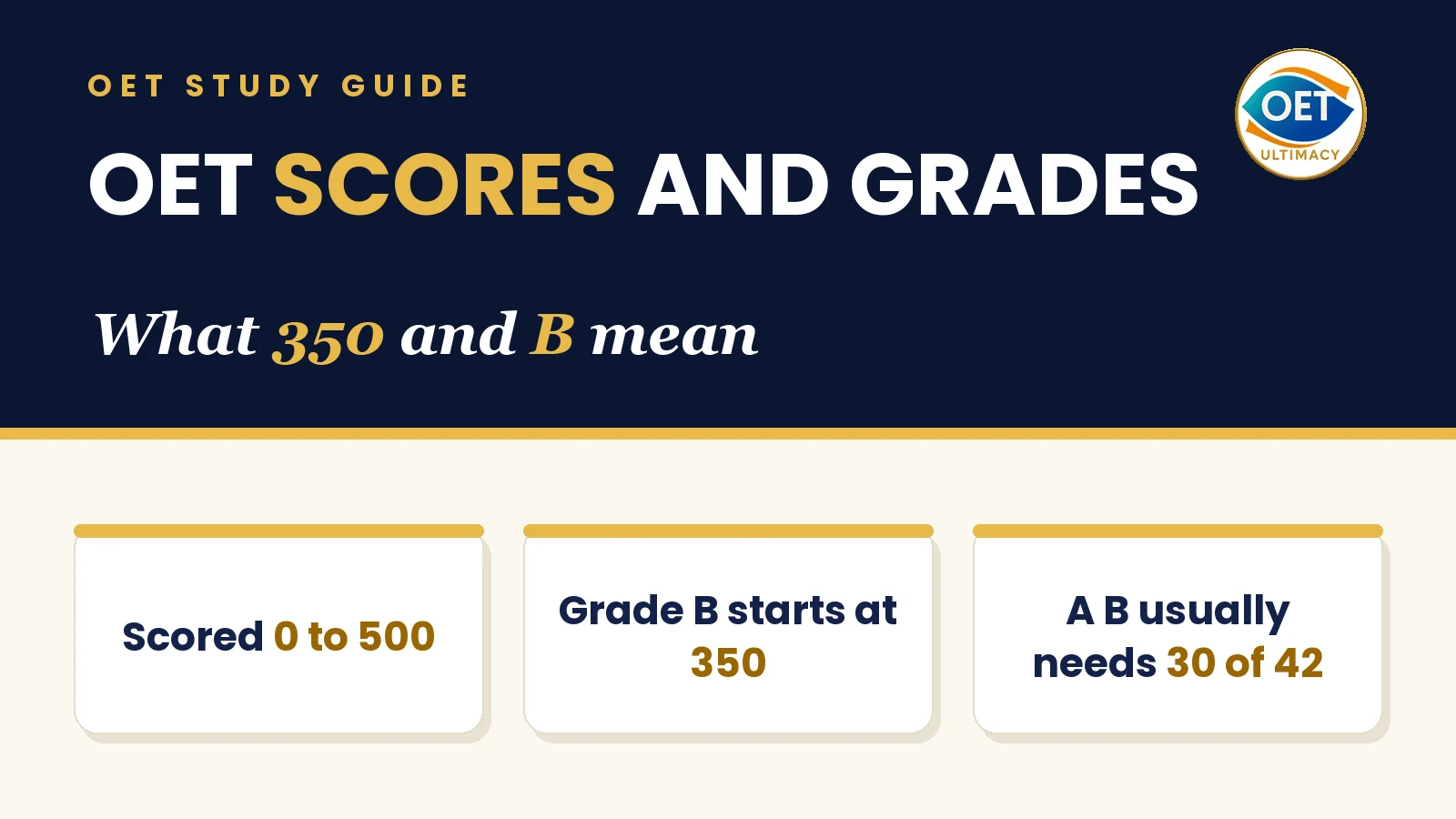
Short answer: Each OET sub-test is scored on its own, from 0 to 500 in steps of 10, and given a grade from A (highest) to E. Grade B is 350 to 440, and it is the grade most regulators ask for. In Listening and Reading, a B typically needs at least 30 of the 42 marks. There is no single pass mark: the body you are applying to decides what you need in each sub-test.
What are the OET grade bands?
OET publishes the bands in its Test Handbook 2026:
| Grade | Score |
|---|---|
| A | 450 to 500 |
| B | 350 to 440 |
| C+ | 300 to 340 |
| C | 200 to 290 |
| D | 100 to 190 |
| E | 0 to 90 |
Your Statement of Results shows a score and a grade for each of the four sub-tests (results and scoring). Regulators look at each sub-test separately, so a high Reading score cannot make up for a low Writing score.
Some websites print different ranges for C, D and E. Use the handbook table above, since it comes from OET.
How many marks out of 42 do you need for a B?
Listening and Reading each have 42 questions, and every correct answer is worth one mark. In Listening, Part A has 24 marks, Part B 6 and Part C 12. In Reading, Part A has 20, Part B 6 and Part C 16. Your marks are then converted to the 500 scale.
OET does not publish its conversion table, and we found no official score calculator on oet.com (checked October 2026). It says a B typically needs at least 30 marks and that the exact number "will therefore vary" from one test version to another (OET Listening). Every score calculator you find online is an estimate made by someone else.
On OET Ultimacy, each Listening mock exam and Reading mock exam scores you out of 42. Its stats panel puts your highest score next to three numbers: the average of everyone who has taken that exam, 30/42 as the usual line for a B, and 35/42 as the target we set. Because the exact line varies between test versions, a score of 35 or more in timed mocks gives you more margin.
Can spelling cost you marks in Listening and Reading?
Yes. Treat every spelling mistake as a lost mark in both sub-tests.
In Reading, you must spell the answer correctly to get the mark, and OET says one wrong letter is enough to score zero for that answer (how important is spelling). Abbreviations are not accepted unless they appear in the texts, and in Part A you must use exactly the same form of the word that the text uses (OET Reading).
In Listening Part A, OET explained in one of its live sessions that a common word, one that any healthcare professional should know, is marked wrong if it is misspelt, even by a single letter. Gallbladder is a good example: write "galbladder" and the answer scores nothing. OET has also said that the words and phrases in Listening Part A are common, known words. So in practice, a spelling mistake in Part A costs you the mark. You also must not change the word form or add extra words, and answers are usually one to three words taken from what you hear (Listening Part A guide).
British and American spellings are both accepted, but OET says you must be consistent across the whole exam. If you choose British spelling (oesophagus, haemoglobin), use it in every answer; if you choose American spelling (esophagus, hemoglobin), use it in every answer.
You can practise exactly this in our OET Listening Part A section: you hear Part A words, type them, and get an instant spelling check.
How are Writing and Speaking marked?
Writing and Speaking are assessed against published criteria, and the criterion scores are combined and converted to the 500 scale (Test Handbook 2026).
Writing has six criteria (OET Writing criteria). Purpose is marked from 0 to 3. Content, Conciseness and Clarity, Genre and Style, Organisation and Layout, and Language are each marked from 0 to 7. In plain terms: is it clear early on why you are writing, did you choose the right case-note details, is the letter short and easy to follow, does the tone suit the reader, is it well organised, and is the English accurate?
Speaking has two groups of criteria (OET Speaking criteria). Four linguistic criteria are marked from 0 to 6: Intelligibility, Fluency, Appropriateness of language, and Resources of grammar and expression. Five clinical communication criteria are marked from 0 to 3: Relationship building, Understanding and incorporating the patient's perspective, Providing structure, Information gathering, and Information giving.
Five of the nine Speaking criteria are about how you manage the conversation with the patient, not about grammar. You can rehearse both with the role-plays in OET Speaking cards.
What score does each regulator ask for?
These rules come from each regulator's own page, as of October 2026. They change, so check the page before you book.
| Regulator | Scores needed | Combining two sittings | OET@Home | Valid for |
|---|---|---|---|---|
| NMC, UK nurses and midwives | B in Listening, Reading and Speaking, C+ in Writing | Yes: two test dates within 12 months of each other, all four sub-tests each time. Each required grade can come from either sitting, but no score in either sitting may be below 300 in Listening, Reading or Speaking or below 250 in Writing. | Accepted | 2 years |
| GMC, UK doctors | B in all four, Medicine version | No: one sitting, and it must be your most recent | Accepted | 2 years |
| NMBI, Ireland nurses and midwives | B in Listening, Reading and Speaking, C+ in Writing | No: one result only | Not accepted | 2 years |
| AHPRA, Australia, National Boards (all except the Aboriginal and Torres Strait Islander Health Practice Board) | Tests from 23 April 2026: Listening 350, Reading 360, Writing 350, Speaking 360 | Up to two sittings within 12 months, all four sub-tests each time, and no score in either sitting below 320 (Listening), 340 (Reading), 350 (Writing) or 350 (Speaking) | Not accepted (at-home and remotely proctored versions are excluded) | 2 years (longer only with continuous relevant work) |
| Medical Council of NZ, doctors, Medicine version | 350 in Listening, Reading and Speaking, 300 in Writing | Up to two sittings within 12 months, all four each time, nothing below 300 in either | Not mentioned in the policy | 2 years |
| Nursing Council of NZ, nurses | 350 in Listening, Reading and Speaking, 300 in Writing | Yes, if every score is met within 12 months of the first sitting | Not accepted (online tests are excluded; OET on computer at an approved venue is accepted) | Sittings within 3 years of applying |
| ECFMG, USA, international medical graduates | 350 in Listening, Reading and Speaking, 300 in Writing, Medicine version | No: one sitting | Check with ECFMG | Set for each Pathway year |
OET itself sets no expiry date. Its handbook says there is no global standard, and each organisation decides how old a result it will accept.
Can you ask for a re-mark?
Yes. You can ask OET to re-mark one or more sub-tests within 72 hours of your results being released; late requests are not accepted (re-marking policy, in force since 30 August 2024). It costs AU$120 per sub-test, or US$95 in the United States.
The fee is refunded if your grade changes. If your score moves but the grade stays the same, there is no refund. The score can go down as well as up, and a re-marked result cannot be changed back: your Statement of Results will show only the re-marked score. The result may take 3 to 6 weeks. Paper candidates request it in their myOET account, and computer and OET@Home candidates follow the instructions in their results email.
How do you send your results to a regulator?
You view and download your results in your OET account, and you can remove an organisation's access at any time (Test Handbook 2026). You share them by giving a specific organisation permission to see them (after the test). OET recommends that organisations accept results only when they are shared this way, so select your regulator in the account rather than emailing a copy.
Where can you practise for your target score?
Timed mocks are the most direct way to see where you stand against 30/42. You can try your first OET Listening mock exam and your first OET Reading mock exam before you decide on a subscription. Part A of Listening is worth 24 of the 42 marks, so spelling there matters a great deal: the OET Listening Part A section lets you type Part A words as you hear them and checks your spelling straight away. For Writing, OET Writing practice has timed case notes to practise the six criteria against. If you are new to the test, start with What is OET?
Frequently asked questions
What is a good OET score?
A grade B (350 to 440) in every sub-test meets most regulators' requirements. Some ask for a little more (AHPRA wants 360 in Reading and Speaking for tests from 23 April 2026), and some accept C+ (300 to 340) in Writing.
Is 350 a pass in OET?
OET has no pass mark. A score of 350 is the start of grade B, which is the grade most regulators ask for, but your own regulator decides what counts as enough.
What does C+ mean in OET?
C+ is a score of 300 to 340. The NMC and NMBI accept C+ in Writing for nurses and midwives, as long as Listening, Reading and Speaking are at B.
How many marks out of 42 is a B in OET Listening?
OET says a B typically needs at least 30 of the 42 marks. The exact number varies between test versions, and OET does not publish its conversion table.
Do spelling mistakes cost marks in OET Listening?
Yes, in practice. OET has said that a common word any healthcare professional should know, such as gallbladder, is marked wrong if it is misspelt, even by one letter, and that the words in Listening Part A are common, known words.
Is there an overall OET score?
Your Statement of Results gives a score and grade for each sub-test, and regulators set a requirement for each one. Plan for four separate targets rather than an average.
Is there an official OET score calculator?
We found none on oet.com. OET converts marks to the 500 scale itself and does not publish its conversion table, so online calculators are estimates by third parties.
How long are OET scores valid?
OET sets no expiry. Most regulators accept results up to 2 years old, with a few exceptions, and the Nursing Council of New Zealand accepts sittings within 3 years of your application.
Can my score go down after a re-mark?
Yes. A re-mark can raise, lower or keep your score, and the re-marked score replaces the original. The AU$120 fee is refunded if your grade changes.
OET Ultimacy is an independent OET preparation provider and is not affiliated with OET or Cambridge Boxhill Language Assessment. Test rules, fees and requirements can change, so always check oet.com and the body you are applying to.