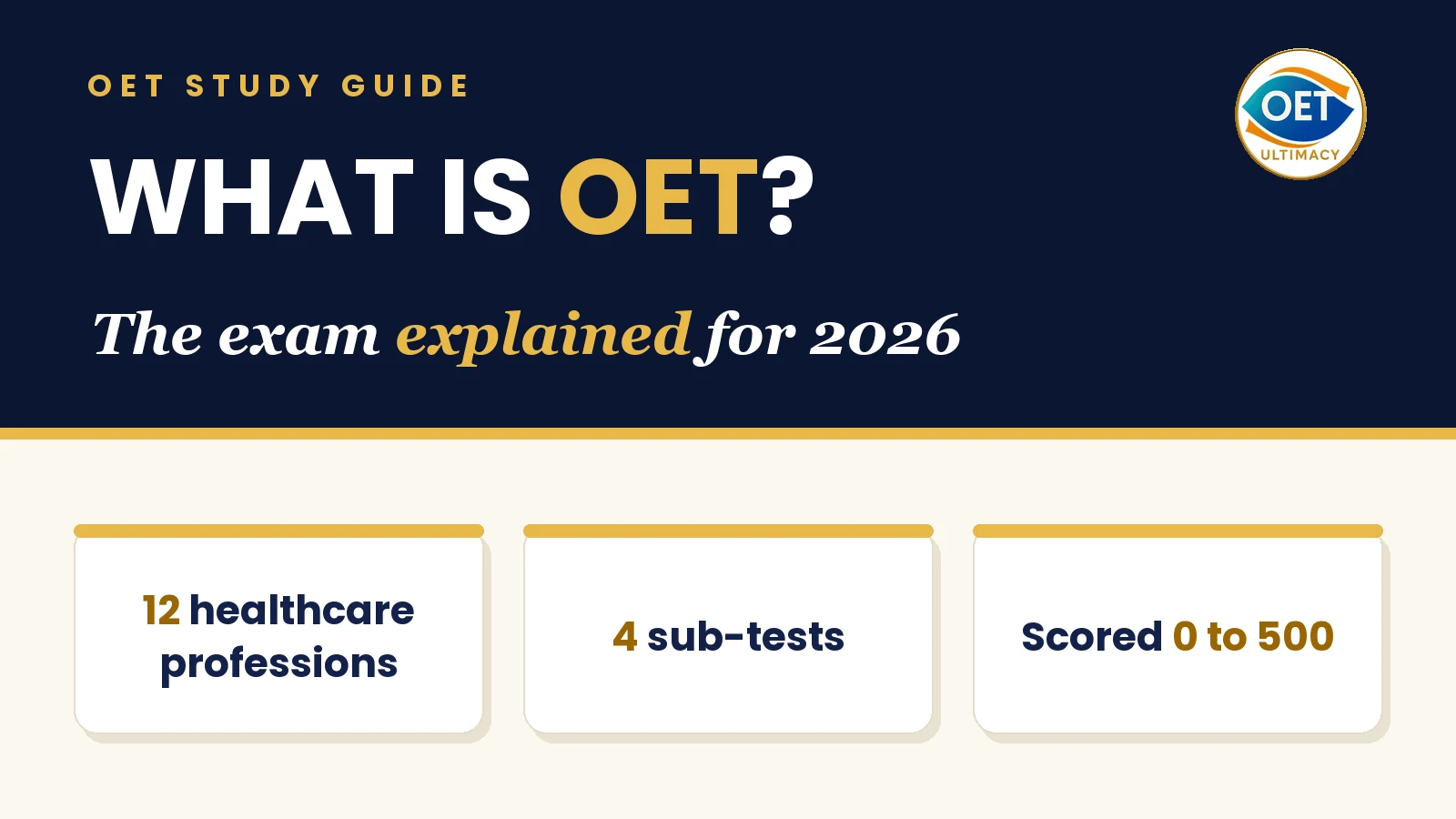
Short answer: OET, the Occupational English Test, is an English test for healthcare professionals who want to register, study or work in an English-speaking country. It has four sub-tests: Listening, Reading, Writing and Speaking. Each one is scored from 0 to 500. There is no single pass mark, because each regulator sets its own, and many ask for grade B (350) or a little more in Listening, Reading and Speaking. Listening and Reading are the same for every profession, while Writing and Speaking use situations from your own work.
Who runs OET, and who is it for?
OET has been owned since 2013 by Cambridge Boxhill Language Assessment (CBLA), a venture between Cambridge English and Box Hill Institute in Australia (OET: about us). Every recording, text, letter and role-play in it comes from a healthcare setting.
You can take OET in one of 12 professions: Medicine, Nursing, Dentistry, Dietetics, Pharmacy, Physiotherapy, Podiatry, Radiology (often called radiography), Occupational Therapy, Veterinary Science, Optometry and Speech Pathology (OET test page).
OET says more than 550 organisations in over 20 countries accept it, including regulators, government departments, universities and immigration departments (who accepts OET, January 2025). Bodies that accept it include the NMC and GMC in the UK, NMBI in Ireland, AHPRA in Australia and ECFMG in the United States.
How is it different from IELTS? IELTS is a general English test taken by people in every field. OET uses only healthcare situations, and two of its four sub-tests are written for your profession. Most of the regulators in this guide accept both, so check which tests your own regulator lists before you choose.
What are the four OET sub-tests?
Each sub-test is marked on its own, and regulators set the grade they need for each one.
| Sub-test | Time | What you do | Same for every profession? |
|---|---|---|---|
| Listening | About 40 minutes | 42 questions in three parts: notes from two consultations, six short workplace extracts, then two longer talks or interviews | Yes |
| Reading | 60 minutes | 42 questions: four short texts in 15 minutes, then six workplace extracts and two long articles in 45 minutes | Yes |
| Writing | 45 minutes | 5 minutes to read the case notes, then 40 minutes to write one letter, usually a referral, transfer or discharge letter | No, it uses your profession |
| Speaking | About 20 minutes | Two role-plays of about 5 minutes each, with 3 minutes to prepare each one | No, it uses your profession |
Four rules are worth knowing before test day. You hear each Listening recording only once (OET Listening). Reading Part A is collected after exactly 15 minutes, whether you have finished or not (OET Reading). In Writing, the first 5 minutes are for reading the case notes, and OET's sample papers say you may not write or make notes during that time; the 180 to 200 words is a guide, not a limit (OET Writing). In Speaking, the person you talk to plays your patient or the patient's relative. That person does not mark you: trained assessors mark the recording later (Cambridge English: OET overview).
How is OET scored, and what does a grade B mean?
Each sub-test gets a score from 0 to 500, in steps of 10, and a grade from A (highest) to E (results and scoring). Grade B is 350 to 440 and C+ is 300 to 340, as set out in the OET Test Handbook 2026.
Listening and Reading are marked out of 42, one mark per correct answer, and then converted to the 500 scale. OET does not publish the conversion table (as of October 2026), but it says a B typically needs at least 30 of the 42 marks (OET scoring). So treat any exact raw-to-score chart you find online as an estimate, and aim a few marks above 30 in practice.
Writing and Speaking are assessed against published criteria. In Speaking, the criteria include clinical communication, such as how you build a relationship with the patient and explain things clearly, not only your grammar and pronunciation. We go through every criterion in OET scores and grades.
Do you need medical knowledge to pass OET?
No. As Dr Ahmed Elgendy puts it, OET is a language test, not a test of medical knowledge. Every Listening and Reading answer is decided by what the speaker says or what the text says, never by what you know from your clinical work. If a Reading text gives a dose or a guideline that differs from your own practice, the correct answer is still the one in the text.
Your profession helps in Writing and Speaking, because the situations feel familiar. Even there, you are marked on how clearly and appropriately you communicate, not on your diagnosis.
What score do regulators ask for?
There is no single pass mark: each regulator publishes its own grade for each sub-test. As of October 2026, the UK's NMC and Ireland's NMBI ask nurses and midwives for B in Listening, Reading and Speaking and C+ in Writing. The GMC asks doctors for B in all four, from one sitting. AHPRA in Australia asks for 350 or 360 depending on the sub-test, and ECFMG asks international medical graduates for 350, with 300 in Writing. Most of them want results less than two years old.
We list each regulator's rules side by side, including how they treat two sittings and OET@Home, in OET scores and grades.
OET itself sets no expiry date on results. How long a result stays valid is decided by the body that accepts it (OET).
Paper, computer or at home?
OET runs in three formats. On paper at a test venue, you sit all four sub-tests on the same day. On computer at a venue, you take Listening, Reading and Writing at the venue, and Speaking is usually done online from home. With OET@Home, you take everything on your own computer (book a test).
The test, the difficulty and the marking are the same in every format. What changes is how you sit it, and whether your regulator accepts it: AHPRA and NMBI do not accept OET@Home, while the GMC does. We compare the formats sub-test by sub-test in OET paper vs computer.
How much does OET cost, and how do you book?
The full test costs AU$587, or US$455 for the computer and at-home tests taken in the United States (OET support, as of October 2026). Local prices can differ, so check the price shown when you book.
You book on oet.com. Paper bookings currently close about 24 days before the test date, and computer and OET@Home bookings about 7 days before. The exact closing date is shown when you book.
After a full first sitting, paper venues outside the United States also offer resits of one, two or three sub-tests. They cost AU$315 for one, AU$415 for two and AU$515 for three (OET support). Check your regulator before you book one. The NMC needs all four sub-tests in each sitting, and the GMC, NMBI and ECFMG want every grade from one sitting, so a partial resit will not help for those.
When do results come out?
OET says computer and OET@Home results can be ready within 48 hours of your last sub-test, and it aims to release them within 6 days. Paper results come about 12 days after the test date (results and scoring, as of October 2026). Different OET pages give slightly different figures, so treat these as typical, not guaranteed.
Where can you practise OET?
Listening and Reading are the same for every profession, so they are a sensible place to start. You can try your first OET Listening mock exam and your first OET Reading mock exam, in a computer-based layout modelled on the real test, before you decide on a subscription. Spelling counts in Listening Part A, where one wrong letter in a common medical word can cost you the mark, so the OET Listening Part A section has you type Part A words as you hear them, with an instant spelling check. For the sub-tests that use your profession, OET Writing practice has timed case notes and OET Speaking cards has role-play cards. If you want a plan, the OET study planner turns your exam date into a day-by-day schedule.
Frequently asked questions
What does OET stand for?
OET stands for Occupational English Test. It is an English test made only for healthcare professionals and owned by Cambridge Boxhill Language Assessment.
Which healthcare professionals can take OET?
Twelve professions: Medicine, Nursing, Dentistry, Dietetics, Pharmacy, Physiotherapy, Podiatry, Radiology (radiography), Occupational Therapy, Veterinary Science, Optometry and Speech Pathology. Your profession decides your Writing and Speaking tasks.
How long does the OET test take?
The four sub-tests add up to about 2 hours 45 minutes: Listening about 40 minutes, Reading 60, Writing 45 and Speaking about 20, before check-in and breaks. On paper everything is on one day; on computer, Speaking is usually a separate session.
How many marks do I need for a B in OET Listening or Reading?
OET says a B (350) typically needs at least 30 out of 42 marks. It does not publish the exact conversion, so aim a few marks higher in practice.
Can I retake just one OET sub-test?
On paper, outside the United States, you can resit one, two or three sub-tests after a full first sitting. Many regulators, including the NMC, GMC, NMBI and ECFMG, will not accept a partial resit, so check yours first.
How many times can I take OET?
OET does not publish a maximum number of attempts (as of October 2026). You can book one test per test date.
Is OET accepted for doctors in the United States?
Yes. ECFMG accepts OET Medicine for international medical graduates and asks for 350 in Listening, Reading and Speaking and 300 in Writing, in one sitting.
Do I need medical knowledge for OET?
No. OET tests your English in healthcare situations. Listening and Reading answers come from what you hear and read, and in Writing and Speaking you are marked on how you communicate.
OET Ultimacy is an independent OET preparation provider and is not affiliated with OET or Cambridge Boxhill Language Assessment. Test rules, fees and requirements can change, so always check oet.com and the body you are applying to.