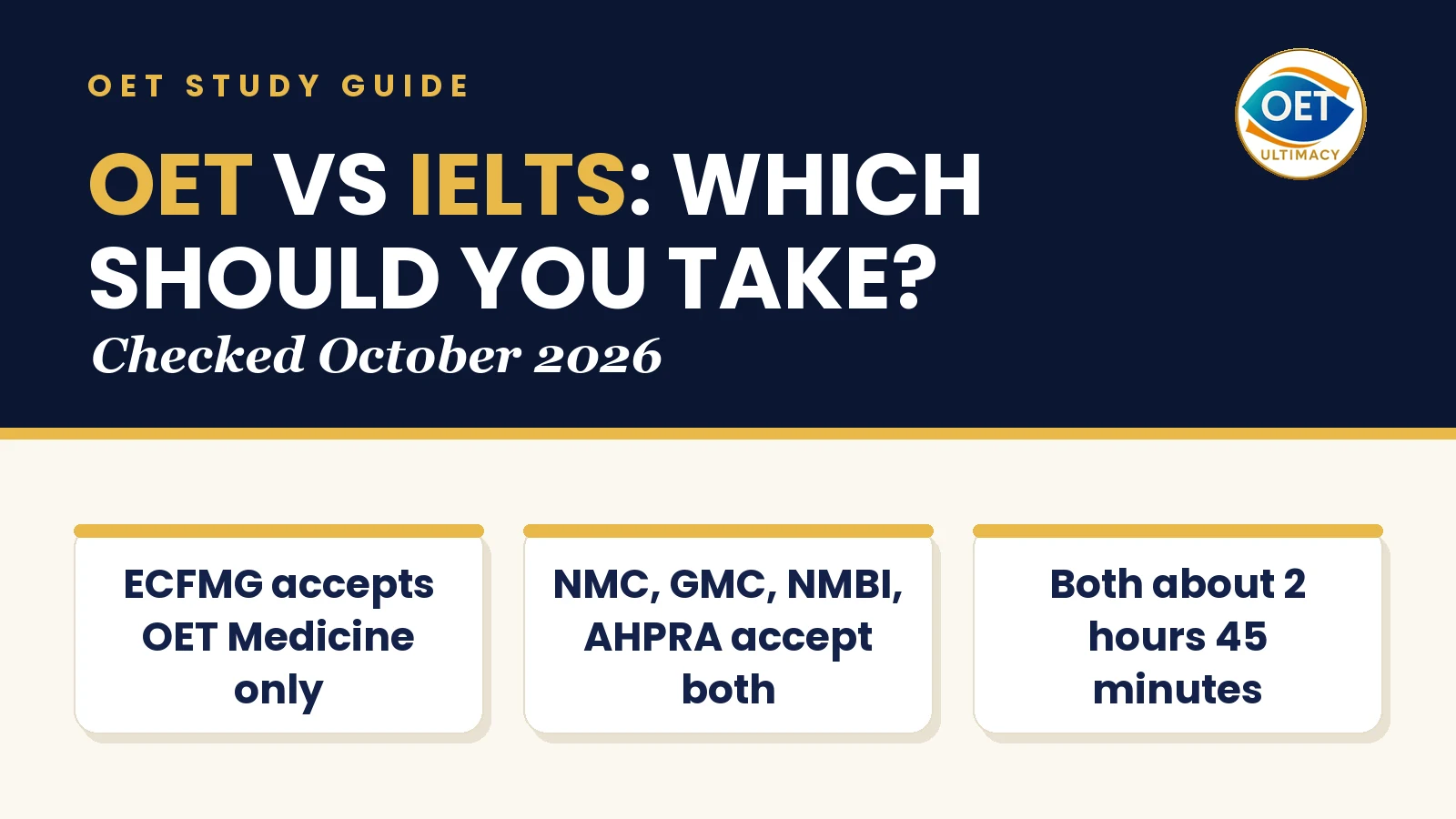
Short answer: If you are a healthcare professional applying to a regulator, both tests usually work: the NMC, GMC, NMBI and AHPRA accept IELTS Academic and OET. OET uses healthcare situations throughout, and its Writing and Speaking sub-tests are written for your profession, while IELTS Academic uses general academic topics. For most healthcare professionals OET is the easier of the two, because the medical words and situations are already familiar, though the questions still test your English. Two rules can decide it for you: ECFMG in the United States accepts only OET Medicine, and IELTS One Skill Retake (resitting one section) is accepted by the GMC and AHPRA but not by the NMC or NMBI. Check your own regulator's page first, then pick the test whose tasks suit you.
What is the difference between OET and IELTS?
OET is an English test made only for healthcare professionals, in 12 professions. IELTS Academic is a general test used for university study, professional registration and migration in every field.
Both test the same four skills, and both take about the same time. The difference is in the tasks.
| OET | IELTS Academic | |
|---|---|---|
| Who it is for | Healthcare professionals, in 12 professions | Anyone, in any field |
| Listening | About 40 minutes, 42 questions, healthcare recordings | About 30 minutes, recordings on everyday and study topics |
| Reading | 60 minutes, 42 questions, healthcare texts | 60 minutes, academic texts |
| Writing | 45 minutes: one letter (usually a referral) from case notes, in your profession | 60 minutes: describe a graph, chart or diagram, then write an essay |
| Speaking | About 20 minutes: two role-plays with a patient or relative, in your profession | 11 to 14 minutes: an interview with an examiner |
| Total | About 2 hours 45 minutes | 2 hours 45 minutes |
| Scores | 0 to 500 for each sub-test, grades A to E | Bands 0 to 9 for each section, plus an overall band |
Sources: OET Test Handbook 2026 and IELTS Academic test format, as of October 2026.
In OET, Listening and Reading are the same for every profession, and Writing and Speaking use your own profession's situations (OET Test Handbook 2026). A nurse writes a nursing letter and speaks to a nursing patient; a doctor sits the Medicine version.
Which test does my regulator accept?
Most regulators that healthcare professionals apply to accept both, and they ask for the Academic version of IELTS, not General Training. The table compares their minimum scores, as of October 2026.
| Regulator | IELTS Academic | OET | One Skill Retake (IELTS) |
|---|---|---|---|
| NMC, UK nurses and midwives | 7 in Listening, Reading and Speaking, 6.5 in Writing | B in Listening, Reading and Speaking, C+ in Writing | Not accepted |
| GMC, UK doctors | 7.5 overall, at least 7 in each section, one sitting | B in all four, Medicine version, one sitting | Accepted, once |
| NMBI, Ireland nurses and midwives | 7 overall, 7 in three sections and 6.5 in one | B in three sub-tests, C+ in one | Not accepted |
| AHPRA, Australia, tests from 23 April 2026 | 7 overall, 7 in Listening, Reading and Speaking, 6.5 in Writing | 350 Listening, 360 Reading, 350 Writing, 360 Speaking | Accepted |
| ECFMG, USA, international medical graduates | Not an option | 350 in Listening, Reading and Speaking, 300 in Writing, OET Medicine, one sitting | Not relevant |
ECFMG says every Pathways applicant must reach a satisfactory score on OET Medicine, "regardless of native language", with no exceptions. If you are heading for the US residency Match, the choice is made for you.
The OET column is a short version. The full OET rules for each regulator, including validity and how two sittings are combined, are in OET scores and grades.
Can you resit one part of OET or IELTS?
For most regulators, no. This is where the two tests differ most in practice.
IELTS has One Skill Retake: you can resit one section within 60 days of a full IELTS on computer test. The GMC accepts it once, and only after a full test on computer (GMC: IELTS). AHPRA's National Boards accept it too. The NMC and NMBI do not.
OET lets you resit one, two or three sub-tests on paper after a full first sitting, outside the United States (OET support). The regulators in the table above do not accept those partial resits:
- The NMC and AHPRA can combine two full sittings within 12 months, but you must take all four parts each time. The NMC also says you cannot mix an IELTS sitting with an OET sitting.
- The GMC wants all OET grades from one sitting, your most recent one.
- NMBI accepts one test result only, and ECFMG says you must retake all four OET Medicine sub-tests if you miss one.
So for UK doctors and Australian applicants who are confident in three skills and weaker in one, IELTS One Skill Retake gives you an option that OET does not. For NMC and NMBI applicants, neither test lets you resit one part, so plan on sitting all four again if you miss a grade.
Is OET easier than IELTS for healthcare professionals?
For most healthcare professionals, yes. It is not much easier, but Dr Ahmed Elgendy, who teaches OET, finds it the easier route for OET Ultimacy students.
The reason is the level of general English each test demands. In Dr Ahmed's experience, reaching the IELTS scores regulators ask for (7 in most sections) takes a true C1 level of English, because every topic is new and general. In OET, students whose general English is closer to B2 can reach the grades they need, because the words, phrases and situations in all four sub-tests come from healthcare, which they already know from work.
That does not make OET a medical exam. As Dr Ahmed puts it, OET is a language test, and the questions are about the language. Your medical knowledge helps you understand the recordings and texts, since the terms and phrases are the ones you use every day, but it does not give you the answers. In OET Listening and Reading, every answer comes from what the speaker says or what the text says. If a Reading text gives a dose that differs from your own practice, the correct answer is still the one in the text.
Your profession helps most in Writing and Speaking. An OET letter uses case notes from your field, and the Speaking role-plays put you with a patient or relative. In IELTS Academic, you describe a graph and write an essay on a general topic, and in Speaking you have an interview with an examiner. If you write clinical letters at work, the OET Writing task will feel closer to your day.
Spelling also costs marks in OET. In Listening Part A, OET explained in one of its live sessions that a common word any healthcare professional should know, such as gallbladder, is marked wrong if it is misspelt, even by one letter. British and American spelling are both accepted, but you must use one style for the whole exam. You can practise this in our OET Listening Part A section: you hear Part A words, type them, and get an instant spelling check.
How do OET and IELTS scores compare?
There is no official one-to-one conversion, so compare each regulator's requirements rather than a chart. As a guide, the NMC sets IELTS 7 against OET B (350) in Listening, Reading and Speaking, and IELTS 6.5 against OET C+ (300) in Writing.
The bigger difference is the overall score. IELTS gives an overall band, which is the average of the four sections rounded to the nearest half band (IELTS scoring), and some regulators, such as the GMC (7.5), set an overall minimum. OET has no overall score. Your Statement of Results shows a score and grade for each sub-test, and regulators set a requirement for each one (OET results and scoring). A strong OET Reading score cannot make up for a low Writing score.
In OET Listening and Reading, a B typically needs about 30 of the 42 marks. We explain how that works in OET scores and grades.
How fast are the results, and what does each test cost?
Computer results come quickly for both. OET on computer and OET@Home results can be ready within 48 hours of your last sub-test, and OET on paper results usually 12 days after the test date (OET results and scoring). IELTS on computer results usually come within 1 to 2 days, IELTS on paper within 13 days, and IELTS Online within 6 to 8 days (IELTS results), as of October 2026.
The full OET test costs AU$587, or US$455 for the computer and at-home tests in the United States (OET support, as of October 2026). IELTS fees are set by each test centre in the local currency, so compare the two prices at the centres near you before you book.
Check the format too. NMBI does not accept OET@Home or IELTS Online, and AHPRA accepts both tests only when taken at a test centre. The GMC accepts IELTS Online. We compare the OET formats in OET paper vs computer.
Which should you take, OET or IELTS?
Start with your regulator, then your strengths.
- Take OET Medicine if you are an international medical graduate applying through ECFMG, because it is the only option there.
- OET is usually the easier choice if your regulator accepts both, because every sub-test uses healthcare language you already know. It suits you even more if you write clinical letters or speak with patients in English at work.
- IELTS Academic can suit you if you are a UK doctor or an AHPRA applicant who wants the option of One Skill Retake, or if you also need a test for university study or a non-healthcare visa.
- If your regulator accepts both and nothing else decides it, look at sample tasks from each test. Pick the Writing task you would rather do on the day: a referral letter from case notes, or a graph description and an essay.
If you choose OET, you can try your first OET Listening mock exam in a computer-based layout modelled on the real test, and practise letters against the OET criteria with OET Writing practice. If you are new to the test, What is OET? explains each sub-test.
Frequently asked questions
Is OET accepted instead of IELTS for nurses in the UK?
Yes. The NMC accepts only two English tests, IELTS Academic and OET. For OET it asks for B in Listening, Reading and Speaking and C+ in Writing; for IELTS Academic, 7 in Listening, Reading and Speaking and 6.5 in Writing.
Which is better for doctors, OET or IELTS?
The GMC accepts both for UK doctors: B in all four OET Medicine sub-tests, or IELTS Academic 7.5 overall with at least 7 in each section. For international medical graduates applying through ECFMG in the United States, only OET Medicine is accepted.
Is OET cheaper than IELTS?
It depends on where you sit it. The full OET test costs AU$587, or US$455 in the United States, as of October 2026. IELTS fees are set by each test centre in the local currency, so compare the prices at your nearest centres.
Can I combine an OET result with an IELTS result?
No. The NMC says you can combine two sittings of the same test, but not an IELTS sitting with an OET sitting. Other regulators, such as the GMC and NMBI, accept one sitting only.
Does OET have a One Skill Retake like IELTS?
Not in the same way. OET on paper lets you resit one, two or three sub-tests after a full first sitting, outside the United States, but the NMC, GMC, NMBI, AHPRA and ECFMG do not accept those partial resits. IELTS One Skill Retake is accepted by the GMC and AHPRA, but not by the NMC or NMBI.
Is IELTS General Training accepted for nursing or medical registration?
Not by the regulators in this guide. The NMC, GMC, NMBI and AHPRA all ask for IELTS Academic.
Is OET easier than IELTS?
For most healthcare professionals, yes, though not by a wide margin. Dr Ahmed Elgendy finds that IELTS 7 takes a true C1 level of general English, while students closer to B2 can reach their OET grades because the healthcare words and situations are familiar. The questions in both tests are about language.
Do I need medical knowledge to pass OET?
No, but it helps. OET tests your English, and Listening and Reading answers come from what you hear and read. Because the terms and phrases come from healthcare, your medical knowledge makes the recordings and texts easier to follow. In Writing and Speaking you are marked on how you communicate, not on your diagnosis.
What OET score is equal to IELTS 7?
There is no official conversion. The NMC asks for OET B (350) where it asks for IELTS 7, in Listening, Reading and Speaking, and C+ (300) where it asks for IELTS 6.5 in Writing.
OET Ultimacy is an independent OET preparation provider and is not affiliated with OET, IELTS or Cambridge Boxhill Language Assessment. Test rules, fees and requirements can change, so always check oet.com, ielts.org and the body you are applying to.