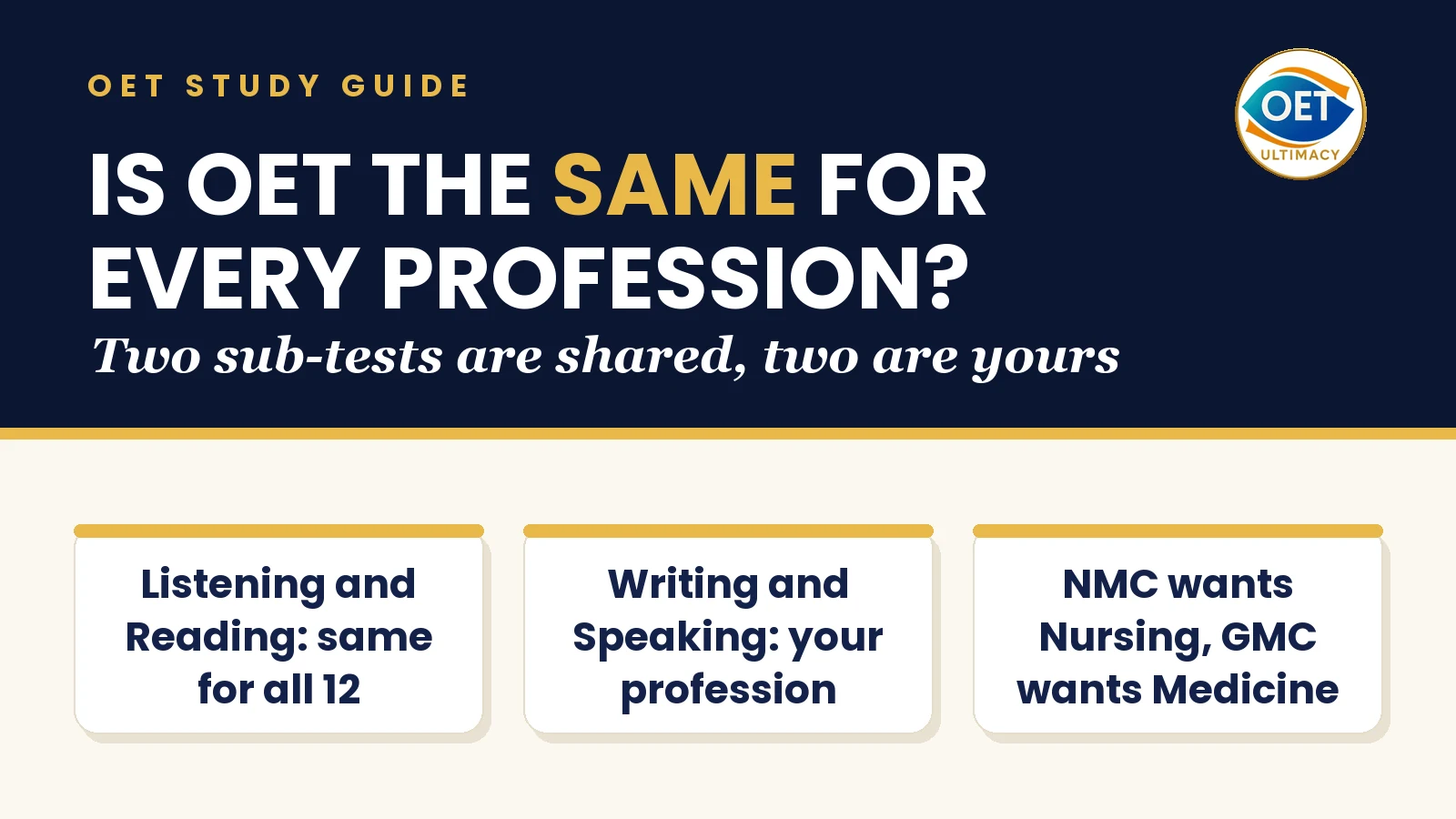
Short answer: Half of OET is the same for everyone. OET Listening and OET Reading are identical for all 12 professions, while OET Writing and OET Speaking are written for the profession you book. The scoring scale (0 to 500 for each sub-test) is the same whatever your profession, but your Statement of Results shows the profession you sat, and some regulators accept only one version: the NMC asks for Nursing, and the GMC and ECFMG ask for Medicine. So any good Listening or Reading practice suits you, and your Writing and Speaking practice should match your own profession.
Which OET sub-tests change with your profession?
Two of the four. The OET Test Handbook 2026 says Listening and Reading "are the same for all candidates, regardless of profession", and Writing and Speaking are tailored to the candidate's profession.
| Sub-test | Same for every profession? | What you do | Time |
|---|---|---|---|
| Listening | Yes | 42 questions on healthcare recordings: consultations, workplace extracts, presentations or interviews | About 40 minutes |
| Reading | Yes | 42 questions on healthcare texts, with Part A collected after 15 minutes | 60 minutes |
| Writing | No | One letter from your profession's case notes | 45 minutes (5 reading, 40 writing) |
| Speaking | No | Two role plays from your profession's role cards | About 20 minutes |
Sources: the OET Test Handbook 2026 for which sub-tests are shared, and the OET Listening and OET Reading pages for the timings, as of October 2026.
The 12 professions are Dentistry, Dietetics, Medicine, Nursing, Occupational Therapy, Optometry, Pharmacy, Physiotherapy, Podiatry, Radiography (listed as Radiology on some OET pages), Speech Pathology and Veterinary Science.
What does "the same" mean in OET Listening and Reading?
It means everyone in the room hears the same recordings and reads the same texts, on topics chosen so that any healthcare professional can follow them. A pharmacist and a physiotherapist sitting OET on the same day answer the same 42 Listening questions and the same 42 Reading questions.
The handbook describes the content this way:
- Listening Part A is two consultations "between a healthcare professional and a patient", with 12 gaps in the notes for each. Note the wording: a healthcare professional, not a doctor.
- Listening Part C and Reading Part C are on healthcare topics "of general interest" to a broad range of healthcare professionals.
- Every Listening and Reading answer is worth 1 mark, and the score out of 42 is converted to the 500 scale.
Your medical knowledge is not what gets the mark. Dr Ahmed applies this rule when he reviews our own mock exams: every answer has to be decided by the English on the page or in the recording, never by clinical knowledge. In his words, "OET is not an exam of testing medical knowledge in the first place, it's a language test." So a topic outside your field is not a handicap. Read or listen for what is actually said, and do not answer from what you would expect clinically.
One part of Listening punishes small errors: spelling in Part A. OET explained in one of its live sessions that a common word any healthcare professional should know, such as gallbladder, is marked wrong if it is misspelt, even by one letter. British and American spelling are both accepted, but OET says you must keep to one style for the whole exam. You can hear Part A words and type them, with an instant spelling check, in our Listening Part A practice.
How do OET Writing and Speaking change with your profession?
The task type stays the same; the case changes. Every candidate writes one letter and does two role plays, and everyone is marked on the same criteria. What changes is the patient, the setting and the decisions in the material you are given.
In OET Writing, you get "profession-specific case notes" and write a letter "to another healthcare professional, or to a person related to the patient's care". The handbook gives a referral letter as its example, and OET's test page also names advice, transfer and discharge letters. All professions are marked on the same six criteria: Purpose, Content, Conciseness and Clarity, Genre and Style, Organisation and Layout, and Language. OET gives a word range of 180 to 200 words for the task, with no automatic penalty for going over or under.
In OET Speaking, an interlocutor "plays the role of the patient or the patient's family member or carer", and you play your own profession. You get 3 minutes to prepare each role card and about 5 minutes for each role play. The recording is assessed by two official OET assessors, using the same nine criteria for every profession: four linguistic criteria (Intelligibility, Fluency, Appropriateness of language, Resources of grammar and expression) and five clinical communication criteria (Relationship building, Understanding and incorporating the patient's perspective, Providing structure, Information gathering, Information giving).
The handbook's own example: Nursing candidates complete Nursing tasks, and Radiography candidates complete Radiography tasks. This is the half of OET where your daily work helps you, because the situations on the case notes and role cards are ones you already handle.
Which profession should you choose when you book OET?
Choose the one your regulator asks for. In most cases that is your own profession, but check, because the rules differ and your Statement of Results prints the profession you sat.
| Body | Which OET version it accepts |
|---|---|
| NMC (UK nurses and midwives) | "All applicants should choose the Nursing examination" |
| GMC (UK doctors) | "You must take the Medicine version of the test" |
| ECFMG (US Pathways for international medical graduates) | OET Medicine only |
| AHPRA (Australia) | Any profession-specific OET test |
As of October 2026. AHPRA explains that OET has not built a test for every profession it registers, so it accepts an OET test from another registered profession if the scores meet its standard. Other bodies may be stricter. The handbook tells you to check each organisation's page for "what OET test profession is required", and the scores each one asks for are in our guide to OET scores and grades.
Get this right before you pay. OET's test regulations say you cannot reschedule a booking to change its profession; you have to cancel and make a new booking.
Can you practise with another profession's materials?
For Listening and Reading, yes, and there is no reason not to. Every Listening or Reading practice test built to OET's format fits every profession, whatever the label on it says, so a set marked for one profession is just as useful to everyone else. The OET Test Handbook says OET's own sample tests exist for all four sub-tests in every profession, in paper and computer formats.
For Writing and Speaking, practise in your own profession wherever you can. The criteria are the same, so another profession's letter can still teach you layout and conciseness. But your case notes and role cards will come from your own field, and the decisions about what to include in a letter or explain to a patient differ between professions.
What we have on OET Ultimacy, as of October 2026:
- Listening and Reading mocks that fit all 12 professions.
- Writing practice with case notes for Medicine, Nursing and Pharmacy.
- Speaking role cards for Medicine.
Where can you practise the shared sub-tests?
Start with the half of OET that is the same for everyone. You can try your first OET Listening mock and your first OET Reading mock in a computer-based layout modelled on the real test, and if Listening is your weaker side, work on Part A spelling in our Listening Part A practice. For Writing, our Writing practice lets you filter case notes by profession and letter type.
Frequently asked questions
Is OET Reading the same for all professions?
Yes. The OET Test Handbook says the Reading sub-test is the same for all candidates, regardless of profession. Everyone gets 60 minutes and 42 questions in three parts, and Part A is collected after 15 minutes.
Can I take OET in a different profession from my own?
You choose one of OET's 12 professions when you book, but your regulator may not accept a version other than the one it names. The NMC asks for the Nursing version, and the GMC and ECFMG ask for Medicine. AHPRA in Australia accepts an OET test from another registered profession if it meets its English standard, so always check the page of the body you are applying to before booking.
Does my profession appear on my OET results?
Yes. The OET Statement of Results shows your profession together with your name, candidate number, test date and your score and grade for each sub-test. That is how a regulator can check you sat the version it requires.
Can I change my OET profession after booking?
Not by rescheduling. OET's test regulations say you cannot reschedule to change the profession you booked; you need to cancel the test and make a new booking. Check your regulator's rules before you pay.
Is grade B the same score in every profession?
Yes. Every sub-test is scored from 0 to 500 for all professions, and grade B starts at 350. What differs is the grade or score each regulator asks for, which is listed in our OET scores and grades guide.
Does OET test medical knowledge?
No, OET tests your English in healthcare situations. Listening and Reading answers come from what is said or written, not from what you know clinically. Writing and Speaking use situations from your profession, but you are marked on criteria such as content, language and clinical communication, not on your diagnosis.
Is the OET Writing letter always a referral letter?
No. A referral letter is the most familiar example, but OET also names advice, transfer and discharge letters. You may write to another healthcare professional or to someone involved in the patient's care, such as a carer.
OET Ultimacy is an independent OET preparation provider and is not affiliated with OET or Cambridge Boxhill Language Assessment. Test rules, fees and requirements can change, so always check oet.com and the body you are applying to.