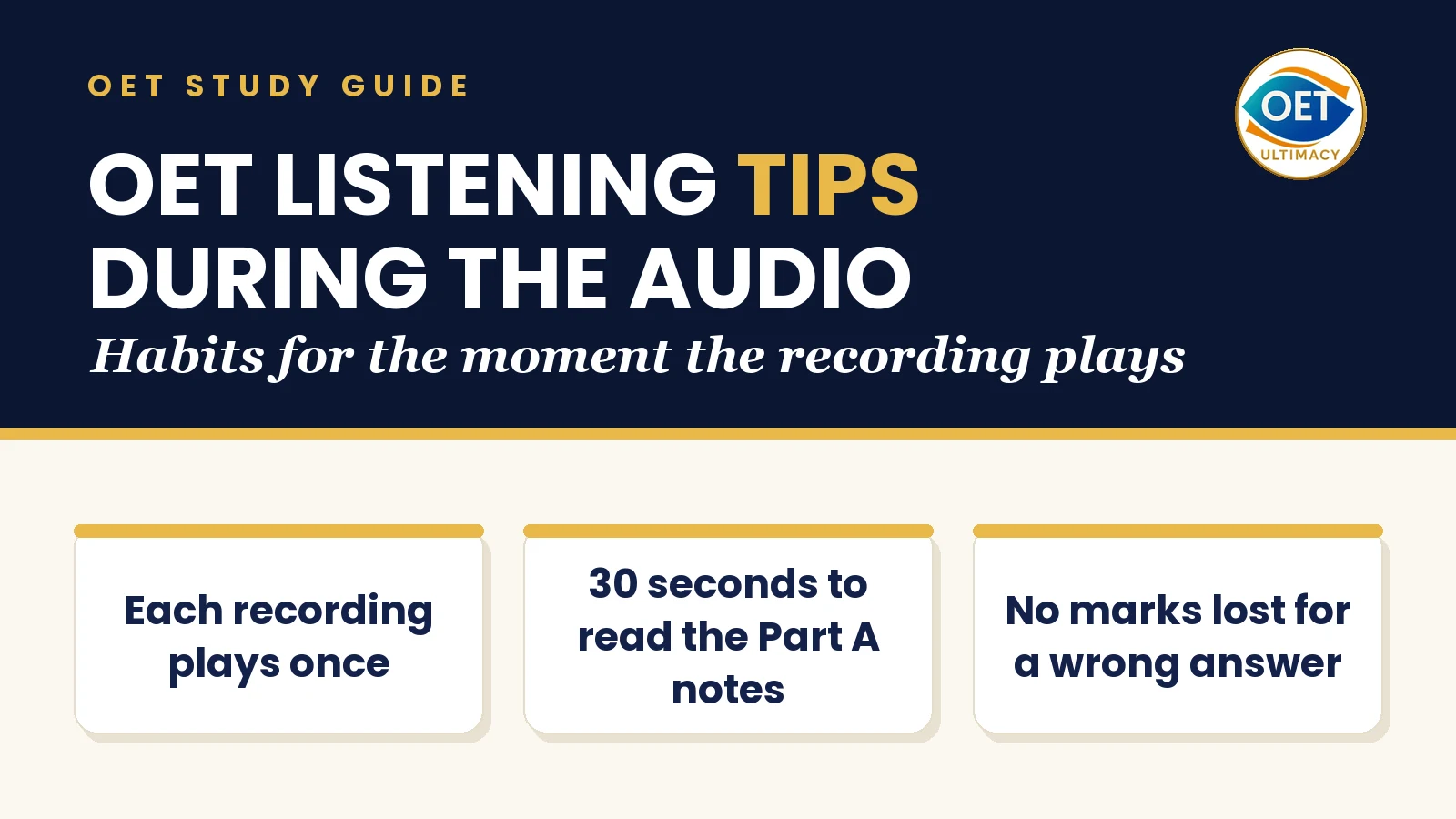
Short answer: In OET Listening you hear each recording once, so the habits that matter happen while it plays. Use every second of reading time to predict what kind of word each gap needs, follow the Part A notes in order using the headings as signposts, and write the exact words you hear. If you miss a gap, leave it and catch the next one, then come back with a guess, because a blank scores nothing. In Parts B and C, the option you clearly heard is often not the one the question asks for.
What should you do in the reading time before each recording?
Use it to predict what you will hear. You get about 30 seconds before each Part A consultation, about 15 seconds before each Part B question and 90 seconds before each Part C recording, according to OET's Part A, Part B and Part C guides. That is not long enough to study anything, so give each part one clear job.
| Part | Reading time | What to do with it |
|---|---|---|
| A | About 30 seconds | Skim all the headings first, then read the first few gaps closely and decide what each one needs: a number, a medicine, a body part, a duration |
| B | About 15 seconds | Find the one word in the question that decides the answer, such as "main", "first", "concern" or "advice" |
| C | 90 seconds | Read the six question stems before the options, so you know what each stretch of the talk will be about |
OET's own advice for Part A says the same thing in a shorter form: skim the whole page for an overview, then go back and read the first gaps carefully (OET test tips).
After the narrator sets the scene, many recordings go completely silent for a stretch before the conversation starts. When we measured the audio in our library, including OET's own sample tests, that silence ran 15 to 22 seconds in Part B and up to about 30 seconds in Part A. Some students in our live sittings have thought the audio had cut out at this point. It is the reading time built into the recording, so keep reading through it.
How do you keep your place in the Part A notes?
Let the headings carry you. Part A notes are grouped under headings (history, symptoms, medication, plan and so on), and the consultation moves through them in the same order as the page. When you hear the speaker move on to a new topic, your eyes should move to the matching heading, even if you are not sure you caught the last gap.
Dr Ahmed Elgendy, who reviews every Listening exam we build, puts the rule for a fair Part A answer like this: "OET answer in Part A must be explicitly mentioned, in correct order, and in an obvious way." That gives you three habits for the day:
- Expect the answers in order. OET's Part A guide says the questions come in order, so gap 5 will not be said before gap 4 and you never need to scan the whole page.
- Write the words you hear. OET's Part A guide says not to change the word form or add words. If the patient says "short of breath", write that, not "shortness of breath".
- Use the words around each gap. OET's Part A guide tells you to use the text around the questions and the headings to predict the kind of word you will hear. A word like "duration", "started" or "dose" next to a gap tells you what kind of answer to wait for. When you hear that idea in the recording, the answer is close.
Keep your writing short while the audio runs. A quick, legible version of the word is enough in the moment; you can tidy spelling in the checking time. Spelling does count in the end, though. OET explained in one of its live sessions that a common word any healthcare professional should know, such as gallbladder, is marked wrong if it is misspelt by even one letter, and OET says the words in Part A are common, known words. British and American spelling are both accepted, but OET says you must keep to one style for the whole exam.
What should you do if you miss an answer?
Let it go at once and listen for the next gap. OET's Part A guide says it in one heading: "If you miss a question, move on." The recording does not wait. A missed gap costs one mark; still thinking about it can cost you the next two or three.
A simple routine works:
- Put a small mark beside the gap you missed so you can find it later.
- Move your eyes to the next gap or the next heading and listen for its signpost word.
- In the checking time, come back and write your best guess. A guess has a chance of scoring; a blank does not. OET's own tip is to write something for every question (OET test tips).
The same applies in Part B. Each Part B recording has only one question, so if you lose the thread, choose the option that fits what you did hear, then give the next recording your full attention.
How do you choose the right option in Parts B and C while the audio plays?
Rule options out as you go, and decide by what the speaker means, not by what you heard most clearly. OET suggests crossing off wrong options as you hear them; on computer you can do this with a right click (OET test tips).
The trap to watch for is the option that is mentioned. Dr Ahmed's point about OET's Part B and Part C items is that a favourite wrong option is one the speaker really does say, does not deny, and may even be true, but that does not answer the question. OET gives the same warning in its own words: its Part C guide tells you not to stop listening when you hear something familiar, and its Part B guide says you should not expect the exact words of the options in the audio. So do not pick an option just because you heard it clearly, or more than once. Hold each option up against the deciding word in the stem ("main", "first", "decides", "advises") before you choose.
Dr Ahmed also reminds students that OET is a language test, not a test of medical knowledge. The answer is what the speaker says in English. If a consultant describes a plan that is different from what you would do at work, the key follows the recording, not your clinical habit.
Do these habits change on paper and on computer?
The listening habits are the same, but where your checking time sits is different, so your recovery plan should be too.
| Paper | Computer | |
|---|---|---|
| Recording | One continuous track that never stops | Each section on its own screens with its own clock |
| Marking the page | Underline key words on the question paper | Right click to cross off Part B and C options |
| When to fix missed gaps | Any time, plus about two minutes at the end of the test | Before you click Next on that section; you cannot go back |
| Part A checking time | The Part B instructions (about 35 seconds) give you a moment to look back | About 2.5 to 3 minutes after each consultation ends, before its 8-minute clock runs out |
The two-minute check at the end of the paper test is in OET's test-day guide. The computer timings and the paper instruction time come from our own recordings of both versions; our OET paper vs computer guide walks through both versions screen by screen. The practical point for computer candidates: do not click Next as soon as the audio stops. The clock keeps running, and those minutes are the only time you will have to fill a missed gap in that section.
How do you stay focused for the whole Listening test?
Start focusing before the first recording. Listening is the first sub-test of the day, when nerves are at their highest. OET suggests reading the printed instructions along with the narrator, since they also give you the context of what you are about to hear (OET test tips).
After that, treat each recording as a fresh start. Part A, Part B and Part C reward different kinds of listening, and a hard Part A says nothing about how Part C will go. If you find your mind going back to an answer you were unsure of, that is the moment to bring it back to the next question on the page.
Where can you practise these habits under real timing?
These habits only become automatic with timed practice. Our OET Listening mock exams include 41 full tests that you can sit in computer mode, with a clock for each section, or in paper mode, where the recording never stops. You can try the first Jahshan exam before deciding on a subscription. For the spelling side of Part A, our Listening Part A section plays Part A words, lets you type each one and checks the spelling straight away. If you want the format itself first, start with our OET Listening test guide.
Frequently asked questions
What should I do if I miss an answer in OET Listening Part A?
Leave it straight away and listen for the next gap, because the recording keeps playing and the answers come in order. Mark the gap you missed, then write your best guess in the checking time. A blank always scores zero, so a sensible guess is better than nothing.
Should I guess in OET Listening?
Yes. Each correct answer earns one mark, and OET says you will not lose marks for an incorrect answer (OET on multiple-choice questions), so a guess can only help. OET's own test tips say to write something down or choose an option for every question.
Do OET Listening Part A answers come in order?
Yes. OET's Part A guide says the questions come in order, so the answer to one gap is heard before the answer to the next. Use the headings to keep your place when the speaker changes topic.
Can I correct my spelling after the OET Listening audio finishes?
Yes, as long as there is still checking time for that part. On paper you can change any answer until the test ends. On computer you can change answers in a section only until you click Next or its clock runs out.
Can I cross out options in OET Listening on computer?
Yes. OET says you can cross off options you have ruled out by right clicking on them. You still select your final answer with a left click.
Is the silence at the start of an OET Listening recording a fault?
Usually not. Many recordings, including OET's own sample tests, have a silent stretch after the narrator sets the scene. That silence is your time to read the questions, so keep reading until the speakers begin.
OET Ultimacy is an independent OET preparation provider and is not affiliated with OET or Cambridge Boxhill Language Assessment. Test rules, fees and requirements can change, so always check oet.com and the body you are applying to.