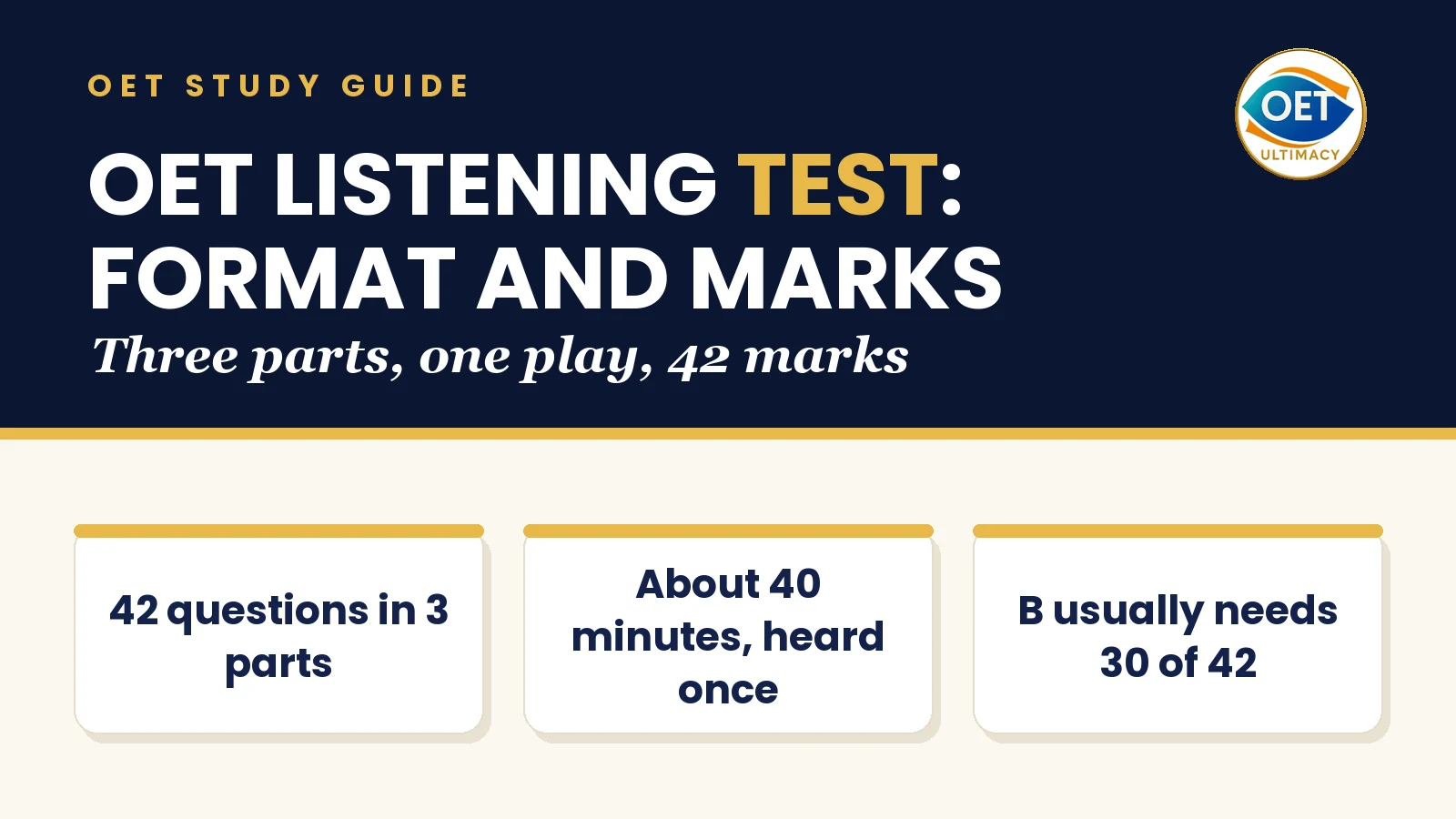
Short answer: The OET Listening test lasts about 40 minutes and has 42 questions in three parts. Part A is two consultations with 12 note gaps each (24 marks), Part B is six short workplace recordings with one question each (6 marks), and Part C is two longer talks or interviews with six questions each (12 marks). You hear every recording once, each correct answer is worth one mark, and a grade B usually needs at least 30 of the 42.
How many questions are in OET Listening?
Forty-two, and every one of them is worth a single mark. They are spread unevenly across the three parts, and Part A alone carries more than half the marks.
| Part | What you hear | Questions | Question type | Marks |
|---|---|---|---|---|
| A | Two consultations between a healthcare professional and a patient | 12 per consultation, 24 in all | Fill the gaps in a set of notes | 24 |
| B | Six short recordings from the workplace | 1 per recording, 6 in all | Multiple choice, three options | 6 |
| C | Two longer recordings: presentations or interviews | 6 per recording, 12 in all | Multiple choice, three options | 12 |
| Total | 10 recordings | 42 | 42 |
Sources: OET Listening and the OET Test Handbook 2026, as of November 2026.
Some prep sites say Part C has four options. OET's own Part C guide describes three, and that is what you will see on the day.
How long is the OET Listening test?
About 40 minutes from start to finish, according to OET's Listening page. Only part of that time is recording. OET's part guides give these lengths:
- Part A: each consultation is about 4.5 to 5 minutes, and you get 30 seconds to look at the notes before it starts (Part A guide).
- Part B: each recording is about 45 seconds, with 15 seconds to read its question first and about 5 seconds afterwards to choose (Part B guide).
- Part C: each talk or interview runs 4 to 5 minutes, after 90 seconds to read its six questions (Part C guide).
Add those up and the recordings come to roughly 21 to 25 minutes: 9 to 10 in Part A, about 4.5 in Part B and 8 to 10 in Part C. The rest of the 40 minutes is reading time, instructions and time to check your answers.
Every recording is played once only. You cannot pause it or hear it again, on paper or on computer, so you write your answers while you listen.
What does each part of OET Listening test?
Each part asks for a different kind of listening, so a strong score in one part says little about the others.
Part A checks that you can catch specific facts and write them down accurately: a symptom, a medicine, a number, a piece of history. You complete a health professional's notes as the patient talks. OET's Part A guide says answers are generally one to three words, and that you must not change the word form or add extra words. If the speaker says "swollen ankles", the gap wants those words, not "ankle swelling".
Part B moves to the workplace: handovers, staff briefings, training sessions, colleagues talking and some conversations with patients (Part B guide). The OET Test Handbook says these questions test detail, purpose, main idea, attitude, opinion and course of action. One question per recording means one missed sentence can cost the whole mark.
Part C is the longest stretch of listening. You follow a presentation or an interview with a healthcare professional and answer questions on the main idea, the detail of the argument, and the speaker's attitude and opinion.
Across all three parts, OET uses a range of accents. Its Listening page names Australian, British and American as the main ones, with New Zealand, Irish, Canadian and South African voices as well.
As Dr Ahmed Elgendy puts it, OET is a language test, not a test of medical knowledge, and that holds in every part: the answer is what the speaker says. If a consultant describes a dose or a step that differs from what you do at work, the key follows the recording, not your clinical habit.
How are the 42 marks turned into a grade?
Your marks out of 42 are converted to a score from 0 to 500, reported in steps of 10. Grade B starts at 350, and OET says candidates at that level "typically achieve at least 30 marks" (results and scoring). OET does not publish its conversion table, and its Listening page says the exact boundary varies between test versions. So 30 is the usual line, not a promise.
Because a wrong answer and a blank both score zero, it always makes sense to write something in every gap and choose an option for every question.
The split of marks changes how you should think about your target. Here is how 30 out of 42 works out depending on your Part A result:
| Part A score (out of 24) | Marks still needed from Parts B and C | Out of |
|---|---|---|
| 22 | 8 | 18 |
| 20 | 10 | 18 |
| 18 | 12 | 18 |
| 16 | 14 | 18 |
| 14 | 16 | 18 |
These are our own sums, using the usual 30-mark line. A candidate with 22 in Part A can drop 10 of the 18 multiple-choice questions and still reach 30. A candidate with 14 in Part A can drop only two. That is why time spent on Part A accuracy pays back so quickly.
Which grade you need is decided by the body you are applying to, not by OET. Our OET scores and grades guide has the full grade bands and each regulator's requirement.
Does spelling count in OET Listening?
Yes. In Part A every answer is a word or a short phrase you write yourself, so spelling is marked along with the content.
OET explained in one of its live sessions that a common word any healthcare professional should know, gallbladder for example, is marked wrong if it is misspelt, even by one letter. OET has also said that the words in Listening Part A are common, known words. In practice, then, a spelling mistake in Part A loses the mark. Words like "diarrhoea", "haemorrhage" and "oesophagus" are worth checking until you can write them without thinking.
British and American spelling are both accepted, but OET says you must keep to one style for the whole exam. Pick the one you use at work and stay with it.
If spelling under pressure is your weak point, our OET Listening Part A section plays you Part A words, lets you type each one, and checks the spelling straight away.
Is OET Listening the same on paper and on computer?
The questions, the recordings and the marking are the same. What changes is how you answer and how much time you get to check.
On paper, you write Part A answers in the question booklet with a pen or pencil, and you shade the answer for Parts B and C with a 2B pencil, according to OET's test-day guide. The recording runs straight through, and at the end you get two minutes to check every part.
On computer, you type your answers, and each part sits on its own screens with its own clock. When we recorded the screens of the computer-based test, each Part A consultation had an 8-minute clock, the six Part B questions shared one 10-minute clock, and each Part C recording had 10 minutes. The audio finishes before the clock does, so the leftover minutes are your checking time for that section. In our recordings, once you moved on to the next section, you could not go back.
OET's test-day guide gives the usual order as Listening, then Reading, Writing and Speaking, though the Speaking time can differ by region, so check the email from your venue. Our OET paper vs computer guide walks through both versions of Listening screen by screen, if you have not chosen a format yet.
Listening is also the same for every profession. A nurse, a pharmacist and a doctor sitting on the same day hear the same recordings and answer the same 42 questions.
Where can you sit a timed OET Listening test before the real one?
The best way to learn the format is to sit it under the real timing, more than once. Our OET Listening mock exams include 41 full tests, each marked out of 42, and you can sit them in computer mode or in paper mode, where the recording never stops. After each one, the stats panel shows your score next to 30/42 as the usual line for a B and 35/42 as the target we set, which gives you room for a harder test version. You can try the first exam in the Jahshan collection before you decide on a subscription, and the Part A section is there for the spelling.
Frequently asked questions
How many questions are in OET Listening Part A?
Twenty-four. Part A has two consultations, and each one has a set of notes with 12 gaps to fill. That makes Part A worth 24 of the 42 Listening marks.
Can you replay the audio in OET Listening?
No. OET plays each recording once only, on paper, on computer and at home. You cannot pause or rewind it, so you answer while you listen.
How long is each recording in OET Listening?
According to OET's part guides, each Part A consultation lasts about 4.5 to 5 minutes, each Part B recording about 45 seconds, and each Part C presentation or interview 4 to 5 minutes. Reading time comes before each one: 30 seconds in Part A, 15 seconds per question in Part B and 90 seconds in Part C. Part B also gives you about 5 seconds after each recording to choose.
Is there negative marking in OET Listening?
OET awards one mark for each correct answer and describes no deduction for wrong ones. A wrong or empty answer simply earns nothing, so answer every question.
How many options are there in OET Listening Part C?
Three. Every multiple-choice question in Parts B and C has options A, B and C, and you choose one.
What accents are used in OET Listening?
A mix. OET says the main accents are Australian, British and American, and you may also hear New Zealand, Irish, Canadian and South African speakers.
Do I need medical knowledge to answer OET Listening questions?
No. The answers come from what the speakers say, and the recordings are chosen so that any healthcare professional can follow them. Your clinical knowledge helps you predict words, but the recording always decides the answer.
OET Ultimacy is an independent OET preparation provider and is not affiliated with OET or Cambridge Boxhill Language Assessment. Test rules, fees and requirements can change, so always check oet.com and the body you are applying to.