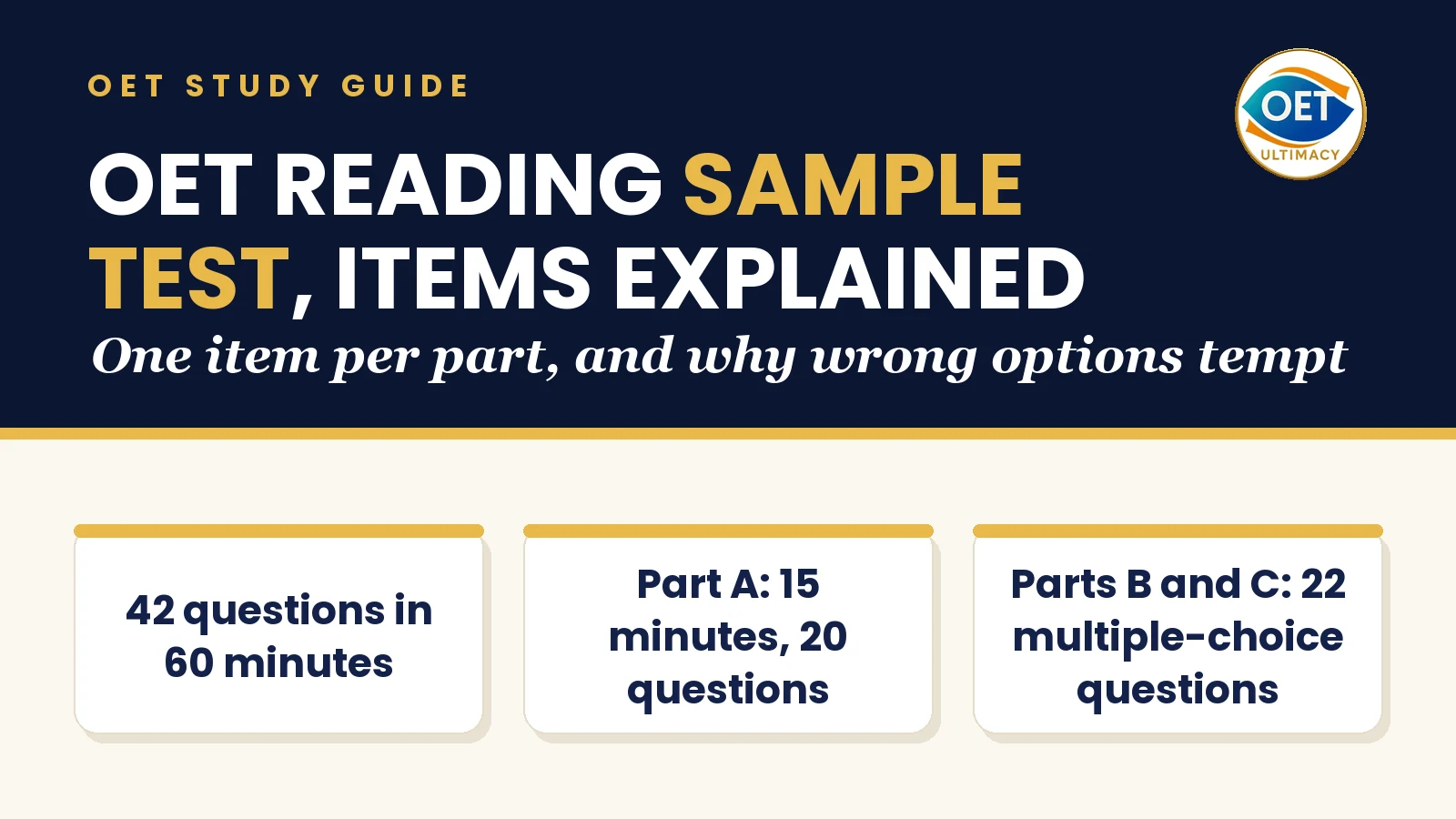
Short answer: An OET Reading sample test has the same 42 questions as the real one: 20 matching, short-answer and sentence-completion questions on four short texts in Part A, six three-option questions on workplace extracts in Part B, and sixteen four-option questions on two long texts in Part C. The official sample tests, with answer keys, are on oet.com. What they do not show is why an answer is right, so below is one item per part, written by us, with the line that proves the answer and the reason each wrong option looks right.
Where are the official OET Reading sample tests?
On OET's sample tests page, split into paper and computer versions, and OET describes them as free. The paper sample tests are listed by profession, and each pack is a full test, Reading included, with an answer key. We found no page on oet.com that publishes single Reading questions on their own, and OET warns that material shared on social media may not be official. Our OET sample test guide explains which pack to choose and how to sit it under real timing, so this guide stays with the questions themselves.
You can take any profession's pack for Reading, because the texts and questions are common to all 12 professions (is OET the same for every profession?). The examples below are invented for teaching. They follow OET's format, but they are not OET items and not items from our OET Reading mock exams.
What does an OET Reading Part A sample item look like?
Part A gives you four short texts on one topic and 15 minutes for 20 questions (OET Reading). Matching questions come first, then short answer or sentence completion (Part A guide). Here are four short texts on hypoglycaemia in hospital patients, cut down to the lines the questions need. They are practice material, not clinical guidance.
Text A (ward protocol): Treat a capillary blood glucose below 4.0 mmol/L as hypoglycaemia, even if the patient has no symptoms. If the patient is conscious and able to swallow, give 15 to 20 g of quick-acting carbohydrate, for example 150 to 200 ml of fruit juice. Recheck the blood glucose after 15 minutes.
Text B (nursing chart): Early warning signs: sweating, trembling, hunger. Later signs: confusion, drowsiness, slurred speech.
Text C (dietitian's note): Once the blood glucose is above 4.0 mmol/L, give a long-acting carbohydrate, such as two biscuits or a slice of bread, unless the next meal is due.
Text D (risk notice): Patients taking insulin or sulfonylureas are at highest risk. Record every episode on the incident form and inform the diabetes specialist nurse.
Question 1 (matching). Which text tells you what to give once the patient's glucose has recovered? Answer: C. The question never says "above 4.0 mmol/L"; it says "recovered", and you have to see that the two mean the same thing here. Text A is the trap: it also tells you what to give, so a fast scan for "give" lands on A. But A's carbohydrate is for the low reading, before it recovers.
Question 2 (short answer). Apart from insulin, which medicines put a patient at highest risk? Answer: sulfonylureas. The answer is in Text D, but the risk is spelling. British texts may print "sulphonylureas", and OET accepts both spellings; copy the form the text uses and keep the same spelling style through the whole exam. A misspelt answer earns no marks (OET Reading).
Question 3 (sentence completion). Drowsiness is one of the ______ signs of hypoglycaemia. Answer: later. Text B lists drowsiness with the later signs, not the early ones. "Late" means the same thing but loses the mark, because OET wants exactly the same form of the word as the text, and Text B prints "Later".
Two habits come out of these three items. Read the question for its meaning and look for that meaning in the texts, not for its words. Then copy the answer letter for letter from the page. If spelling under pressure is your weak point, the OET Listening Part A section has you type healthcare words as you hear them and checks every letter, and that habit carries over to Reading Part A.
What does an OET Reading Part B sample item look like?
Part B has six short workplace extracts of about 100 to 140 words, each with one three-option question that tests the main idea, the purpose or a detail (Part B guide). Each question comes with a context statement telling you the type of text (managing time in Reading). Here is one we wrote:
This notice is displayed at the entrance to a respiratory ward.
From Monday 3 March, visiting on Ward 6 is limited to two visitors per bed between 2 pm and 8 pm. Visitors who have had a cough, fever or sore throat in the past 48 hours should not enter the ward; they may phone the nurses' station for an update instead. Children under 12 may visit only with the agreement of the nurse in charge. All visitors must clean their hands at the dispenser on entry and when leaving. Outside visiting hours, one family member may stay with a patient receiving end-of-life care.
The notice tells visitors that
- A. children under 12 are not allowed on the ward.
- B. one relative may remain outside visiting hours if a patient is dying.
- C. anyone with recent symptoms must phone the ward before visiting.
Answer: B. The last sentence says it in different words: "one family member may stay" becomes "one relative may remain", and "a patient receiving end-of-life care" becomes "a patient is dying".
A and C are the interesting part. A uses the printed detail about children under 12, but drops "only with the agreement of the nurse in charge", which turns a condition into a ban. C joins two printed details the wrong way: phoning is what an unwell visitor may do instead of coming, not a step before coming. OET's tip for this part is to check that every element of an option is in the text, because an option can carry some correct information and still be wrong.
What does an OET Reading Part C sample item look like?
Part C has two texts of about 800 words, each with eight four-option questions. The questions follow the order of the text, and some ask for the writer's opinion, the meaning of a word in context, or what a word like "it" or "they" refers to (Part C guide). Here is one paragraph from an article we wrote, with one question:
When the hospital moved its evening handover from the corridor to the bedside, few nurses welcomed the change. Handover took longer in the first month, though it is now no slower than before, and some staff worried that patients would be upset by what they heard. Those fears have largely faded. Patients now point out details that are wrong in their notes, from an allergy recorded against the wrong drug to an out-of-date phone number for a relative. Siobhan Kerr, the ward manager, admits she expected the opposite. "I assumed patients would want to sleep, not listen to us," she says. "In fact, it is often the quiet ones who speak up." This is not to say the model suits every department: in a crowded emergency unit, a conversation at one bed can be overheard at three others.
In this paragraph, the writer suggests that bedside handover
- A. takes longer than the corridor handover it replaced.
- B. was opposed by patients when it was first introduced.
- C. gives patients a part in checking the accuracy of their records.
- D. would work equally well in emergency departments.
Answer: C. No sentence says "checking the accuracy of their records". The writer gives two examples of patients pointing out wrong details, and the key names what those examples have in common. That one step, from examples to the idea behind them, is typical of Part C.
Each wrong option is built from a line you did read. A takes "took longer" but ignores "in the first month" and "now no slower", so a detail from the past becomes a permanent fact. B takes the worry about patients being upset and gives it to the patients; in the text it was the staff who had doubts. D comes from the last sentence and turns its warning into the opposite claim. OET's Part C guide warns against picking an option just because you see words you saw in the text, and every wrong option here is designed to make you do exactly that.
How do OET Reading questions reword the text?
Almost always. Across the three items above, the right answer was never a copy of the question's wording:
| What the text says | What the question or key says | Part |
|---|---|---|
| once the blood glucose is above 4.0 mmol/L | once the patient's glucose has recovered | A |
| one family member may stay | one relative may remain | B |
| a patient receiving end-of-life care | a patient is dying | B |
| patients point out details that are wrong in their notes | patients have a part in checking the accuracy of their records | C |
The rewording gets bigger as you move through the paper. Part A usually uses a synonym or a different grammar for the same fact, and the answer you write is then copied exactly. A Part B key is typically a paraphrase of one sentence. By Part C the key often sums up two or three sentences, so you have to read the whole stretch of text the question points to, not one line.
Why do the wrong options in OET Reading look right?
Because they are built from the text. Dr Ahmed Elgendy's explanation to students is that OET tries to make you choose something you have already read: your memory says "I have seen this", so the option feels safe, even though it is wrong. When we write our own Reading tests, these are the kinds of wrong option he asks for, because they tempt:
- A printed line with one small limiting word or phrase dropped ("only with the agreement of", "in the first month").
- Two printed details joined in a way the text does not join them.
- Printed words given to the wrong person or put under the wrong condition.
An option that the text contradicts in plain words is easy to cross out and catches almost nobody. The ones above are harder, so expect each wrong option to need a second look.
Two more points from building our tests. First, OET Reading tests English, not medicine. The answer is the option the text supports, even when your clinical experience suggests something else, and the wrong options are ruled out by what the page says. Second, watch for absolute words. In the 120 Part B questions from 20 practice tests that we studied, "all", "must" and "only" appeared in 12 wrong options and never in a correct one. That is a pattern to notice, not a rule to answer by, so still check the option against the text.
How should you check an OET Reading sample item you got wrong?
Use each wrong answer to find the trick that caught you, not only the right letter. For every item you miss in a sample test:
- Find the exact line or lines that prove the key, and write down how the key rewords them.
- Find the line your wrong option was built from.
- Name what the option changed: a dropped limit, two details joined, the wrong person, or the wrong condition.
- For Part A, check the form of your answer letter by letter against the text: the same word form, no added words, no abbreviation the text does not use.
After two or three sample tests, the same one or two tricks usually account for most of your lost marks, and that tells you what to slow down for. OET suggests a score in the low 30s out of 42 as the level to aim for in practice before you can feel confident of a B on test day (what to do with your sample test answers). Our OET Reading test guide shows how those marks divide between the three parts.
Where can you practise more OET Reading items?
The official samples run out after a handful of tests, so you will need more papers in the same format. Our OET Reading mock exams hold 41 complete tests in a layout modelled on the computer-based test, each scored out of 42 when you finish: 21 in the Jahshan collection, the 5 official OET sample tests rebuilt to run on screen, 5 Ultimacy Sample Tests written by our team, and 10 in the Ultimacy special collection. You can try the first Jahshan exam before you decide on a subscription.
Frequently asked questions
Where can I download an OET Reading sample test?
From OET's sample tests page on oet.com, which has paper and computer versions. The Reading part is inside each full sample test, with its answer key. We found no single Reading questions published separately.
Is there a separate OET Reading sample test for nurses?
No. OET Reading uses the same texts and questions for every profession, so a nurse can use the Reading part of any profession's sample test. Only Writing and Speaking change by profession.
Do OET Reading sample tests come with answers?
Yes. OET's sample tests include an answer key, so you can mark your Reading out of 42. The key gives the letter or the words, not the reason, so check each wrong answer against the text yourself.
Can I write a synonym in OET Reading Part A?
No. OET asks for exactly the same form of the word or phrase as the text, so a synonym or a different word form loses the mark. The question may reword the text, but your answer must copy it.
Why is my Part B answer wrong when its words are in the text?
Because OET builds wrong options from words in the text. A wrong option often repeats a printed line but drops a limit, joins two details wrongly or changes who did something. Check that every part of the option matches what the text says.
Do I lose marks for a wrong answer in OET Reading?
No. OET says you won't lose marks for an incorrect answer, so a blank and a wrong answer both score zero. Choose an option or write an answer for every question before time runs out.
How many questions does an OET Reading sample test have?
Forty-two, the same as the real test: 20 in Part A, 6 in Part B and 16 in Part C. Each correct answer is worth one mark.
OET Ultimacy is an independent OET preparation provider and is not affiliated with OET or Cambridge Boxhill Language Assessment. Test rules, fees and requirements can change, so always check oet.com and the body you are applying to.