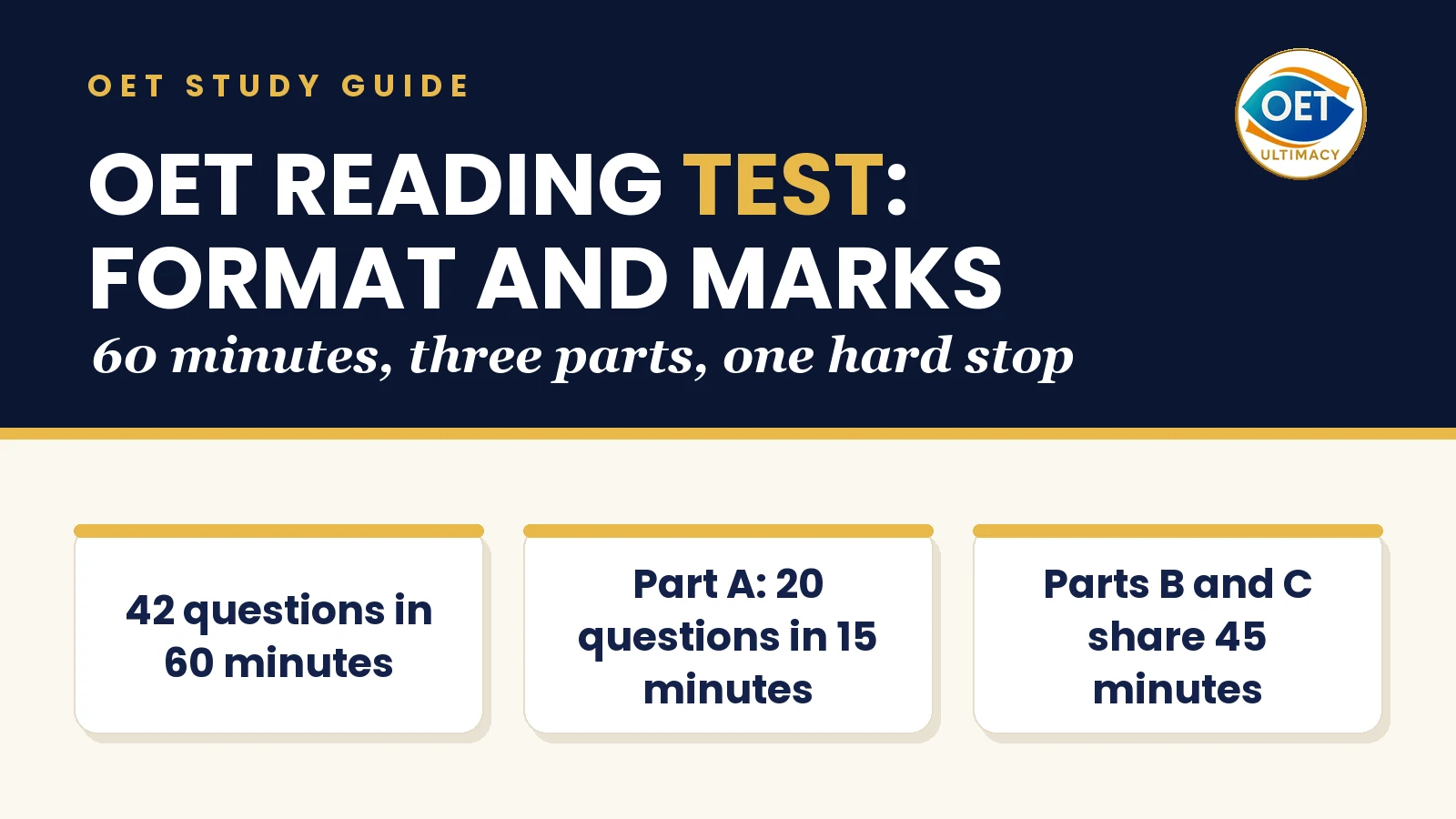
Short answer: The OET Reading test lasts 60 minutes and has 42 questions in three parts. Part A gives you exactly 15 minutes for four short texts and 20 questions (20 marks), and then it is taken away. Parts B and C share the remaining 45 minutes: six short workplace extracts with one three-option question each (6 marks), and two long texts of about 800 words with eight four-option questions each (16 marks). Every correct answer is one mark, and a grade B typically needs at least 30 of the 42.
How is the hour of OET Reading divided?
Into two blocks with a hard wall between them. The first 15 minutes belong to Part A only. When they end, Part A is over, finished or not, and the 45-minute block for Parts B and C begins.
| Clock | What you are doing | Questions | Marks |
|---|---|---|---|
| 0 to 15 minutes | Part A: four short texts on one healthcare topic | 20 | 20 |
| At 15 minutes | Part A papers are collected before Parts B and C are handed out | ||
| 15 to 60 minutes | Part B: six short extracts from the workplace | 6 | 6 |
| Part C: two long texts | 16 | 16 | |
| Total | 60 minutes | 42 | 42 |
Sources: OET Reading, the Part A guide and OET's test-day guide, as of November 2026.
Inside the 45 minutes, nobody tells you when to move from Part B to Part C. OET's own time-management advice suggests about 10 minutes for the six Part B questions and at least 35 for Part C, shared evenly between its two texts. That works out at roughly two minutes for each Part C question. OET's Reading page also says there is no extra time at the end to check your answers, so the last minute is not a safety net.
What is in OET Reading Part A?
Four texts (A to D) on a single healthcare topic, the kind of reference material a clinician might look up during a shift, and 20 questions to answer in 15 minutes. OET calls it the expeditious reading task: the skill is finding a fact fast, not reading every line.
The Part A guide lists three question types, and matching always comes first:
- Matching: usually 5 to 7 questions where you decide which text (A, B, C or D) contains a piece of information.
- Short answer: a question you answer with a word or short phrase from the texts.
- Sentence completion: a sentence with a gap that you fill from the texts.
Answers are usually one to three words, and they can be words, numbers or both. On paper, the texts come in a separate Text Booklet and you write in the Question Paper, so you move between two documents. On computer, OET says the screen is split, with the texts on the left and the questions on the right.
Here is an invented example of how the wording rule works. Suppose Text C, a wound-care leaflet, says: "Dressings should be changed when strike-through is visible." The question reads: "Nurses should change a dressing once they can see ______." The answer is "strike-through". Writing "the wound fluid" or "leakage" loses the mark, even though a nurse would know what is meant, because OET asks for the exact word or phrase used in the text.
What do Parts B and C ask you to do?
Both are multiple choice, but they test different reading.
| Part B | Part C | |
|---|---|---|
| Texts | 6 short extracts, about 100 to 140 words each | 2 long texts, about 800 words each |
| Where the texts come from | The healthcare workplace | Articles on topics of interest to a broad range of healthcare professionals |
| Questions | 1 per extract, 6 in all | 8 per text, 16 in all |
| Options | 3 (A, B, C) | 4 (A, B, C, D) |
| What you need to find | The main idea, the purpose or a detail | Detail, the writer's opinion or attitude, what a word or reference means, ideas stated or implied |
Sources: the Part B guide and the Part C guide, as of November 2026.
In Part B, OET's time-management advice points to the short context statement that comes with each extract, which tells you what kind of document you are about to read, for example a memo, an email or a policy. In Part C, the questions follow the order of the text, so question 3 usually points to a later paragraph than question 2.
Dr Ahmed Elgendy's rule for both parts is that OET Reading tests English, not medicine. The right option is the one the text supports, and the wrong options are ruled out by what the page says, never by what you know from your clinical work. If a Part C writer recommends something you would not do on your ward, the answer still follows the writer.
How many marks do you need from each part for a B?
OET converts your marks out of 42 to a score from 0 to 500, and grade B starts at 350. OET's results and scoring page says candidates at that level typically achieve at least 30 marks, and the Reading page adds that grade boundaries are adjusted slightly for each test. Treat 30 as the usual line, not a guarantee.
The parts do not pay the same rate for your time. Part A gives 20 marks for 15 minutes, about 1.3 marks a minute. Parts B and C give 22 marks for 45 minutes, about half a mark a minute. So the 15 minutes of Part A decide a lot. Using the usual 30-mark line, our own sums look like this:
| Your Part A score (out of 20) | Marks you then need from Parts B and C | Questions in B and C you can still get wrong |
|---|---|---|
| 20 | 10 of 22 | 12 |
| 18 | 12 of 22 | 10 |
| 16 | 14 of 22 | 8 |
| 14 | 16 of 22 | 6 |
| 12 | 18 of 22 | 4 |
A candidate who leaves eight Part A gaps empty because the 15 minutes ran out has to answer 18 of the 22 multiple-choice questions correctly. One who finishes Part A with 18 can miss nearly half of Parts B and C. A blank and a wrong answer both earn nothing, so it is worth writing something in every Part A gap and choosing an option for every B and C question.
Which grade you need is set by the body you are applying to, and some ask for more than 350 in Reading. Our OET scores and grades guide keeps the full table of regulators.
Which rules cost marks in OET Reading?
Most lost marks in Part A come from the form of the answer rather than from not finding it. OET's Reading page sets these rules:
- Use exactly the same form of the word or phrase as the text. "Swelling" is not the same answer as "swollen".
- Abbreviations are not accepted unless they appear in the texts.
- A misspelt answer earns no marks.
The Part A guide adds that an answer with extra words that are not needed is marked wrong, so do not write a full sentence where a phrase will do. In Parts B and C, answers written anywhere else in the booklet are not marked.
American and British spellings are both accepted. OET says you must be consistent, though, so choose one style and keep it for the whole exam. If spelling under time pressure is a weak point, our OET Listening Part A section has you type healthcare words as you hear them and checks every letter, and the same habit carries straight into Reading Part A.
There are room rules too. According to OET's test-day guide, you cannot leave the room during Part A or in the first and last 10 minutes of Parts B and C. Outside those times, you raise your hand and an invigilator takes you there and back.
Is OET Reading different on computer and on paper?
The structure, the content, the length and the marking are the same; OET says the paper and computer tests follow the same structure, content, length and marking. The difference is how you handle the page.
On paper, you can use a pen or a pencil in Part A, but for Parts B and C you need a 2B pencil to shade the circle next to your answer (OET Reading). If you forget one, the invigilator can give you a pencil. On computer, you type the Part A answers and click the options. When we recorded the screens of OET's computer-based test simulator in August 2026, each Part C text appeared on one screen with all eight of its questions in a single scrolling column next to the text, while Part B still showed one extract and one question at a time.
Reading is also the same for every profession. All 12 professions sit the same texts and questions; only Writing and Speaking change (is OET the same for every profession?). Our OET paper vs computer guide shows both versions of Reading side by side if you have not chosen a format yet.
Where can you sit a timed OET Reading test before the real one?
Finishing Part A inside 15 minutes comes from timed practice. Our OET Reading mock exams include 41 full tests in a layout modelled on the computer-based test, each with a 15-minute Part A clock and a score out of 42 at the end. Subscribers can also sit Part A, B or C alone when one part needs work. You can try the first exam in the Jahshan collection before you decide on a subscription.
Frequently asked questions
How long is OET Reading Part A?
Exactly 15 minutes. You answer 20 questions on four short texts in that time, and then the Part A papers are collected before Parts B and C begin. There is no extra time to finish Part A later.
Can I go back to Part A after the 15 minutes?
No. On paper, the Part A papers are taken away before Parts B and C are handed out. Whatever you have not answered by then stays unanswered, so fill every gap with your best attempt before time runs out.
How long do I have for OET Reading Parts B and C?
Forty-five minutes for both together, and you decide how to share it. OET's own advice is about 10 minutes for the six Part B questions and at least 35 minutes for the 16 questions in Part C.
How many options are there in OET Reading Part C?
Four. Each of the 16 Part C questions has options A, B, C and D. Part B questions have three options.
Can I use abbreviations in OET Reading Part A?
Only if the abbreviation appears in the texts. OET does not accept an abbreviation you made up yourself, even a common one, so copy the word or phrase in the same form the text uses.
Does spelling count in OET Reading?
Yes. OET says a misspelt answer earns no marks in Reading. American and British spellings are both accepted, but you should keep to one style for the whole exam.
Is OET Reading the same for nurses and doctors?
Yes. OET Reading uses the same texts and questions for all 12 professions. Only Writing and Speaking are written for your own profession.
OET Ultimacy is an independent OET preparation provider and is not affiliated with OET or Cambridge Boxhill Language Assessment. Test rules, fees and requirements can change, so always check oet.com and the body you are applying to.