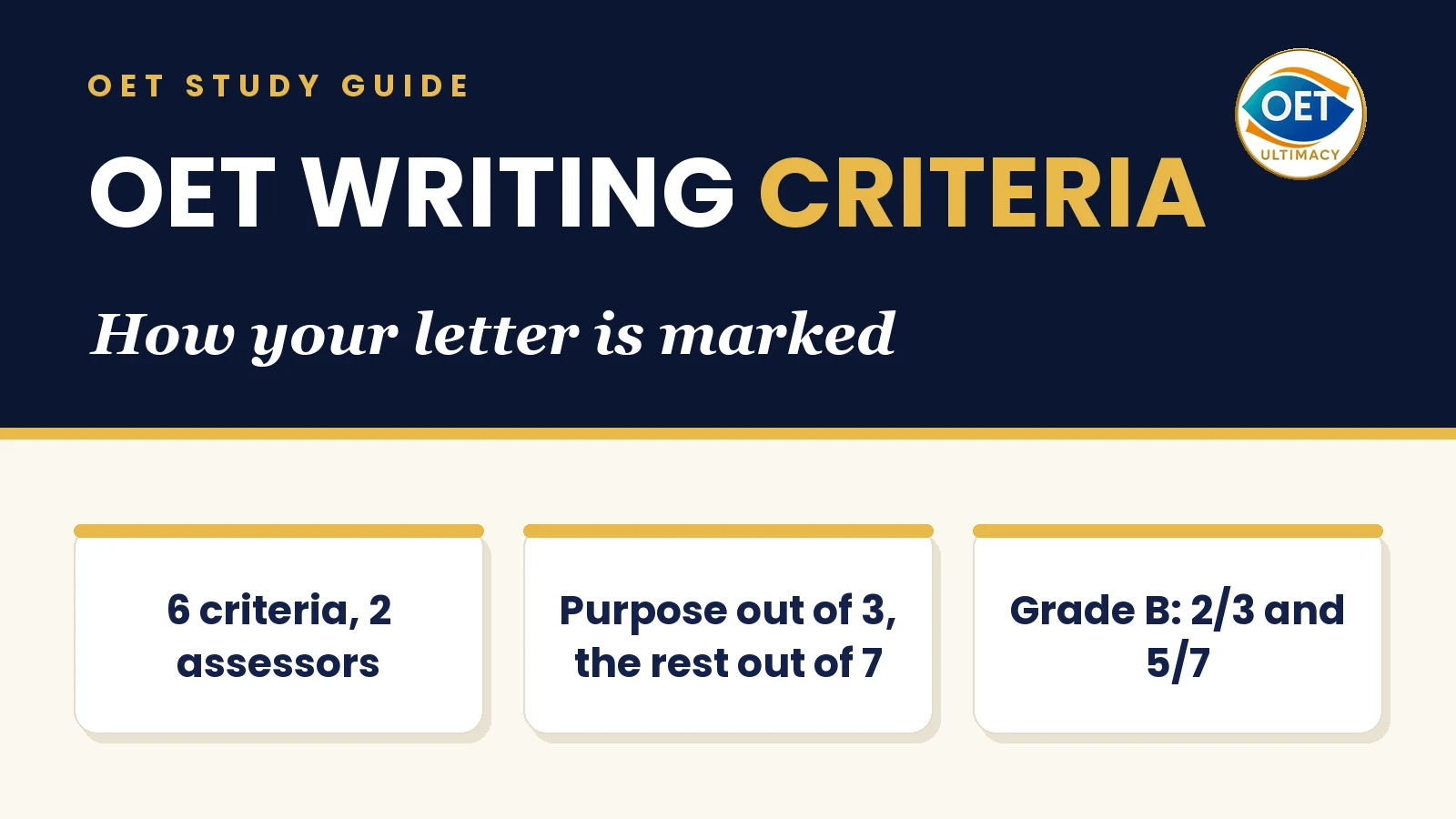
Short answer: Your OET Writing letter is marked against six criteria: Purpose, Content, Conciseness and Clarity, Genre and Style, Organisation and Layout, and Language. Purpose is scored out of 3 and the other five out of 7, and OET says a grade B letter scores 2 out of 3 for Purpose and 5 out of 7 for each of the rest (OET Writing). Two OET assessors mark every letter. Five of the six criteria are about what you chose from the case notes and how you presented it to the reader; only one is about grammar and spelling.
What are the six OET Writing criteria?
OET lists the six criteria in the same order everywhere, and each one asks a different question about your letter (Writing assessment criteria). As of November 2026 they are:
| Criterion | Scored out of | The question the assessor asks |
|---|---|---|
| Purpose | 3 | Can the reader see straight away what you are asking them to do, and is it explained further later in the letter? |
| Content | 7 | Is every piece of information this reader needs to continue care included, and is it accurate? |
| Conciseness and Clarity | 7 | Have you left out what the reader does not need, and summarised the rest well? |
| Genre and Style | 7 | Is the tone clinical, factual and polite, with technical words and abbreviations suited to this reader? |
| Organisation and Layout | 7 | Are the paragraphs logical, and is the key information easy to find? |
| Language | 7 | Are the grammar, vocabulary, spelling and punctuation accurate enough not to slow the reader down? |
OET publishes a single Writing criteria sheet, and it names no profession, while the Writing task itself is tailored to your profession (OET Test Handbook 2026).
How is each criterion scored, and what does grade B need?
Each assessor gives a band for each criterion: 0 to 3 for Purpose, 0 to 7 for the other five. For the five 7-point criteria, OET's criteria sheet describes the odd bands (1, 3, 5 and 7) in words, and the even bands sit between them; Purpose has a description for each of its four bands (Writing assessment criteria). So a 6 in Content means the letter shares features of a 5 and a 7.
OET then says the criterion scores "are combined and converted to the 500 scale" (OET Test Handbook 2026). It does not publish the conversion table, so any chart that turns criterion bands into an exact score out of 500 is someone's estimate.
What OET does publish is the profile of a grade B: 2 out of 3 for Purpose and 5 out of 7 for the other five criteria (OET Writing). Grade B is a score of 350 to 440, and some regulators accept C+ (300 to 340) in Writing; the full list is in OET scores and grades.
In other words, grade B asks for a 5 in every 7-point criterion, not a high average. OET's own Writing guide says you "must score highly across ALL the criteria" to get the grade you want (Ultimate Guide to OET Writing). Excellent grammar cannot rescue a letter whose purpose is buried in the last paragraph.
What does a weak and a strong line look like for each criterion?
The clearest way to see the criteria is to take one case and write each part of the letter twice. The case below is invented by us for this guide; it is not from any OET paper.
The case notes (extract). Mrs Rosa Jennings, 61. Lives with her husband, retired teacher, enjoys gardening, two grandchildren. Type 2 diabetes since 2015, hypertension. Metformin 1 g twice daily, ramipril 5 mg once daily. Three-week history of chest tightness on climbing stairs, settles with rest within 5 minutes, no pain at rest. Resting ECG normal. Started aspirin 75 mg daily and GTN spray. Plan: refer to cardiology for assessment of suspected stable angina.
The task. You are her GP. Write to Dr Patel, cardiologist, referring Mrs Jennings for assessment.
Purpose
Weak: "I am writing regarding Mrs Rosa Jennings, a 61-year-old retired teacher who lives with her husband."
Strong: "I am writing to refer Mrs Rosa Jennings, aged 61, for assessment of exertional chest tightness, which I suspect is stable angina."
The weak line tells Dr Patel who the patient is but not what you want. OET's top band for Purpose is a purpose that is "immediately apparent and sufficiently expanded" (Writing assessment criteria), so the strong letter also returns to the request in its last paragraph.
Content
Weak: "She has been getting chest pain recently."
Strong: "For the past three weeks, she has had chest tightness when climbing stairs, which settles with rest within five minutes. She has had no pain at rest."
The weak line changes the notes: "tightness" becomes "pain", and the trigger, the duration and the relief by rest disappear. Those are the details a cardiologist needs. Content is about accuracy as much as completeness.
Conciseness and Clarity
Weak: "She was diagnosed with type 2 diabetes in 2015. She takes metformin. The dose is 1 g twice a day. She also has hypertension. For this she takes ramipril. She enjoys gardening and has two grandchildren."
Strong: "Her type 2 diabetes (since 2015) and hypertension are treated with metformin 1 g twice daily and ramipril 5 mg once daily."
The strong line keeps every relevant fact in one sentence and drops the gardening and the grandchildren, which do not change what Dr Patel will do. OET's criteria sheet asks a simple question here: "Is there any information that could be left out?" (Writing assessment criteria).
Genre and Style
Weak: "Pt c/o chest tightness on stairs, prob angina. Pls see her ASAP, she's quite anxious about it."
Strong: "I would be grateful if you could assess Mrs Jennings and advise on further investigation and management."
The weak line copies the note style, uses abbreviations a reader should not have to decode, adds a contraction and a judgement that is not in the notes, and asks for urgency the notes do not support (her tightness comes only on exertion and settles with rest). OET's sheet says the register should be clinical and factual, with no personal feelings or judgements, and that abbreviations "should not be overdone" (Writing assessment criteria).
Organisation and Layout
Weak order: the medication list first, then the social history, then the chest tightness, with the referral request in the closing line.
Strong order:
- Opening: who the patient is and why you are referring her.
- The chest tightness: what happens, for how long, what relieves it, and the normal ECG.
- Background that matters for this problem: diabetes, hypertension and her regular medication.
- What you have started: aspirin and GTN spray.
- Closing: the request repeated, with thanks.
The weak order follows the case notes line by line. OET's lowest Organisation band describes exactly that: "heavy reliance on case note structure" (Writing assessment criteria). Put the problem the reader is acting on near the top.
Language
Weak: "She have this tightness since three weeks when she climb the stairs."
Strong: "She has had this tightness for three weeks when climbing stairs."
The weak line has the wrong verb form ("have"), "since" where English needs "for", and "climb" without its "-s". None of them makes the meaning impossible, but each one slows the reader down, and the top Language band asks for language that is "accurate" and does "not interfere with meaning" (Writing assessment criteria).
Does the word count, spelling or handwriting affect your score?
On word count, OET says there is "no automatic penalty" for going over or under the 180 to 200 word range (OET Writing). The range matters through the criteria: a long letter usually loses marks in Conciseness and Clarity, and a very short one usually misses Content.
OET says spelling mistakes are taken into account in your Language score (OET Writing). British and American spellings are both accepted, but OET says you must be consistent (OET on letter layout). So use one style for the whole letter, and it makes sense to keep the same style across the whole exam. If your spelling of common medical words is shaky, the OET Listening Part A section is a good daily drill: you hear Part A words, type them and get an instant spelling check, and the same words turn up in your letters.
On paper, your handwriting is not assessed, but the assessor must be able to read it (Ultimate Guide to OET Writing). You may write in all capital letters if you prefer, as long as you do it throughout (OET Writing).
For layout, OET says there is no particular format or layout you have to use in the Writing sub-test (OET Writing). What matters is that the reader can follow it. That is why Organisation and Layout is marked on whether the reader can find things, not on a fixed template.
Which criteria depend on your reading time?
Four of the six are mostly decided before you write a word. Purpose, Content, and Conciseness and Clarity all come from reading the task and choosing from the case notes, and Organisation and Layout comes from deciding the order. Only Genre and Style and Language are mainly about the sentences themselves.
The Writing sub-test gives you 5 minutes of reading time before the 40 minutes of writing (OET Test Handbook 2026). Spend them finding the reader and the request first, then going through the notes and asking of each line whether it changes what this reader will do. Our guide to OET Writing samples explains what the case notes contain and where OET's official samples and graded letters are.
Where can you practise against the OET Writing criteria?
Start with OET's own material: its criteria sheet and its Writing guide, linked above, are short and worth reading in full. Then write as many letters as you can under real timing. OET Writing practice on our site has case notes for Medicine, Nursing and Pharmacy, filtered by letter type, in a copy of the computer-based test: 5 minutes with the answer box locked, then 40 minutes with a live word count. After you write, read the letters other candidates wrote for the same case and check which details each of you kept, which is the Content and Conciseness question in practice. One case per profession is open to everyone; the full set comes with Ultimacy Premium.
Frequently asked questions
How many criteria are there in OET Writing?
There are six: Purpose, Content, Conciseness and Clarity, Genre and Style, Organisation and Layout, and Language. Purpose is scored out of 3 and the other five out of 7. OET publishes one Writing criteria sheet, and it names no profession.
What score on each criterion do you need for grade B in OET Writing?
OET says grade B letters score 2 out of 3 for Purpose and 5 out of 7 for each of the other five criteria. Grade B is 350 to 440 on the 500 scale. OET does not publish the exact table that converts criterion scores into a score out of 500.
Who marks the OET Writing letter?
Two OET assessors mark each letter against the official Writing criteria. The criterion scores are combined and converted to the 0 to 500 scale, and you receive one Writing score and grade.
Can you use abbreviations in an OET letter?
Yes, with care. OET's criteria say abbreviations should not be overdone and must suit the reader: a colleague in the same field will follow more of them than a professional from another discipline or a patient. Case-note shorthand such as "c/o" or "pt" is better written out in full. Our guide to OET abbreviations, acronyms and symbols explains when to write an abbreviation out and when to keep it, with a full glossary.
Is there a penalty for writing more than 200 words in OET Writing?
There is no automatic penalty for writing over or under the 180 to 200 word guide. Length affects your score through the criteria instead: extra detail tends to cost marks in Conciseness and Clarity, and a letter that is too short often leaves out content the reader needs.
Where is the official OET Writing criteria PDF?
OET publishes a Writing assessment criteria sheet with the band descriptions for all six criteria, and a longer Ultimate Guide to OET Writing with examples. Both are on OET's website. Read them alongside your own letters, criterion by criterion, rather than once at the start.
OET Ultimacy is an independent OET preparation provider and is not affiliated with OET or Cambridge Boxhill Language Assessment. Test rules, fees and requirements can change, so always check oet.com and the body you are applying to.