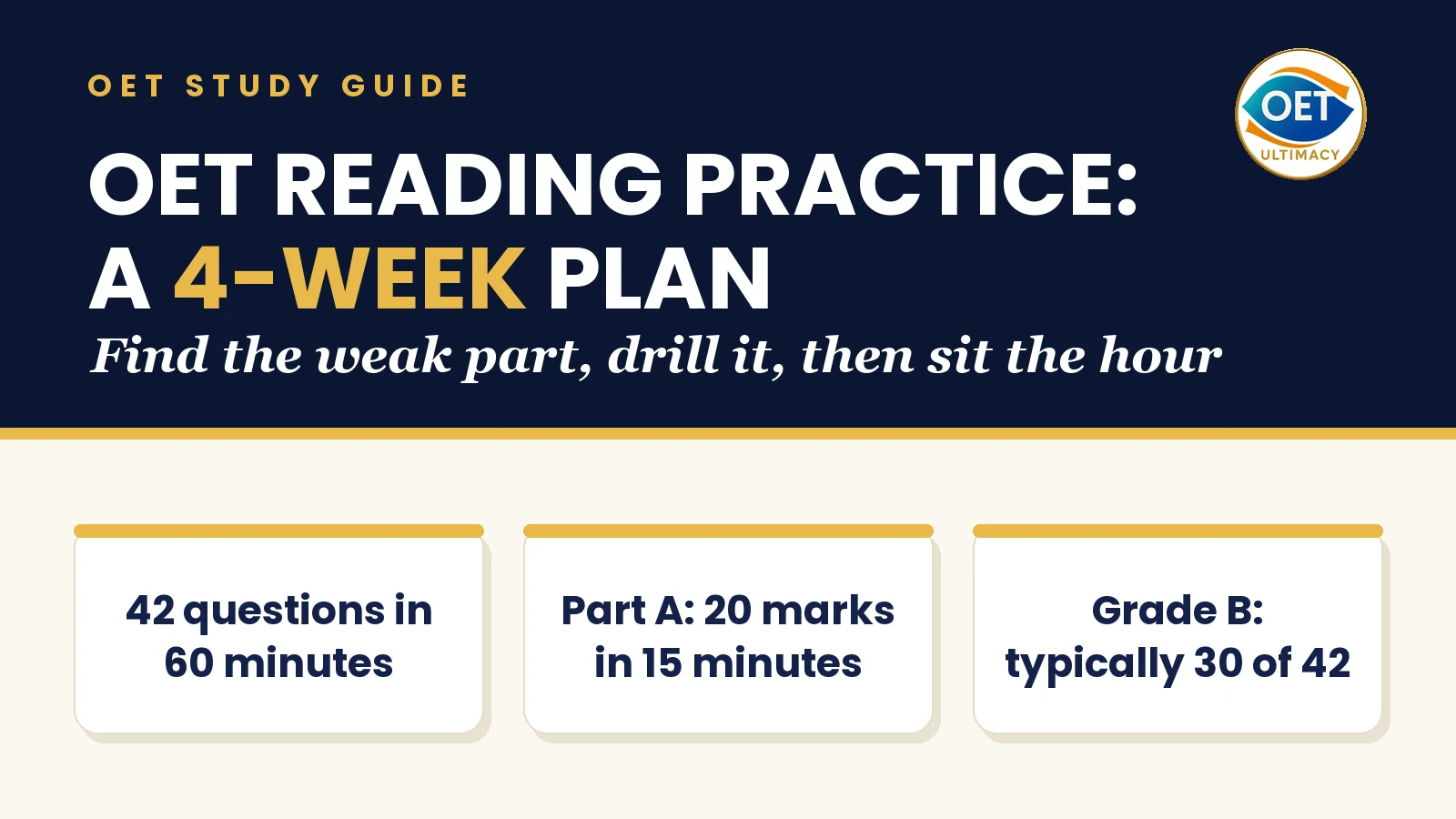
Short answer: Good OET Reading practice starts with one full timed test, marked part by part, so you know whether your lost marks sit in Part A (20 marks in 15 minutes) or in Parts B and C (22 marks in 45 minutes). Then give the weaker block a full week, the other block the next week, and spend week four on complete 60-minute tests. Practise about 45 to 60 minutes a day, six days a week, and write every wrong answer into a log with the reason you chose it. Reviewing that log raises the score faster than sitting extra tests.
Where does a month of OET Reading practice start?
With a diagnostic: one complete Reading test under real timing, before any drills. Sit Part A with a 15-minute stop, then Parts B and C together in 45 minutes, with no pauses and no dictionary. Use an official test for this if you have one; OET's sample tests page has them. Any profession's pack will do, because Reading is the same for every profession.
Mark it and write down three numbers: Part A out of 20, Part B out of 6 and Part C out of 16. The total out of 42 matters less on day one than where the gaps are. OET says candidates at grade B (350) typically score at least 30 of the 42 marks (results and scoring). "Typically" is the important word, so treat 30 as a line to clear with room to spare.
Now count the marks you lost in each block:
| Block | Marks available | Your score | Marks lost |
|---|---|---|---|
| Part A | 20 | 20 minus your score | |
| Parts B and C | 22 | 22 minus your B and C score |
Whichever block lost more marks gets week two. The other gets week three. If they are within one mark of each other, start with Part A, because each Part A minute carries more marks than a minute in Parts B and C (the OET Reading test guide shows the sums).
What does the four-week OET Reading plan look like?
Six practice days and one rest day each week. The plan below assumes your diagnostic showed Part A as the weaker block; if it was Parts B and C, swap weeks two and three.
| Week | Focus | A typical day (45 to 60 minutes) | End of the week |
|---|---|---|---|
| 1 | Find where the marks go | Day 1 diagnostic. Days 2 to 6: one part a day in rotation (A, B, C), then review every wrong answer into the log | Read the log: which mistake type appears most? |
| 2 | Part A speed and copying | One Part A set in 15 minutes, a letter-by-letter check of every answer, 10 minutes of spelling practice | Full timed test, compare Part A with week 1 |
| 3 | Parts B and C options | Six Part B extracts in about 10 minutes, or one Part C text in about 17 minutes, then a written reason for every wrong option | Full timed test, compare B and C with week 1 |
| 4 | The whole hour | Full 60-minute tests on days 1, 3 and 5, a log review on days 2 and 4, a light day 6 | Your last full test should be one you have never seen |
Over the month that is six full tests: one diagnostic, one at the end of weeks two and three, and three in week four. If you have only a few official tests, save one unseen for the end of week four, because a test you have already sat will flatter your score.
Many healthcare professionals in full-time work cannot find an hour every day. On a short day, do the drill and leave the review for the next day; never skip the review entirely. A drill without review mostly rehearses the same mistakes.
Outside the plan, OET's own advice on building a reading habit is to read something in English every day, and it describes reading for 45 minutes without tiring as the goal. That is the length of Parts B and C together. Ten minutes of a health article on a break counts.
How do you practise OET Reading Part A in week two?
Every day, one Part A set against a hard 15-minute stop, then a slow check of each answer against the text. OET's Part A guide describes the task as finding information quickly across four short texts, with matching questions first and then short answers and sentence completions. In practice you are training two things at once: finding the line fast, and copying it exactly.
Finding the line is only half of each mark. The check after each set looks for four faults, all of them rules in OET's common questions about Part A:
- A different form of the word from the text ("infected" where the text says "infection").
- An abbreviation that does not appear in the texts.
- A spelling error, even of one letter. A misspelt answer earns no marks.
- Extra words that the gap does not need.
Mark each set twice: once for whether you found the right place, once for whether the answer as written would score. If the second number is much lower than the first, the marks are going in the copying, so slow down for the last few seconds of each answer instead of trying to scan faster.
Spelling deserves ten minutes of its own each day this week. American and British spellings are both accepted, but OET asks you to stay with one style for the whole exam. A practical daily drill is our OET Listening Part A section: you hear healthcare words, type them, and every letter is checked at once. It is one of the most used sections on the site, and the same spelling habit carries straight into Reading Part A.
How do you practise Parts B and C in week three?
By reviewing every option after each set. Parts B and C are multiple choice: six three-option questions on short workplace extracts in Part B, and sixteen four-option questions on two long texts in Part C (OET's Part B guide and Part C guide). A wrong answer here almost always means a wrong option looked right. So after each set, write one line for every option you rejected and every option you chose wrongly:
- For the key: which sentence in the text proves it, and how the option rewords that sentence.
- For each wrong option: which line it was built from, and what it changed.
Most of the learning is in that second line. As Dr Ahmed Elgendy puts it to his students, OET makes wrong options out of lines you have already read, so your memory says "I saw this" and the option feels safe. Our OET Reading sample test guide shows three of these patterns with worked items; in week three you are learning to name them in your own wrong answers.
Use one more check while you review. OET Reading tests English, not medicine, so an option is right because the text supports it, never because it matches what you do on your ward. If your reason for choosing an option starts with "clinically", look at that question again.
For timing this week, OET's advice on managing time in Reading suggests about 10 minutes for Part B, leaving the rest of the 45 minutes for Part C. That works out at a little over 17 minutes for each Part C text, which is the timer to set when you practise one text alone. Our own single-part sittings are a little more generous: 12 minutes for Part B and 33 for Part C, the two parts' shares of the 45 minutes by question count.
What should your OET Reading wrong-answer log look like?
One row per wrong answer, filled in on the same day. Here is an invented example of four rows from a week-three log, to show the level of detail that helps:
| Test and question | Part | My answer | Key | Why I chose mine | What went wrong |
|---|---|---|---|---|---|
| Mock 4, Q9 | A | "monitored" | "monitoring" | Found the right line | Changed the word form |
| Mock 4, Q24 | B | A | C | Option A repeated a line about staff training | The line had "only after induction"; the option dropped it |
| Mock 4, Q31 | C | B | D | The writer mentions cost in paragraph 3 | Cost was a view the writer quotes and then rejects |
| Mock 5, Q38 | C | A | B | It matched my own practice | Chose by clinical knowledge, not by the text |
At the end of each week, count the last column. Often two or three kinds of mistake account for most of your lost marks, and those are what the next week's drills should target.
How do you know your OET Reading practice is working?
Compare the full test at the end of each week with your diagnostic, part by part. The weekly totals will move up and down with each test's difficulty, so look at two things instead: the marks lost in the block you trained that week, and whether the same mistake type keeps returning in the log.
| What you see at the end of the week | What to do next |
|---|---|
| The trained block improved and its main mistake type is rarer | Move on to the next week as planned |
| The score rose, but the same mistake type still fills the log | Repeat that week's drill for three more days before moving on |
| Part A is unfinished when the 15 minutes end | Practise matching questions on their own until you can do them faster; OET says they come first and there are usually 5 to 7 |
| Part C is rushed at the end | Check your Part B time; if it is well over 10 minutes, that is where Part C's minutes went |
| Full tests sit at or above the low 30s out of 42 | Keep one full test a week until the exam, with the log |
OET says you won't lose marks for an incorrect answer in its multiple-choice questions, and a blank earns nothing either, so in every practice test, fill every Part A gap and choose an option for every Part B and C question before time runs out. Practise this habit now, so it is automatic on test day.
If your test is in a different format from your practice, the timing stays the same: 15 minutes for Part A, then 45 for Parts B and C. OET describes its computer test as the same trusted test content delivered digitally; what changes is how you give your answers, typing and clicking on screen, or writing and shading answers on paper, where Parts B and C must be done with a 2B pencil. Our paper vs computer guide explains the difference.
Where can you practise OET Reading for four weeks?
You will need more tests than OET publishes. Our OET Reading mock exams hold 41 complete tests in a layout modelled on the computer-based test, with a 15-minute Part A clock and a score out of 42. After each test you can see your answers next to the correct ones, which is the starting point for your log. Subscribers can also sit Part A, B or C alone; a Part B or Part C sitting ends with your time used and your time per question, which suits weeks two and three. You can try the first Jahshan exam before you decide on a subscription, and the study planner can lay out the weeks around your exam date.
Frequently asked questions
How can I improve my OET Reading score in a month?
Sit one timed diagnostic test, find whether you lose more marks in Part A or in Parts B and C, and train that block first. Keep a log of every wrong answer with the reason you chose it, and finish the month with full 60-minute tests. Steady review of mistakes matters more than the number of tests.
How many OET Reading practice tests should I do before the exam?
In a four-week plan, about six full timed tests is enough, with part-by-part drills between them. Keep at least one test you have never seen for the last week, so your final score is not inflated by memory.
How long should I practise OET Reading each day?
About 45 to 60 minutes, six days a week, is a realistic target alongside a full-time job. That covers one timed drill and the review of its wrong answers. On a short day, do the drill and review it the next day.
Is one month enough to prepare for OET Reading?
It can be if your first timed test is already near the low 30s out of 42 and your mistakes fall into a few clear types. If your diagnostic is much lower, repeat weeks two and three before moving to full tests, and give yourself more time.
Where can I find OET Reading practice tests with answers?
OET publishes official sample tests on oet.com, and our OET sample test guide explains how to mark them. For more tests in the same format, practice platforms such as our Reading mock exams score each test out of 42 and show the correct answers afterwards.
Should I practise OET Reading on paper or on a computer?
Practise in the format you will sit, at least in the last two weeks. The parts and timing are the same in both, but answering on paper and on screen feels different under time pressure, and on paper Parts B and C must be shaded with a 2B pencil.
OET Ultimacy is an independent OET preparation provider and is not affiliated with OET or Cambridge Boxhill Language Assessment. Test rules, fees and requirements can change, so always check oet.com and the body you are applying to.