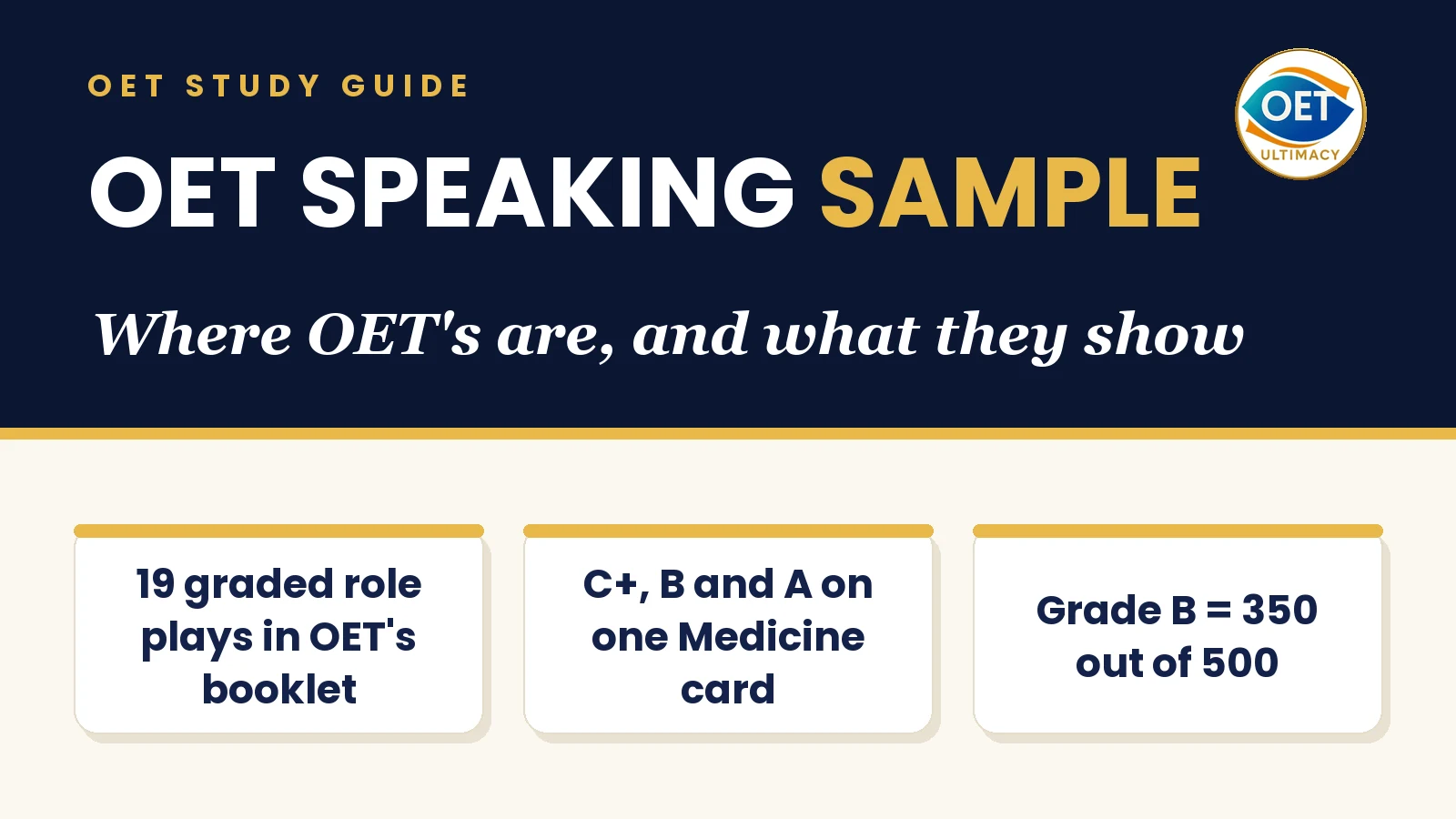
Short answer: OET publishes three kinds of official Speaking sample: role-play cards inside its computer sample test packs, a Graded Speaking Sample Booklet with 19 real candidates' recordings, transcripts and assessor comments across 10 professions, and sample role-play videos. The booklet is the most useful, because you can hear a C+, a B and an A on the same card. What lifts a role play to a high grade there is rarely medical content: it is open questions before closed ones, answering the patient's worries, signposting each change of topic, and checking that the patient has understood.
Where are the official OET Speaking samples?
All of them are on oet.com, and as of November 2026 they sit in three places. Our OET Speaking cards are for practising once you have seen them.
| Official sample | Where | What is in it |
|---|---|---|
| Speaking role cards | OET Test on Computer sample tests, then your profession | A PDF per sample test with the candidate card and the roleplayer card for one role play. The Medicine page and the Nursing page list four sample tests (1 to 4) with a Speaking role card; the other professions list one, numbered Sample Test 3. |
| Graded Speaking Sample Booklet | OET's sample booklets post | 19 role plays by real candidates, each with a playable recording, a time-stamped transcript and assessor comments. |
| Sample role-play videos | The Videos section of OET's Speaking sample tests page | Sample Speaking tests for Nursing and Pharmacy, and full sub-test role plays for Nursing and Medicine. |
The paper sample packs have no Speaking card: their pages list test questions, an answer key and an audio file, and nothing else. If you will sit OET on paper, take your Speaking cards from the computer page anyway: the role play is the same task in both formats, as our OET Speaking test guide explains.
OET also warns on its sample tests page that material shared on social media may not be official practice tasks. OET goes further and does not recommend studying with them. Our own view is that role plays written by teaching sites can be extra practice once you know the official ones, but they are not OET samples, and their "model answers" have not been graded by an OET assessor.
What is in the Graded Speaking Sample Booklet?
The Graded Speaking Sample Booklet is an 89-page PDF. OET says in its introduction that every recording comes from a real candidate doing the Sample Test 5 role play from the OET website for the first time.
| Profession | Graded role plays |
|---|---|
| Medicine | 4 |
| Nursing | 3 |
| Pharmacy | 3 |
| Occupational Therapy | 2 |
| Physiotherapy | 2 |
| Dentistry, Optometry, Radiography, Speech Pathology, Veterinary Science | 1 each |
That makes 19 role plays. Dietetics and Podiatry have no recording in it. Each role play has an audio icon to play the recording, a time-stamped transcript with a key marking the candidate's and the interlocutor's lines, and a paragraph of assessor comments that walks through the nine criteria. Each is labelled with the grade it shows (C+, B or A), such as "B GRADE EXAMPLE".
The booklet also gives a useful benchmark in OET's own words: a candidate who secures grade B has scored 5 out of 6 on the linguistic criteria and 2 out of 3 on the clinical communication criteria. A grade B is 350 on OET's 0 to 500 scale (OET results and scoring); our OET scores and grades guide shows which grade each regulator asks for.
What separates a C+, a B and an A in OET's Medicine samples?
The four Medicine recordings all answer OET's Medicine Sample Test 5 card: an 86-year-old patient with lower back discomfort, where the card tells the doctor to suspect mild back strain. That card is no longer on OET's sample test pages, but it is card 37 of our OET Speaking cards. The booklet grades the four recordings C+ (sample 1), B (samples 2 and 3) and A (sample 4). Because the card does not change, the assessor comments show clearly what moves a role play up a grade. Here is what they say, in our words.
| What the assessors looked at | C+ (sample 1) | B (samples 2 and 3) | A (sample 4) |
|---|---|---|---|
| Starting the history | Did not open with broad, open questions; follow-ups were unclear | Sample 2 moved from open to closed questions but used questions with several parts; sample 3 did not grade its questions | Restated why the patient came, then asked an open question so the patient could describe the problem first |
| The patient's worries | Gave a simple reply when the patient asked about giving up her classes, with no exploration | Picked up the worry about exercise only weakly (sample 2) or answered it minimally and somewhat dismissively (sample 3) | Named the patient's concerns out loud and acknowledged them before explaining |
| Shaping the talk | Very little signposting to a new topic | Basic or little signposting; one phrase repeated as the only signal | A logical order, with phrases that marked each section and highlighted the key advice |
| Checking understanding | Checked the patient's reaction to one suggestion only | Did not invite a response (sample 2), or checked once (sample 3) | Several checks for questions and concerns |
| Language | Some unclear words, many restarted phrases, "um" starting to intrude | Generally clear; sample 3 had clear pronunciation and a natural pace with some vocabulary gaps | Fluent long turns and a mix of formal and everyday wording |
The diagnosis is printed on the card, so all four candidates had the same medicine to explain, and the grades split on how they managed the conversation. And even the A comment names something to improve: after many recommendations, the assessors wanted a better check than "Do you follow what I'm saying?" and suggest an open question, such as asking how the plan sounds to the patient. A high grade does not need a perfect role play.
Card 37 is one of five OET Medicine samples in our set, each marked "Official Sample". Anyone can read it, and signing in adds the exam timers and the roleplayer's card.
How should you study an OET Speaking sample?
The booklet's introduction makes five suggestions, and the first one starts before you listen to anything. Here they are in our words:
- Record yourself first, then place your recording. Do a role play with a teacher, friend or colleague and record it. Then listen to the candidates in your profession and ask whether yours is stronger or weaker than each, whether the assessor comments describe your own habits, and which criteria you need to improve. OET's candidates all did Sample Test 5; for Medicine that card is our card 37, and for other professions, use one of the role cards on OET's computer sample pages.
- Take one criterion at a time. Follow, say, information gathering through every recording in your profession, with its comments.
- Study the grade you need. Listen closely to the candidate at your target grade and use the assessor comments as a checklist for your next attempt, or redo the role play trying to do everything the assessors praised.
- Listen beyond your profession. The scenarios differ, but how candidates build rapport or signpost a new topic carries over.
- Compare everyone at your target grade. The role plays at one grade have different strengths and weaknesses. There is no single perfect way; a high grade comes from meeting the criteria at the right level in both role plays.
OET adds a warning: the recordings are not templates. Each assessor comment carries a note that copying the language used for a different card will not produce the same score and is strongly discouraged, and the introduction says assessors can tell when a candidate repeats a learned script. Learn the moves (the open question, the acknowledged worry, the check), not the sentences.
Where can you practise after the official samples?
OET's samples give you a handful of cards per profession, and most candidates need many more conversations than that. Our OET Speaking cards has 40 Medicine role-play cards, sorted by type: first visit, follow-up visit, after examination, emergency and breaking bad news. Anyone can read a card; sign in to use the 3-minute preparation and 5-minute role-play timers and to show the roleplayer's card to your partner. Take one of the moves from the booklet into each practice session, and listen back to your recording for it. If you have no one to play the patient, OET Study Partner matches you with a candidate who sits OET around your date, and Dr Ahmed Elgendy runs OET Speaking mock sessions when you want a teacher's view.
Frequently asked questions
Where can I download OET Speaking sample role-play cards?
Go to OET's sample tests page, choose OET Test on Computer, then your profession. Each sample test there that has a Speaking role card offers a PDF with the candidate card and the roleplayer card. As of November 2026, Medicine and Nursing have four sample tests with a role card and the other professions have one.
Are there OET Speaking samples with audio?
Yes. OET's Graded Speaking Sample Booklet has 19 recordings by real candidates, each with a transcript and assessor comments. OET's Speaking sample tests page also has sample role-play videos for Nursing, Pharmacy and Medicine.
Is there an OET Speaking sample for nurses?
Yes. The Nursing page of OET's computer sample tests lists four sample tests with a Speaking role card, the graded booklet has three Nursing recordings, and OET's Speaking sample tests page has a Nursing sample test video and a full Nursing sub-test role play.
What does a grade B OET Speaking role play sound like?
The graded booklet labels B grade examples, including two for Medicine on the same card. OET says a grade B candidate scores 5 out of 6 on the linguistic criteria and 2 out of 3 on the clinical communication criteria. In the Medicine B samples, the language was clear, but the assessors noted weak responses to the patient's worries and little signposting.
Can I memorise a sample OET Speaking role play?
No. OET says the assessor comments apply only to the card each candidate answered, and that copying their language for a different card will not produce the same score. Assessors can tell when a candidate repeats a learned script, so practise the skills the comments describe instead.
Are OET Speaking samples on other websites official?
Only material published by OET is official. OET warns that tasks shared on social media may not be official practice tasks, and role plays written by teaching sites have not been graded by OET assessors. Use them for extra practice, and use OET's own samples to judge the standard.
OET Ultimacy is an independent OET preparation provider and is not affiliated with OET or Cambridge Boxhill Language Assessment. Test rules, fees and requirements can change, so always check oet.com and the body you are applying to.