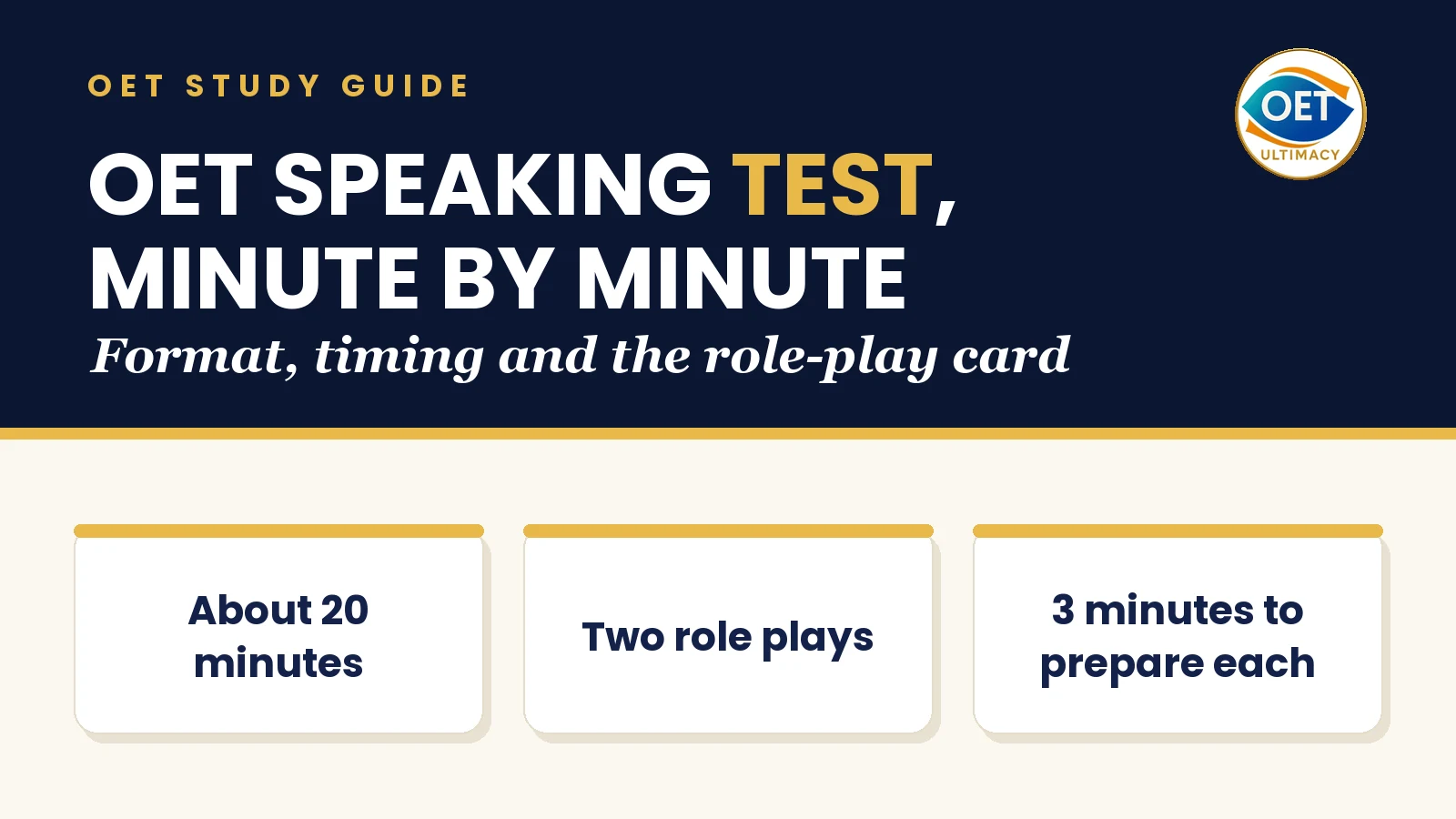
Short answer: The OET Speaking test takes about 20 minutes. After an ID check and a short warm-up conversation that is not marked, you do two role plays from your own profession. For each one you get 3 minutes to read the card and make notes, then about 5 minutes to speak with an interlocutor who plays the patient or a relative. The session is recorded, and two OET assessors score only the two role plays, on a scale of 0 to 500.
How long is the OET Speaking test?
About 20 minutes on paper, according to OET's Speaking page. If you take Speaking online from home, OET's at-home test day guide allows 20 to 30 minutes, because the security checks of your room and screen come first.
Most of those minutes are yours. Add up the timed parts: two preparation periods of 3 minutes and two role plays of about 5 minutes make 16 minutes. The rest is the ID check, the warm-up and the change from one card to the next.
What happens, minute by minute?
The order is the same in every OET Speaking test. The preparation and role-play times come from OET; the first two stages are short and are not timed for you.
| Stage | About how long | What you do | Marked? |
|---|---|---|---|
| ID check | A few minutes | Show your ID; at home, the security checks of your room come here too | No |
| Warm-up | A few minutes | A short chat with the interlocutor | No |
| Role play 1, preparation | 3 minutes | Read card 1 and write notes | No |
| Role play 1 | About 5 minutes | Talk to the "patient" played by the interlocutor | Yes |
| Role play 2, preparation | 3 minutes | Read card 2 and write notes | No |
| Role play 2 | About 5 minutes | Second conversation, a different situation | Yes |
OET's own post on common Speaking questions confirms that the ID check and the warm-up are not rated, and that the assessors score your two role plays only. Use the warm-up for what it is: a few minutes to get your voice going and settle your nerves.
How many role plays are in OET Speaking?
Two. Each one is a separate conversation with a different patient and a different task, and both are written for the profession you booked. A nurse gets nursing cards, a pharmacist gets pharmacy cards, and a doctor gets Medicine cards. OET Listening and Reading are the same for every profession, but Speaking and Writing are not (our guide on whether OET is the same for every profession explains the split).
Each role play comes to an end at around 5 minutes, whether or not you have reached the last task. OET says there is no penalty for not completing every element of the card, so a calm, well-run conversation that misses the last point is better than a rushed one that ticks every box.
What is on an OET Speaking role-play card?
OET's cards follow one layout: the setting, a short background under your profession (for example DOCTOR), and a task list of about five bullet points. OET explains in its post on the 3 preparation minutes that the background can hint at how the patient feels, and that it helps to estimate how much time each task needs.
This is OET's own Medicine Sample Test No. 5, the candidate card, as it appears on card 37 of our OET Speaking cards:
CANDIDATE CARD NO. 5, MEDICINE (OET Sample Test)
SETTING: Medical Clinic
DOCTOR: You see an 86-year-old patient who has limited mobility. He/she uses a walking frame, and attends regular chair exercise classes. He/she has come to see you about discomfort in his/her lower back. You suspect mild back strain.
TASK:
- Find out reason for patient's visit.
- Find out more details about problem (exact location, any pain, etc.). Explore any possible causes (injury, exercise, etc.).
- Give possible diagnosis of mild back strain (over-stretching of muscles/ligaments: not cause for concern, etc.). Advise on next steps (e.g., physical examination to confirm diagnosis, etc.). Recommend one week off exercise classes (e.g., not exercising when in pain, not ignoring pain, etc.).
- Stress importance of rest from exercise (e.g., prevention of further injury/strain, time to recover, etc.). Make further recommendations (e.g., heat pack, paracetamol/acetaminophen, etc.).
- Emphasise benefits of exercise classes (e.g., improved posture, maintaining muscle strength, boosting energy/mood, social interaction, etc.). Advise against overdoing exercise (e.g., awareness of own limits, etc.). Establish patient's consent for physical examination.
© Cambridge Boxhill Language Assessment. OET Sample Test.
Three things about this card are worth noticing before your own test.
The interlocutor has a different card, the roleplayer card, with the same setting and the patient's side of the story. Many of its lines begin "When asked", so the patient gives details such as where the discomfort is only if you ask. The first two tasks on your card exist for exactly that reason.
The patient's card also carries a turn you cannot see coming. In this sample, the patient pushes back on missing a week of classes and then wonders about giving them up altogether, which is why your last task asks you to stress the benefits of exercise. So listen to what the patient says and answer it, as well as working through your card.
The medical content is light. The diagnosis is given to you on the card ("You suspect mild back strain"), and the bullets even suggest what to say. What gets marked is how clearly you explain it, in words a non-medical person can understand, as OET's criteria overview puts it.
OET says you can make notes on the role-play card, and the 3 minutes of preparation are the time to do it. On paper, you hand the card back to the interlocutor at the end of each role play. At home, you write your notes on a blank sheet of paper that has only your confirmation number on it, and you need a pen or pencil ready.
How is OET Speaking marked?
At least two trained OET assessors listen to the recording later and score it against nine criteria. The interlocutor in the room does not give your score.
| Group | Criteria | Scored out of |
|---|---|---|
| Linguistic (4) | Intelligibility; Fluency; Appropriateness of language; Resources of grammar and expression | 6 each |
| Clinical communication (5) | Relationship building; Understanding and incorporating the patient's perspective; Providing structure; Information gathering; Information giving | 3 each |
Sources: OET Speaking criteria overview and OET results and scoring, as of November 2026.
Your criteria scores become one result from 0 to 500, reported in steps of 10. A grade B is 350. Which grade you need depends on the body you are applying to; our OET scores and grades guide has the table for each regulator.
Is OET Speaking done at home or at the test centre?
It depends on how you book OET.
| OET on paper | OET on computer and OET@Home | |
|---|---|---|
| Where | At the test venue, face to face | At home, online, on camera (at a venue in a few countries) |
| When | Same day as Listening, Reading and Writing | On a separate day from the other sub-tests |
| Your notes | On the role-play card | On a blank sheet of paper |
| Time | About 20 minutes | About 20 to 30 minutes with security checks |
Sources: OET Speaking, OET on paper, OET on computer and the at-home test day guide, as of November 2026.
For Speaking at home, OET's guide asks for a laptop or desktop computer with a webcam, and the computer's built-in or USB speakers and microphone. Headphones and headsets are not allowed, and neither are wireless or Bluetooth speakers or microphones. You must be alone in a quiet, private, well-lit room with walls. OET has also announced that new and rescheduled at-home and computer bookings use its own OET Speaking Platform, and says the format and marking stay the same. Our OET paper vs computer guide compares the two formats across all four sub-tests.
Where can you practise the OET Speaking test format?
The quickest way to get used to the timing is to run real-format cards against a clock. Our OET Speaking cards has 40 Medicine role-play cards, sorted by type: first visit, follow-up visit, after examination, emergency and breaking bad news. You can read any card without an account; sign in to use the 3-minute preparation timer and the 5-minute role-play timer and to reveal the interlocutor's card, so your partner can play the patient. If you need someone to practise with, OET Study Partner matches you with a candidate who sits OET around your date, and when you want a teacher's view, Dr Ahmed Elgendy runs OET Speaking mock sessions.
Frequently asked questions
How many minutes is the OET Speaking test?
About 20 minutes on paper. Online from home, OET allows 20 to 30 minutes because of the security checks. Inside that time you have two role plays of about 5 minutes, each after 3 minutes of preparation.
Is the OET Speaking warm-up marked?
No. OET says it does not rate the ID check or the warm-up conversation. Only the two role plays are scored, so treat the warm-up as time to settle in.
Who plays the patient in OET Speaking?
The interlocutor plays a patient or a patient's relative or carer. The interlocutor does not score you. The session is recorded, and two OET assessors mark it later.
Can I write notes in the OET Speaking test?
Yes. During the 3 minutes of preparation you can write notes on the role-play card when you sit OET on paper. At home, you write them on a blank sheet of paper with only your confirmation number on it.
What happens if I do not finish all the tasks on the card?
The role play still ends at around 5 minutes. OET says there is no penalty just for not reaching every task, because the assessors score how you communicate against the nine criteria, not a checklist of tasks.
Can I use headphones for OET Speaking at home?
No. OET's at-home guide does not allow headphones or headsets for Speaking. Use the built-in or USB speakers and microphone of a laptop or desktop computer, and avoid Bluetooth or wireless devices.
Is the OET Speaking test different for each profession?
Only the cards change. Every profession has the same structure: a warm-up, then two role plays with 3 minutes of preparation each, marked on the same nine criteria. The situations on the cards come from your own profession's work.
OET Ultimacy is an independent OET preparation provider and is not affiliated with OET or Cambridge Boxhill Language Assessment. Test rules, fees and requirements can change, so always check oet.com and the body you are applying to.