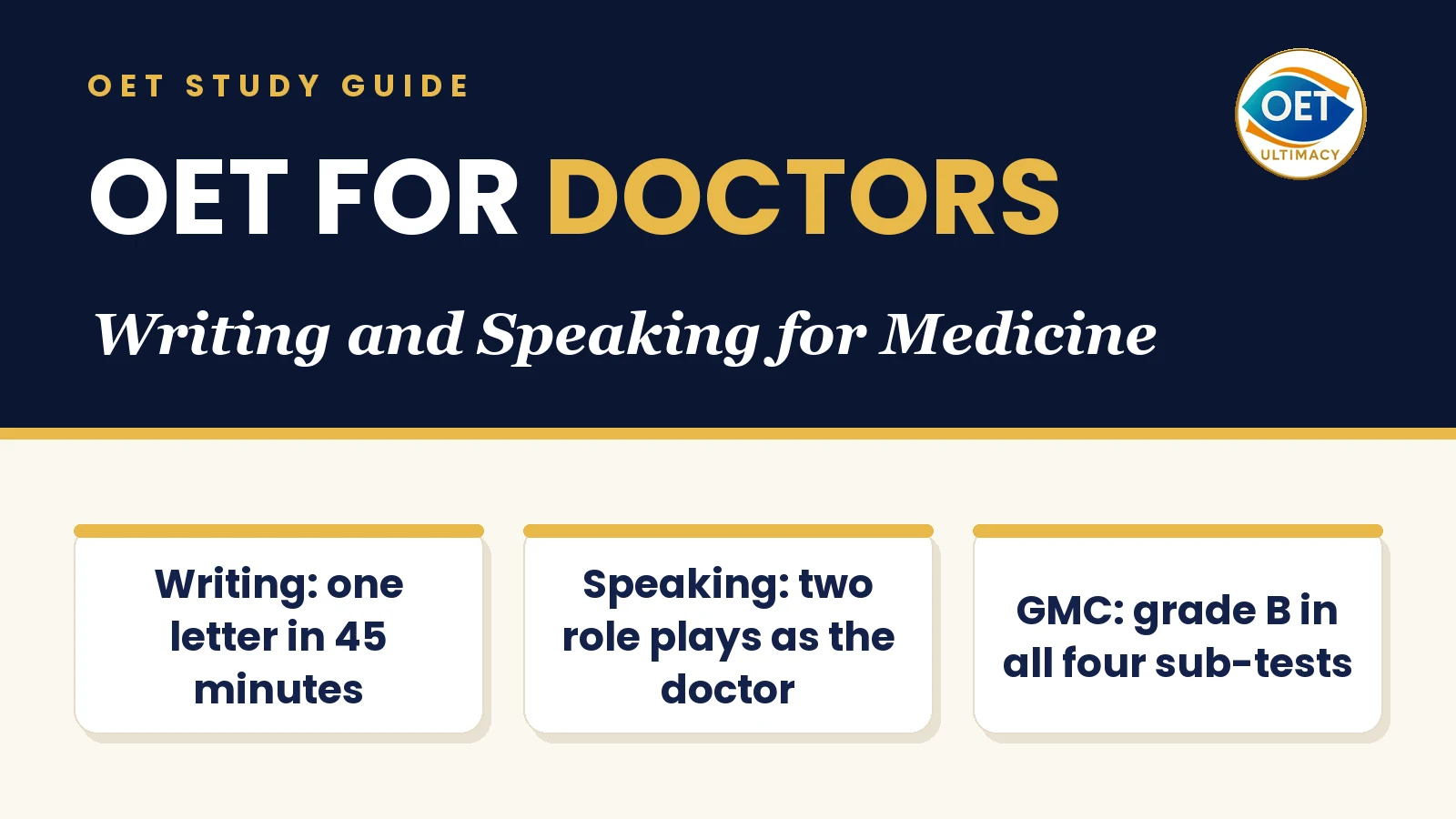
Short answer: Doctors take OET Medicine. OET Listening and OET Reading are the same papers every profession sits, but in OET Writing you write one letter from a patient's case notes, such as a referral to a specialist, and in OET Speaking you play the doctor in two role plays with an interlocutor who plays the patient or a relative. The GMC, ECFMG and the medical councils of Ireland and New Zealand all ask for the Medicine version. Below are a Medicine Writing task and a doctor's role card that we wrote as examples, and a seven-day plan for whichever sub-test is your weakest.
What changes in OET when you book Medicine?
Only the second half of the test. As of November 2026, the OET Test Handbook 2026 says Listening and Reading are the same for all candidates, regardless of profession, while Writing and Speaking are written for the profession you book. So the 42 Listening questions and the 42 Reading questions a doctor answers come from the same papers a nurse or a pharmacist sits. Our guide Is OET the same for every profession? covers that shared half in detail.
| Sub-test | What a doctor does | Time |
|---|---|---|
| Listening | Healthcare recordings shared by all 12 professions | About 40 minutes |
| Reading | Healthcare texts shared by all 12 professions | 60 minutes |
| Writing | One letter from Medicine case notes | 45 minutes |
| Speaking | Two role plays as the doctor | About 20 minutes |
What does an OET Medicine Writing task look like?
You get a page of case notes about one patient and a task line telling you who to write to and why. The handbook gives 5 minutes of reading time and 40 minutes of writing time, and OET's Writing page suggests a letter of about 180 to 200 words. For doctors, OET's own OET vs IELTS for doctors article names referral, transfer and discharge letters, and the handbook says the reader is another healthcare professional or a person related to the patient's care.
Here is a short extract of case notes we invented for this guide. It is not from any OET paper.
- Patient: Mrs Lena Morris, 64, retired schoolteacher
- Seen: GP surgery, 3 weeks of worsening breathlessness on exertion, now after one flight of stairs; ankle swelling for 10 days
- History: hypertension for 10 years (amlodipine 5 mg daily); ex-smoker, stopped 2015
- Social: lives alone; looks after her grandson two afternoons a week
- Examination: BP 158/94, pulse 92 regular, pitting oedema both ankles, fine crackles at both lung bases
- Assessment: ?heart failure
- Plan today: furosemide 40 mg each morning started; refer to cardiology for echocardiogram and review
- Task: Write to Dr Sam Patel, Cardiologist, City Hospital, referring Mrs Morris for assessment.
The skill being tested is selection. A cardiologist needs the breathlessness and its time course, the examination findings, her blood pressure history and the new furosemide. Her old job adds nothing for Dr Patel. Living alone is worth one short line, because it matters if she needs follow-up at home. That kind of judgement is what OET's Content and Conciseness and Clarity criteria reward. The handbook lists one set of six criteria, which our OET Writing criteria guide explains.
An opening we wrote for this case:
Dear Dr Patel,
Re: Mrs Lena Morris, aged 64
I am writing to refer Mrs Morris, who has a three-week history of worsening breathlessness on exertion and bilateral ankle swelling, for an echocardiogram and further assessment of suspected heart failure.
The purpose is in the first sentence, and the reader knows what you are asking for before any history. On OET Ultimacy, 13 of the 18 Medicine case notes in our Writing practice are referral or urgent referral tasks (as of November 2026). That is our own collection, not a statement about how often OET sets each letter type, so practise transfer and discharge letters as well.
What does a doctor's role card look like in OET Speaking?
You read a role card with the setting, some background on the patient and a list of task prompts, you get 3 minutes to prepare, and then the role play runs for about 5 minutes. The handbook says the interlocutor plays the patient or the patient's family member or carer. You do this twice, and the whole Speaking sub-test, warm-up included, takes about 20 minutes.
A card we wrote as an example:
Setting: General practice
Doctor: Mr Omar Haddad, 45, has come back for the results of his blood tests. They show type 2 diabetes.
- Find out what he already knows about diabetes.
- Explain the result in plain language.
- Explain the first steps: diet, activity, a follow-up appointment and possibly a tablet.
- Respond to his worry that he will need insulin injections.
- Agree a plan and check that he understands it.
Doctors usually know this content well, so the marks rest on how it is said. OET's criteria include Appropriateness of language, which its criteria glossary links to explaining medical matters in lay terms, and five clinical communication criteria, among them understanding the patient's perspective and information giving. "Your HbA1c is 52 mmol/mol" is accurate but tells a worried patient very little; "a blood test shows your sugar has been running high for the past few months" is something he can take home. The nine criteria are set out in our OET Speaking criteria guide.
Our 40 Medicine Speaking role cards are grouped by situation: 18 after an examination, 11 first visits, 7 follow-up visits, 3 emergencies and 1 breaking bad news card (as of November 2026). If you have only practised first visits, the after-examination cards are where explaining results gets tested.
Which bodies accept OET Medicine?
The GMC wants the Medicine version with grade B in all four sub-tests from your most recent sitting, while ECFMG wants OET Medicine with 350 in Listening, Reading and Speaking and 300 in Writing, in one test administration (both checked November 2026). Every body's numbers sit in one table in our OET scores and grades guide.
Which sub-test should a doctor work on first?
The one with the lowest score, because the GMC, ECFMG and the medical councils of Ireland and New Zealand all set a minimum for each of the four sub-tests. If you have never sat OET, find out with one timed attempt at each: an official OET Medicine sample test, or our mocks for Listening and Reading. Do not guess from how a sub-test feels. Listening Part A is one place where small slips cost marks: OET explained in one of its live sessions that a common word any healthcare professional should know, such as gallbladder, is marked wrong if misspelt, even by one letter. British and American spelling are both accepted, but OET says you must keep to one style for the whole exam.
A first-week plan for your weakest sub-test
This is a plan we suggest, built around the tools on our site and OET's own samples. Pick the column for your weakest sub-test and give it about an hour a day.
| Day | Listening | Reading | Writing | Speaking |
|---|---|---|---|---|
| 1 | Sit a full Listening mock, timed | Sit a full Reading mock, timed | Write one referral letter in 45 minutes | Record one role play: 3 minutes to prepare, 5 to speak |
| 2 | Mark every wrong answer: missed, misheard or misspelt | For each wrong answer, find the line that decides it | Mark your letter against the six criteria | Listen back and score yourself on the nine criteria |
| 3 | 20 minutes of Part A words with a spelling check | Part A only, strictly 15 minutes | Rewrite the same letter, fixing your weakest criterion | Re-record the same card, fixing your two weakest criteria |
| 4 | One Part B section, then read the transcript | One Part B set, no time limit, then review | Plan a new case in 5 minutes: list what goes in and what stays out | A new card from a situation you have not practised |
| 5 | Part A words again, then one Part C extract | One Part C text, then review each wrong option | Write the new letter in 40 minutes | Two cards back to back, as in the real test |
| 6 | Another Part C extract | Part A again, strictly 15 minutes | Compare your letter with a sample answer where one exists | An after-examination card that needs a result explained |
| 7 | A second full mock, compared with day 1 | A second full mock, compared with day 1 | A third letter, a different letter type | Re-record day 1's card and compare the two recordings |
Day 7 tells you whether to keep the same focus for week two. If the weakest sub-test has caught up with the others, move to the next lowest.
Where can doctors practise OET Medicine?
For Writing, our OET Writing practice lets you filter case notes by Medicine and by letter type. The Medicine role cards are sorted into those five situations, and a Speaking mock with a teacher gives you an outside ear. On the shared half, try your first OET Listening mock and your first OET Reading mock, and practise Part A spelling in the Listening Part A section.
Frequently asked questions
Is OET Medicine harder than OET Nursing?
Both use the same 0 to 500 scale, the same grade boundaries and the same assessment criteria, and Listening and Reading are identical papers. The difference is in the Writing case notes and Speaking role cards, which use situations from each profession's own work.
Do doctors always write a referral letter in OET Writing?
No. For doctors, OET names referral, transfer and discharge letters, and the handbook says the reader can be another healthcare professional or a person related to the patient's care. Referrals are a good place to start, but practise the other types too.
Will my clinical knowledge help me in OET Medicine?
Only indirectly. Listening and Reading answers come from what is said or written, and none of the six Writing criteria or nine Speaking criteria is a test of clinical knowledge: they cover purpose, content selection, language and communication. Your knowledge helps you understand the case quickly, which leaves more time for the English.
Can a doctor take OET Nursing instead of OET Medicine?
You can book any of OET's 12 professions, but the GMC, ECFMG and the medical councils of Ireland and New Zealand ask for the Medicine version. OET's test regulations also say you cannot change the profession of a booking by rescheduling, so fixing the wrong profession means a new booking.
What OET score does a doctor need?
It depends on the body. The GMC wants grade B in all four sub-tests from the same test, your most recent one, and ECFMG accepts 300 in Writing with 350 in the other three. Our OET scores and grades guide lists each regulator's numbers in one table.
How long does OET Medicine take?
About 2 hours 45 minutes of test time: about 40 minutes of Listening, 60 minutes of Reading, 45 minutes of Writing and about 20 minutes of Speaking. The timings are the same as for every other profession.
OET Ultimacy is an independent OET preparation provider and is not affiliated with OET or Cambridge Boxhill Language Assessment. Test rules, fees and requirements can change, so always check oet.com and the body you are applying to.