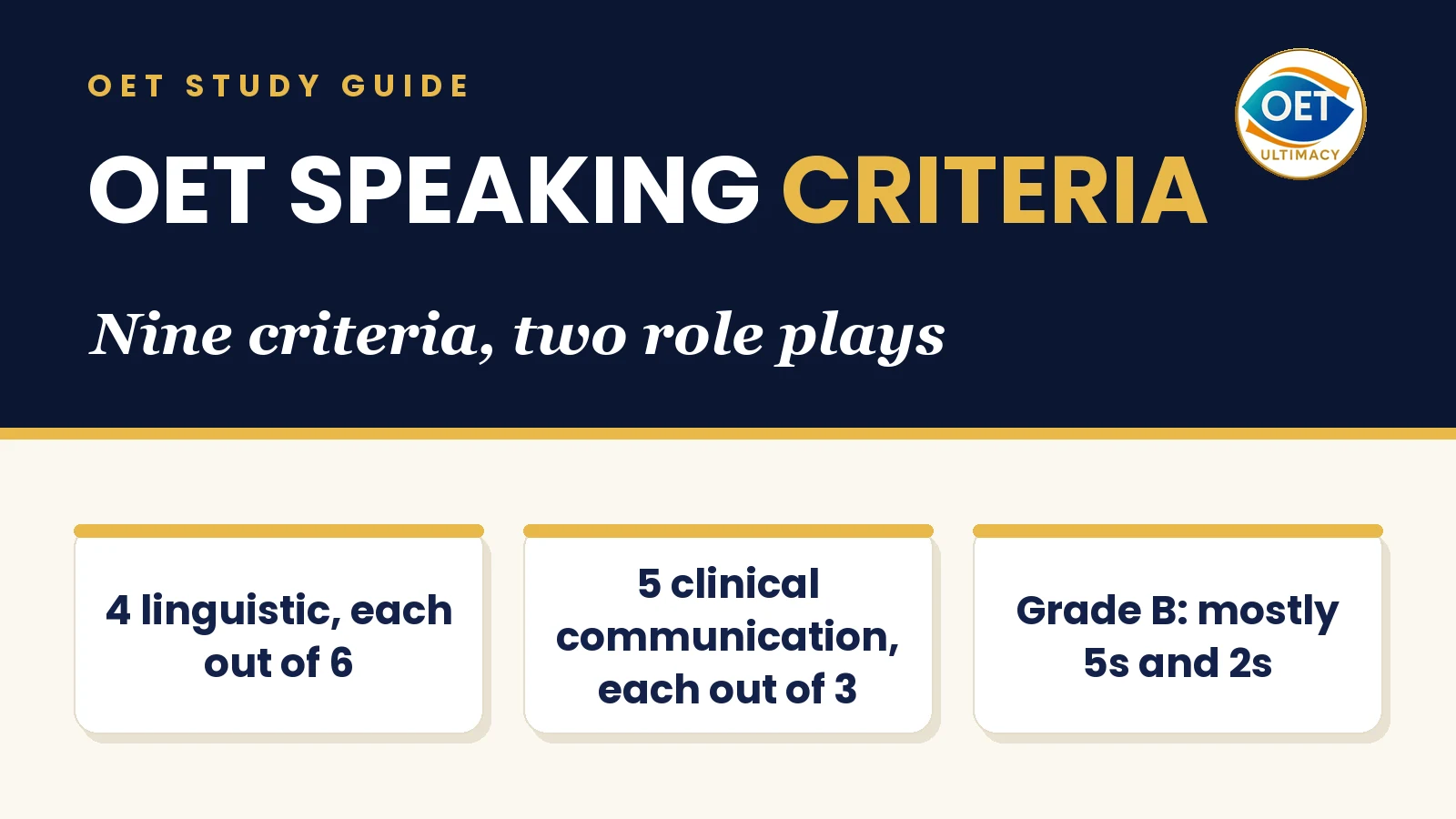
Short answer: OET Speaking is marked on nine criteria. Four are linguistic (Intelligibility, Fluency, Appropriateness of language, Resources of grammar and expression), each scored out of 6, and five are clinical communication (Relationship building, Understanding and incorporating the patient's perspective, Providing structure, Information gathering, Information giving), each scored out of 3. OET says two official assessors score your two role plays from the recording. It also says a grade B candidate scores mostly 5 out of 6 on the linguistic criteria and 2 out of 3 on the clinical communication ones, and that you will not be evaluated on your medical knowledge.
What are the nine OET Speaking criteria?
They fall into two groups, and both are judged from how you speak with the patient in the role plays. As of November 2026, OET's Test Handbook 2026 lists them like this:
| Criterion | Group | Scored out of | What the assessor listens for |
|---|---|---|---|
| Intelligibility | Linguistic | 6 | Pronunciation, stress, intonation and rhythm, and how much effort your accent costs the listener |
| Fluency | Linguistic | 6 | The speed and flow of your speech: pauses, repetition, restarts, fillers |
| Appropriateness of language | Linguistic | 6 | Register and tone that suit the patient, and medical matters explained in lay terms |
| Resources of grammar and expression | Linguistic | 6 | The range and accuracy of your grammar and vocabulary |
| Relationship building | Clinical communication | 3 | Your opening, a respectful and non-judgemental manner, empathy |
| Understanding and incorporating the patient's perspective | Clinical communication | 3 | Finding out the patient's ideas, concerns and expectations, and answering them |
| Providing structure | Clinical communication | 3 | A logical order, signposting each new topic, organised explanations |
| Information gathering | Clinical communication | 3 | Open questions first, active listening, clarifying and summarising |
| Information giving | Clinical communication | 3 | Finding out what the patient knows, pausing, checking understanding |
The plain-language column is our summary of OET's level descriptors and criteria glossary. OET's published grid is one document for all professions, and its handbook says the role plays are tailored to your profession, as our OET Speaking test guide explains with the timings.
How do the nine criteria become a Speaking score?
The session is recorded, and OET says on its Speaking page that the audio is assessed by two official OET assessors. They score your two role plays only; OET's post on common Speaking questions says the ID check, the warm-up and your 3 minutes of preparation are not rated.
The handbook then says the criterion scores "are combined and converted to the 500 scale", reported in steps of 10 (OET Test Handbook 2026). The handbook does not explain how the conversion works, so a chart that turns criterion bands into an exact score is someone's estimate.
What OET does publish is the profile of a grade B. Its Speaking page says candidates who secure grade B "will have achieved predominantly scores of 5 out of 6" on the linguistic criteria and 2 out of 3 on the clinical communication criteria. Note the word "predominantly": it describes a typical B, not a rule that every criterion must hit that number.
| Grade | Score out of 500 |
|---|---|
| A | 450 to 500 |
| B | 350 to 440 |
| C+ | 300 to 340 |
| C | 200 to 290 |
Source: OET Test Handbook 2026, as of November 2026. The grade you need depends on the body you are applying to; our OET scores and grades guide shows which body accepts what.
What do the four linguistic criteria reward?
A typical grade B has 5s on these criteria, so this section compares band 5 with band 4. The wording comes from OET's level descriptors, summarised in our words.
Intelligibility. At 5 you are easily understood, and a few pronunciation slips or a noticeable accent cause the listener minimal strain. At 4 you are easily understood most of the time, but at times the listener has to work. A first-language accent is expected; OET's glossary frames the question as how much strain it causes, and at band 6 the accent has no effect on being understood.
Fluency. At 5 you speak at normal speed, with only occasional repetition or self-correction. At 4 the flow is uneven, especially in longer sentences, with some searching for words, or speech that comes out too fast, too slow or in bursts.
Appropriateness of language. At 5 your register, tone and word choice are mostly right for the patient, and the odd lapse does not intrude. At 4 they are generally appropriate but restricted, and the lapses are noticeable. At 6, OET adds, you have no difficulty at all explaining technical matters in lay terms. Compare two ways of giving the same news:
- "You have stage 1 hypertension, which raises your cardiovascular risk." (correct, but written for a colleague)
- "Your blood pressure has been higher than it should be at three visits. Over the years, that extra pressure can strain your heart and blood vessels." (the same fact, in words the patient can use)
Resources of grammar and expression. At 5 you use a wide range of grammar and vocabulary, generally accurately, and occasional errors do not intrude. At 4 you have enough to keep the conversation going and your meaning is generally clear, but errors in complex sentences are sometimes intrusive.
Two of these criteria cannot be shown on a page. Intelligibility and fluency live in the sound of your voice, which is why reading model answers does little for them and recording yourself does a lot.
What are the clinical communication indicators?
Each clinical communication criterion is a short list of behaviours, 20 in all, and the assessor rates how well you use them on a four-point scale: 3 adept, 2 competent, 1 partially effective, 0 ineffective (level descriptors). OET numbers them by letter, and here they are in our words:
| Criterion | OET's indicators |
|---|---|
| A. Relationship building | A1 opening well (greeting, introducing yourself, the purpose of the talk); A2 an attentive, respectful attitude; A3 a non-judgemental approach; A4 empathy for the patient's feelings or situation |
| B. Patient's perspective | B1 drawing out the patient's ideas, concerns and expectations; B2 picking up the patient's cues; B3 linking your explanations to what the patient told you |
| C. Providing structure | C1 a purposeful, logical order; C2 signposting changes of topic; C3 organising your explanations |
| D. Information gathering | D1 letting the patient tell their story, listening actively, few interruptions; D2 open questions first, then closed ones; D3 no compound or leading questions; D4 clarifying anything vague; D5 summarising so the patient can correct you or add more |
| E. Information giving | E1 finding out first what the patient already knows; E2 pausing and using the response to guide what comes next; E3 inviting the patient's reactions and feelings; E4 checking understanding; E5 finding out what else the patient wants to know |
OET's clinical communication guide explains each indicator at length, with example language. It is worth reading once, slowly, before you practise.
What does each indicator sound like in a role play?
Here is one short consultation written by us for this guide, with each line tagged to the indicator it shows. The card is invented: Mr Tom Reeves, 48, has had raised blood pressure at three clinic visits. The doctor's task is to explain the readings and discuss treatment. What the card does not say is that his father had a bad reaction to blood pressure tablets.
| What the doctor says | Indicator |
|---|---|
| "Good morning, Mr Reeves. I'm Dr Patel, one of the doctors here. I understand you've come to talk about your blood pressure readings. Is that right?" | A1 |
| "Before we look at the numbers, how have you been feeling since your last visit?" | D2, D1 |
| (Patient: "Fine, I suppose. I just hope this doesn't mean tablets.") "You mentioned tablets. It sounds as if they're on your mind. What worries you about them?" | B2, B1 |
| (Patient explains his father's reaction.) "That must have been hard to watch." | A4 |
| "When you say he reacted badly, what happened exactly?" | D4 |
| "So, let me check I have this right. You've had no headaches or chest pain, and your main worry is that tablets might make you unwell, as they did your father. Is that correct?" | D5 |
| "Can I ask what you already know about high blood pressure?" | E1 |
| "Now I'd like to explain what your readings mean, and then we can talk about what might help." | C2 |
| "There are two parts to this. First, changes to salt, activity and alcohol. Second, a tablet, if those changes aren't enough on their own." | C3 |
| "Many people find cutting down on salt harder than they expected, so let's look at what would work for you." | A3 |
| "You said side effects are your main worry, so let me explain how we'd keep an eye on them." | B3 |
| "How does that sound so far?" | E2, E3 |
| "Just so I know I've explained it clearly, could you tell me in your own words what we've agreed?" | E4 |
| "Is there anything else you'd like to know before you go?" | E5 |
Two habits would cost marks under D3. "Do you smoke or drink, and do you exercise?" is a compound question: the patient answers one part and the rest is lost. "You don't smoke, do you?" is a leading question that invites the answer you want. Ask one thing at a time, without steering.
Notice that none of these lines needs medical knowledge beyond the card. They are the moves OET describes, and even a candidate with excellent English has to show them to score well on the clinical communication criteria.
Is medical knowledge part of the OET Speaking criteria?
No. OET's clinical communication guide says the clinical communication criteria are language-based and that you will not be evaluated on your medical knowledge; the four linguistic criteria are about your English. The card already gives you the clinical content; what is scored is how you deliver it.
Two related points come from OET's Speaking page. There is no penalty for not completing every element on the role card, although OET adds that the more of them you cover, the more evidence you are likely to give the assessors. And because the criteria reward responding to this patient, a memorised script works against you: OET's linguistic criteria guide advises you not to limit yourself to a few learned phrases.
Where is the official OET Speaking criteria PDF?
OET's criteria documents are PDFs linked from its Speaking page. As of November 2026 they are:
- Speaking assessment criteria and level descriptors: the two-page marking grid, with every band of the linguistic criteria and all 20 clinical communication indicators.
- Speaking assessment criteria glossary: what the terms in the grid mean.
- OET Speaking Guide Part 1: Linguistics and Part 2: Clinical Communication: longer explanations with advice and examples.
OET's short criteria overview post is a gentler start if you want the idea before the grid. To hear the criteria applied to real candidates, the graded recordings in our OET Speaking sample guide come with assessor comments on each criterion.
How can you practise against the criteria?
Practise one criterion at a time. Pick an indicator group, say information giving, do a role play, record it, then listen back only for E1 to E5. Next session, pick another group.
Our OET Speaking cards has 40 Medicine role-play cards, sorted by type (first visit, follow-up visit, after examination, emergency and breaking bad news), so you can run many conversations against the clock. Anyone can read a card; sign in to use the 3-minute preparation and 5-minute role-play timers and to show the patient's card to the person playing the patient. OET Study Partner matches you with another candidate if you need someone to play the patient. For an outside ear, Dr Ahmed Elgendy runs OET Speaking mock sessions, with an evaluation of each task, an overall rating and a projected score for each card.
Frequently asked questions
What score do I need in each OET Speaking criterion for a grade B?
OET says grade B candidates score predominantly 5 out of 6 on the four linguistic criteria and 2 out of 3 on the five clinical communication criteria. Grade B is 350 to 440 on the 0 to 500 scale. OET's handbook does not explain the exact conversion, so treat any criterion-by-criterion calculator as an estimate.
Are the OET Speaking criteria the same for every profession?
Yes, as far as OET's published material shows. Its Speaking criteria and level descriptors are one document for all professions. What changes is the role-play cards, which are written for the profession you booked.
Does my accent lower my OET Speaking score?
Not by itself. Intelligibility is about how much strain your pronunciation causes the listener, and OET's band 5 allows a noticeable first-language accent that does not get in the way of communication. Work on stress, rhythm and the clarity of key words rather than trying to sound like a native speaker.
Who marks OET Speaking?
OET says two official OET assessors listen to the recording of your session and score it. They rate only the two role plays, not the ID check, the warm-up or your preparation time.
Is there an OET Speaking criteria checklist?
OET's level descriptors work as one. The 20 clinical communication indicators (A1 to E5) are a ready-made list of behaviours, and you can turn them into a page of tick boxes to use when you listen back to a recording. OET's glossary explains each term in the grid.
Is medical knowledge assessed in OET Speaking?
No. OET says the clinical communication criteria are language-based and that your medical knowledge is not evaluated. The role-play card gives you the clinical content, and the assessors score how you explain it to the patient.
Can I use memorised phrases in OET Speaking?
Short, flexible phrases for signposting or checking understanding are fine, but OET advises against relying on a few learned phrases. The criteria reward listening and responding to the patient in front of you, which a fixed script cannot do.
OET Ultimacy is an independent OET preparation provider and is not affiliated with OET or Cambridge Boxhill Language Assessment. Test rules, fees and requirements can change, so always check oet.com and the body you are applying to.