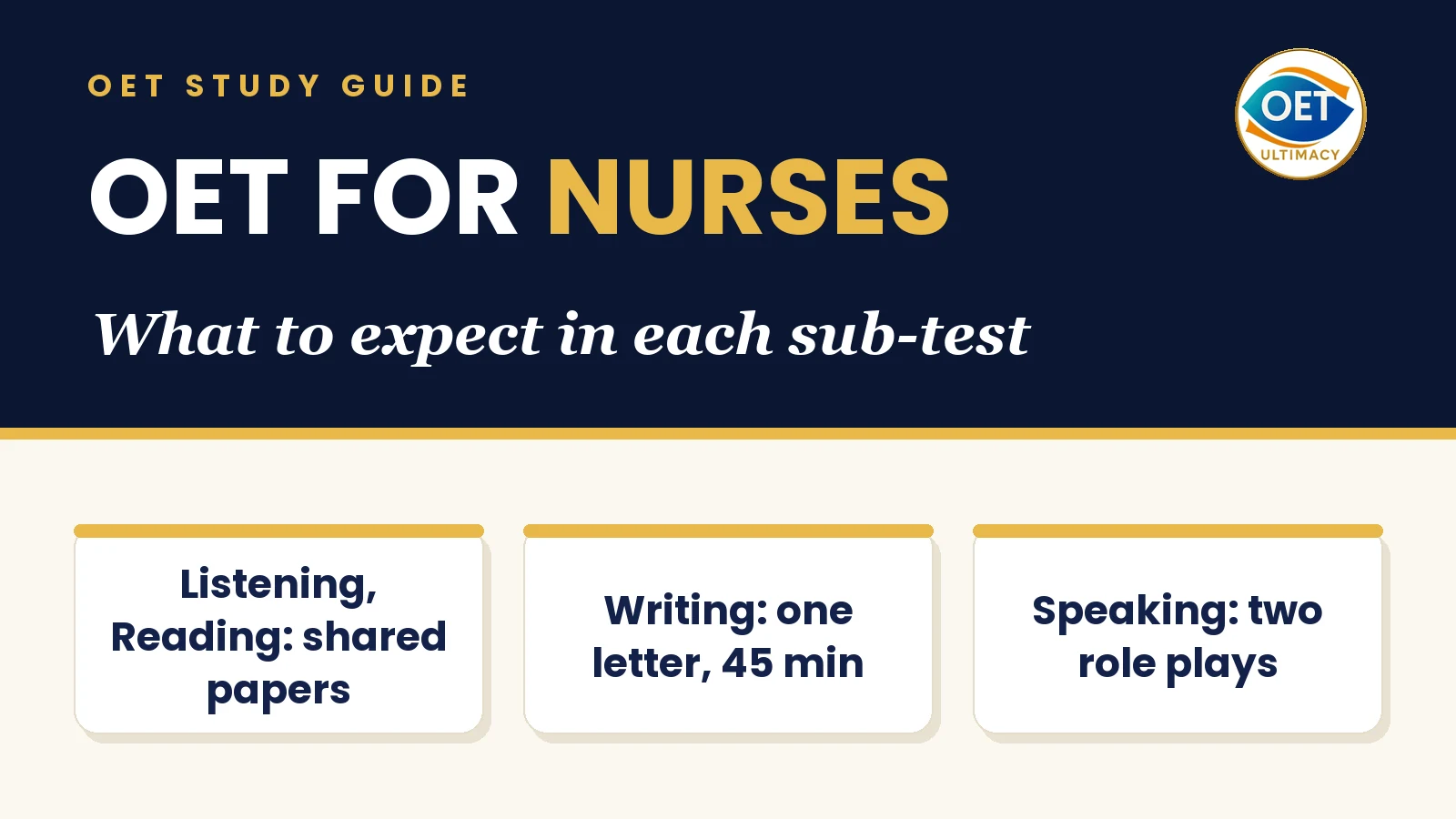
Short answer: Nurses book OET Nursing. Half of it is shared: OET Listening and OET Reading are the same papers for all 12 professions. The other half is written for nurses: in OET Writing you turn a patient's case notes into one letter, often a discharge or referral letter, in 45 minutes, and in OET Speaking you play the nurse in two role plays of about 5 minutes each. Below is a short discharge task and a ward role card that we wrote as examples, and a plan for the first week of preparation.
Which parts of OET are written for nurses?
Writing and Speaking. The OET Test Handbook 2026 says Listening and Reading are the same for all candidates, regardless of profession, and that Writing and Speaking are specific to the profession you book. When you register you choose Nursing, and that choice decides which case notes and role cards you get on the day.
So a nurse sitting OET Listening hears the same consultation extracts and workplace talks as a physiotherapist or a dentist, and answers the same 42 questions. If you want the detail of that shared half, our guide Is OET the same for every profession? goes through it sub-test by sub-test.
What will a nurse face in OET Listening and Reading?
General healthcare material that any of the 12 professions could follow. OET Listening has three parts and lasts about 40 minutes; OET Reading has three parts in 60 minutes, and Part A has a strict limit of 15 minutes. Neither paper asks for nursing knowledge. The answers come from what is said or written.
In Listening Part A you can understand every word and still lose marks on spelling. OET explained in one of its live sessions that a common word any healthcare professional should know, gallbladder for example, is marked wrong if it is misspelt, even by one letter, and OET says Part A uses common, known words. British and American spellings are both accepted, but OET's letter layout article says consistency is key, so keep to one style for the whole exam. The Listening Part A section on our site lets you hear Part A words, type them and get an instant spelling check.
What letter does a nurse write in OET Writing?
One letter, from a page of case notes about a single patient, with 5 minutes of reading time and 40 minutes of writing time. OET's article on letter layout gives a guided range of 180 to 200 words. For nurses, OET's article Which English test should a nurse take? names a referral letter or a discharge letter, and the handbook says you write to another healthcare professional or to a person related to the patient's care. OET's own example in that article is a letter to a senior nurse who will be responsible for the patient's continued care at a nursing home.
Here are case notes we invented for this guide. They are not taken from any OET paper.
- Patient: Mr Peter Walsh, 79, retired bus driver
- Admitted: 12 November, cellulitis of the left lower leg after a skin tear on the shin
- Treatment: IV antibiotics for 4 days; now oral clindamycin 300 mg four times a day until 22 November (penicillin allergy: rash)
- Wound: 3 cm skin tear, left shin, non-adherent dressing, change every 2 days
- Other: type 2 diabetes on metformin; enjoys gardening and watching football
- Social: lives with his wife, who has early dementia; daughter visits at weekends
- Mobility: walks with a stick, unsteady on stairs
- Discharge: 18 November, home
- Task: Write to Ms Grace Ellis, District Nurse, Riverside Community Nursing Team, who will continue his care at home.
The marks start before you write a word, when you decide what the district nurse needs. A simple way to check yourself is to sort every note into keep or leave out, with a reason.
| Note | Keep or leave out | Why |
|---|---|---|
| Skin tear, dressing type, change every 2 days | Keep | It is the main task she will carry out |
| Clindamycin dose and end date | Keep | She can check he finishes the course |
| Penicillin allergy | Keep | It affects any future antibiotic |
| Type 2 diabetes | Keep, briefly | It slows wound healing, so she will watch the leg |
| Wife with early dementia | Keep | He may get less help at home than she expects |
| Unsteady on stairs | Keep | A fall risk in the home she will visit |
| Retired bus driver, gardening, football | Leave out | Nothing here changes his care |
That judgement is what OET's Content and Conciseness and Clarity criteria look at. There are six Writing criteria in all, and our OET Writing criteria guide explains each one.
An opening we wrote for this case:
Dear Ms Ellis,
Re: Mr Peter Walsh, aged 79
Mr Walsh is being discharged home today after treatment for cellulitis of his left lower leg, and I am writing to ask you to continue his wound care and to monitor him until his course of oral antibiotics finishes on 22 November.
The reader knows in one sentence who the patient is, why he is coming home and what you are asking her to do.
What happens in a nurse's OET Speaking role play?
You get a role card, 3 minutes to prepare, and about 5 minutes to talk with an interlocutor who plays the patient, or a relative or carer. You do this twice, and the whole Speaking sub-test, with a short warm-up first, takes about 20 minutes. The handbook says each card is written for your profession and gives you the setting, some background and a list of task prompts.
A card we wrote as an example:
Setting: Orthopaedic ward
Nurse: Mrs Dana Brooks, 70, had a right hip replacement yesterday. The physiotherapist wants her to take her first walk with a frame this afternoon, but she refuses to get out of bed.
- Find out why she does not want to walk today.
- Explain why getting up early after the operation helps her recovery.
- Respond to her fear that walking will dislocate the new hip.
- Offer pain relief before the walk and explain how it will be timed.
- Agree a plan for the afternoon and check that she is happy with it.
It is tempting to go straight to persuading her. The first prompt asks for something else: find out what worries her. Two of OET's five clinical communication criteria are about exactly this, understanding the patient's perspective and gathering information, and the criteria glossary describes them. If Mrs Brooks says she is frightened because a neighbour's hip "popped out", your explanation of hip precautions has something to answer. Without that, the same explanation sounds like a lecture. Our OET Speaking criteria guide covers all nine criteria.
Which regulators ask nurses for OET?
In the UK, the NMC asks for grade B in Listening, Reading and Speaking and grade C+ in Writing. In Ireland, NMBI asks for the same grades from OET (Nursing), accepts only one test result, not a combination, wants results less than two years old and does not accept OET@Home, so Irish applicants should book a test at a venue (both checked November 2026). Australia, New Zealand and the other bodies set their own numbers, and all of them sit in one table in our OET scores and grades guide. For UK registration in detail, including combining two sittings for the NMC, see our OET UK guide.
How should a nurse spend the first week?
Spend the first day finding out where you stand, and the next six on your lowest sub-test. Every nursing regulator named above sets a minimum for each of the four sub-tests, so the weakest one decides whether you pass.
Day 1. Sit one timed attempt at each sub-test: an official OET Nursing sample test, or our mocks for Listening and Reading. For Writing, use a nursing case note and the full 45 minutes. For Speaking, record yourself on one card with a 3-minute preparation. Do not judge by feel; judge by the marks.
Then, for days 2 to 7, follow the path for the sub-test that scored lowest. These are plans we suggest, about an hour a day.
If Listening is lowest: on day 2, sort every wrong answer into misheard, missed or misspelt. Spend twenty minutes on Part A words with a spelling check on days 3 and 5, and on day 4 do one Part B section and then read its transcript. On day 6, take one Part C extract and stop after each question to say why the other options were wrong. A second full mock on day 7 shows how far you have moved since day 1.
If Reading is lowest: on day 2, find the exact line that decides each question you got wrong. Do Part A on its own with a strict 15-minute timer on days 3 and 6, Part B with no time limit and a review on day 4, and one Part C text on day 5. Finish with a second full mock on day 7.
If Writing is lowest: mark your day 1 letter against the six criteria on day 2, then rewrite it on day 3, fixing the weakest criterion only. On day 4, take a new case note and spend 5 minutes on a keep or leave out list like the one above, without writing the letter; write that letter in 40 minutes on day 5. Compare it with a sample answer where one exists on day 6. For day 7, write a third letter of a different type, for example a transfer if you have only written discharges.
If Speaking is lowest: listen to your recording on day 2 and score it against the nine criteria, then record the same card again on day 3, working on your two weakest criteria. Use new cards in different settings (ward, community, clinic) on days 4 and 5, and do two cards back to back on day 6, as in the real test. On day 7, repeat day 1's card and compare the two recordings.
At the end of the week, sit the lowest sub-test again. If it has caught up, move to the next lowest.
Where can nurses practise for OET Nursing?
For Writing, our OET Writing practice has 14 Nursing case notes (as of November 2026): 6 referrals, 4 discharges, 2 transfers, 1 update and 1 urgent referral, five of them with a sample answer. For the shared half, start with your first OET Listening mock and your first OET Reading mock, and keep your Part A spelling sharp in the Listening Part A section. Our Speaking role cards are written for doctors, so for nursing cards use OET's own Nursing sample tests, and practise the role plays with a partner you can find through our OET study partner page.
Frequently asked questions
Is OET only for nurses?
No. OET is offered in 12 healthcare professions, from Dentistry to Veterinary Science, and Nursing is one of them. Listening and Reading are shared by all 12, and Writing and Speaking change with the profession you book.
What OET grades does a nurse need for the NMC?
Grade B (350 or above) in Listening, Reading and Speaking, and grade C+ (300 or above) in Writing. The NMC's language guidance lets you combine two sittings taken within 12 months of each other, as long as you sat all four sub-tests both times, and your results must be no more than 2 years old when it considers your complete application.
Can a nurse combine results from two OET sittings?
It depends on the regulator. The NMC accepts two sittings within 12 months, with all four sub-tests taken each time. Across the two you need B in Listening, Reading and Speaking and C+ in Writing, and neither sitting may fall below C+ in Listening, Reading or Speaking or below C in Writing. NMBI in Ireland accepts only one test result. Check the rule of the body you are applying to before you plan a second attempt.
Is there a separate OET for midwives?
No. Midwifery is not one of OET's 12 professions, and the NMC says applicants to its register should choose the Nursing version of OET. Midwives therefore sit the same Nursing Writing and Speaking tasks as nurses.
Does OET Nursing test my clinical knowledge?
Not directly. Listening and Reading answers come from the recording or the text, and the six Writing criteria and nine Speaking criteria judge purpose, choice of content, language and communication. Your nursing experience helps you understand a case quickly, which leaves more of the 45 minutes for writing.
Which letter types should nurses practise for OET Writing?
OET names referral and discharge letters for nurses, written to another healthcare professional or to someone involved in the patient's care, such as a nurse at a care home. Our Nursing case notes also include transfer, update and urgent referral tasks, so practise more than one type before the test.
How long is the OET exam for nurses?
About 2 hours 45 minutes of test time, the same as every other profession: about 40 minutes of Listening, 60 minutes of Reading, 45 minutes of Writing and about 20 minutes of Speaking.
OET Ultimacy is an independent OET preparation provider and is not affiliated with OET or Cambridge Boxhill Language Assessment. Test rules, fees and requirements can change, so always check oet.com and the body you are applying to.