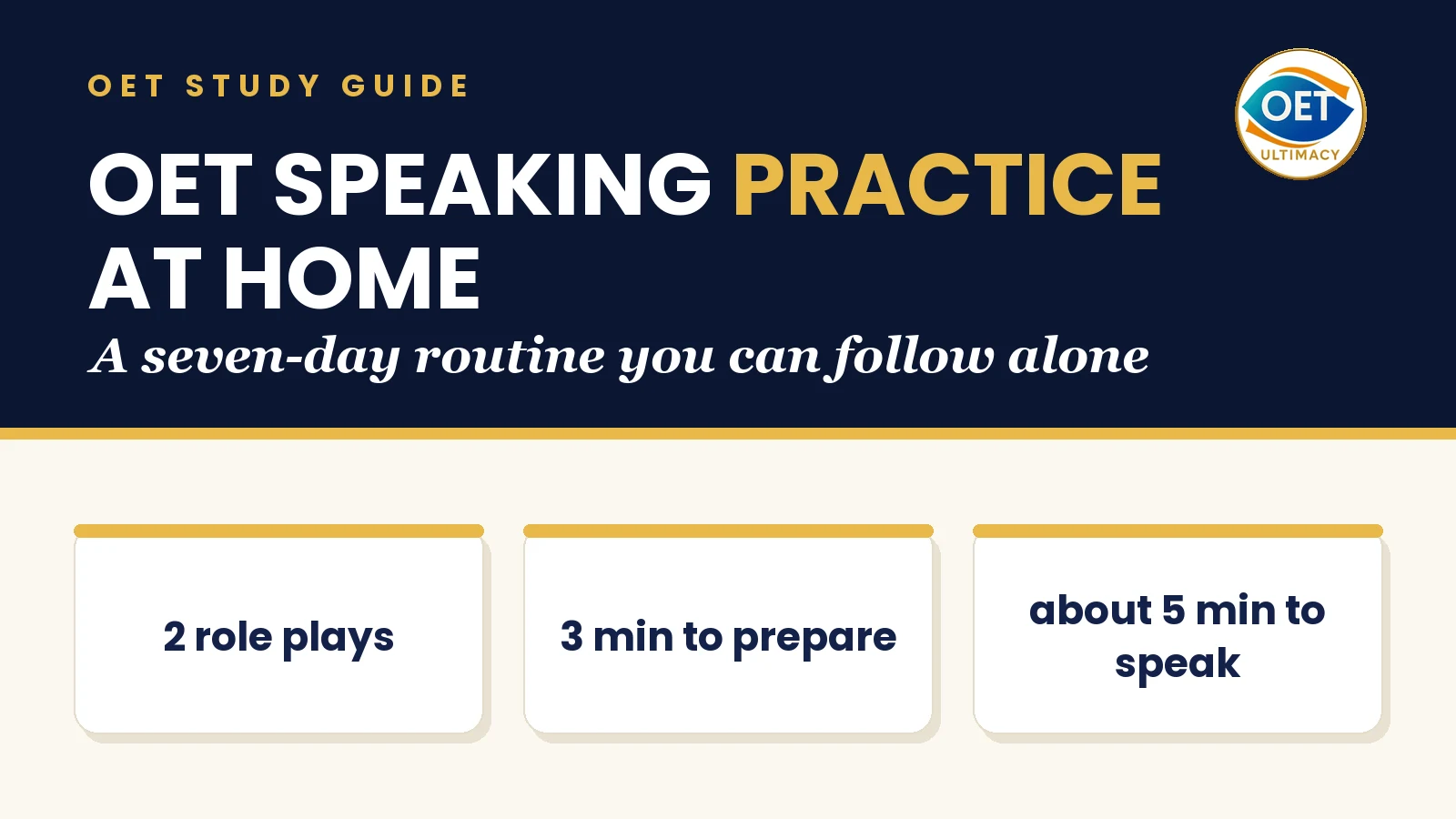
Short answer: you can do most OET Speaking practice alone if you record yourself and review the recording against OET's nine criteria. A good week has five short practice days and one full timed mock: two role plays, each with 3 minutes to prepare and about 5 minutes to speak, as in the real test. Spend the other days on reading cards, turning medical terms into plain English, shadowing a clear speaker and listening back to yourself. Add a partner or a teacher for the one thing you cannot do alone: a patient who answers back.
Can you practise OET Speaking on your own?
Mostly, yes. OET Speaking is a conversation with an interlocutor who plays the patient, a relative or a carer, (OET Test Handbook 2026), and the session is recorded and scored later by two OET assessors (OET Speaking). Of the nine criteria, the four linguistic ones (Intelligibility, Fluency, Appropriateness of language, Resources of grammar and expression) are about how your English sounds and is built, and you can hear all four in your own recording. OET's own Speaking Guide Part 1 makes a related point: recording yourself is a good way to check your speech and see whether you overuse fillers.
The five clinical communication criteria are harder alone, because they reward how you respond to this patient: picking up a worry, asking the next question from their answer, checking they understood. A recording shows whether you did those things at all. It cannot surprise you the way a real person can. That is why this routine keeps one session a week for a partner, and why our OET speaking partner guide explains how to run that session.
Solo practice also has one blind spot: you cannot hear the mistakes you do not know are mistakes. If the same recording sounds fine to you every week and your mock scores do not move, that is the moment to get an outside ear.
What does a week of OET Speaking practice look like?
Here is the routine we suggest, built around the real timings of the test. OET itself advises timing both your preparation and your role plays to simulate test conditions (OET on the three preparation minutes). Each day takes 30 to 45 minutes. Move the days around your shifts; keep the order roughly the same.
| Day | Focus | What you do | Time |
|---|---|---|---|
| 1 | Reading cards | Read four new role-play cards, 3 minutes each. For each, say aloud your opening line and the order you will cover the tasks in. No full role play yet. | 30 min |
| 2 | One recorded role play | Take one of yesterday's cards. Prepare for 3 minutes, then speak for 5 minutes to an empty chair, with your phone recording. Do it once more on a second card. | 30 min |
| 3 | Listen back | Review Day 2's two recordings with the three-pass sheet below. Write down the two habits you most want to fix. | 40 min |
| 4 | Plain English | Take the medical terms from this week's cards and explain each one in two short sentences a patient could repeat. Record yourself. | 30 min |
| 5 | Shadowing | Listen to a clear model speaker, such as one of the videos on OET's Speaking page, for one or two minutes, then play it again and speak along a moment behind, copying stress and rhythm. Finish by recording one role play again. | 30 min |
| 6 | Full mock | Two role plays back to back under exam timing, ideally with a partner playing the patient. Record it. | 45 min |
| 7 | Rest and plan | Listen to the Day 6 recording once, start to finish, without stopping. Pick next week's two habits. | 20 min |
Two habits at a time is deliberate. A recording usually shows ten things to fix, and trying to fix all ten in one role play tends to make your speech slower and less smooth, and speed and smoothness are exactly what the Fluency criterion listens for.
How do you review your own recording?
Listen three times, and listen for one layer each time. Trying to judge everything at once means you hear nothing clearly. The layers follow OET's two groups of criteria, which our OET Speaking criteria guide explains band by band.
| Pass | Listen for | What to note | Criteria it trains |
|---|---|---|---|
| 1. The sound | Long pauses, "um" and "er", restarts, words you swallowed or stressed on the wrong syllable | Count fillers in one minute; mark any word you had to replay to understand | Intelligibility, Fluency |
| 2. The words | Medical terms you used without explaining, a tone too formal or too casual for the patient, grammar slips that change the meaning | Write each unexplained term and the plain version you should have used | Appropriateness of language, Resources of grammar and expression |
| 3. The conversation | Did you introduce yourself and the purpose? Ask an open question first? Ask about the patient's worry? Signpost each new topic? Check the patient understood before you finished? | A yes or no for each question | The five clinical communication criteria |
Keep the notes in one place, week after week. The point of a log is to see whether last week's two habits have gone. If Pass 1 shows fewer fillers each week, the routine is working.
How do you practise the patient's side when you are alone?
Write the patient's lines before you start. While you prepare a card, take 30 seconds to write three things the patient might say on separate slips of paper: one worry, one question and one objection. Turn them face down. During the role play, stop after any task, pick a slip at random, read it aloud and answer it.
Here is how that looks on a card we invented for this guide. A nurse is asked to explain to Mrs Joan Hale, 67, how to use a new inhaler for her chronic obstructive pulmonary disease (COPD) and to make sure she can use it before discharge.
| Slip | What the patient says | What a good answer does |
|---|---|---|
| Worry | "My sister used one of these and it made her heart race." | Acknowledges the worry, asks what happened, then explains what to look out for |
| Question | "Do I need to rinse my mouth every time?" | Answers it plainly and checks she has understood |
| Objection | "I'd rather just keep my old tablets, to be honest." | Asks what worries her about the change before giving any reasons |
The slips give you two things a silent rehearsal does not. You have to change direction in the middle of your plan, and you have to answer what was said rather than what you prepared. Both are what the clinical communication criteria reward.
If you practise on our OET Speaking cards, signing in lets you reveal the interlocutor's card for each role play. Read it after your attempt, never before, and use it to check which of the patient's concerns you missed.
What does the plain English drill sound like?
Take one term a card is likely to contain and say it the way a patient would understand it, in two sentences. Here are two lines we wrote for the inhaler card above:
- "Your lungs have become narrower over time, which is why you get short of breath when you walk." (instead of "you have chronic airflow obstruction")
- "This inhaler opens up your airways for several hours, so it is best used at the same time each morning." (instead of "this is a long-acting bronchodilator taken once daily")
Record each line, then play it back and ask one question: could a 67-year-old with no medical training repeat it to her daughter? If not, make it shorter. OET's own description of the appropriateness criterion rewards explaining technical matters in lay terms (level descriptors), so this drill is time well spent.
When should you add a partner or a teacher?
Add a partner as soon as you can, for the Day 6 mock at least. OET also suggests practice role plays with a study partner or mentor (Take control in the OET Speaking sub-test). A partner plays the patient with their own words, keeps the time and tells you where you lost the thread. OET Study Partner on OET Ultimacy matches you with another candidate who sits OET around the same time as you.
Add a teacher when your own recordings stop teaching you anything new. Signs to watch for: the same two habits appear on your list for three weeks in a row, or your recordings sound fine to you but your partner keeps pointing at the same problem. Dr Ahmed Elgendy runs OET Speaking mock sessions with an evaluation of each task and a projected score for each card.
Where can you practise OET Speaking at home?
Our OET Speaking cards has 40 Medicine role-play cards, grouped as first visit, follow-up visit, after examination, emergency and breaking bad news, so you can pick a different type each week. Anyone can read a card. Sign in to use the 3-minute preparation and 5-minute role-play timers and to reveal the interlocutor's card. If you sit OET in another profession, OET's Test Handbook 2026 says its sample tests cover all four sub-tests for every profession, and its Speaking sample tests page links to that library and to two Speaking guides with real candidate role plays. Our our OET Speaking sample guide explains where the graded recordings are. OET also suggests (OET on the three preparation minutes) making your own practice cards from cases at work: note a few details of a patient's background and treatment plan, leaving out anything that could identify them.
Frequently asked questions
How can I practise OET Speaking alone?
Record yourself doing full role plays on real-format cards, with 3 minutes to prepare and about 5 minutes to speak. Then listen back three times: once for the sound, once for the words and once for the structure of the conversation. Write the patient's likely worries on slips of paper and answer them at random, so you practise reacting rather than reciting.
How do I start preparing for OET Speaking?
Read OET's Speaking criteria first, so you know what the assessors listen for. Then read a few role-play cards and say your opening line and plan aloud for each one before you try a full role play. Record your first attempt and keep it; comparing it with a recording a few weeks later shows you what has changed.
Is OET Speaking difficult?
It asks for two things at once: clear English, and clinical communication habits such as asking open questions first and checking the patient understood, which are easy to skip under time pressure. OET's clinical communication guide says you will not be evaluated on your medical knowledge, so the work is in how you talk to the patient. Regular recorded practice is what turns those habits into reflexes.
How many role plays should I practise each day?
On most days, one or two role plays is enough if you review them properly. Reviewing a recording teaches you more than doing three new role plays without listening back. Once a week, do two back to back under exam timing, as in the real test.
Can I practise OET Speaking online?
Yes. You can read role-play cards and use exam-style timers on our OET Speaking cards page, and practise with another candidate by video call. If you will sit OET Speaking at home, practise at least some role plays on camera so the format feels normal on the day.
Does recording yourself help in OET Speaking?
Yes, because the real test is assessed from a recording. Listening back is the only way to hear your own pauses, fillers and unexplained medical terms the way an assessor will. Keep each week's recording so you can compare them over time.
Is there OET Speaking practice for my profession?
OET Speaking role plays are written for your profession, so practise on cards from it where you can. Our OET Speaking cards are Medicine cards, and OET publishes sample tests for every profession. The review method in this guide works the same way for every profession.
OET Ultimacy is an independent OET preparation provider and is not affiliated with OET or Cambridge Boxhill Language Assessment. Test rules, fees and requirements can change, so always check oet.com and the body you are applying to.