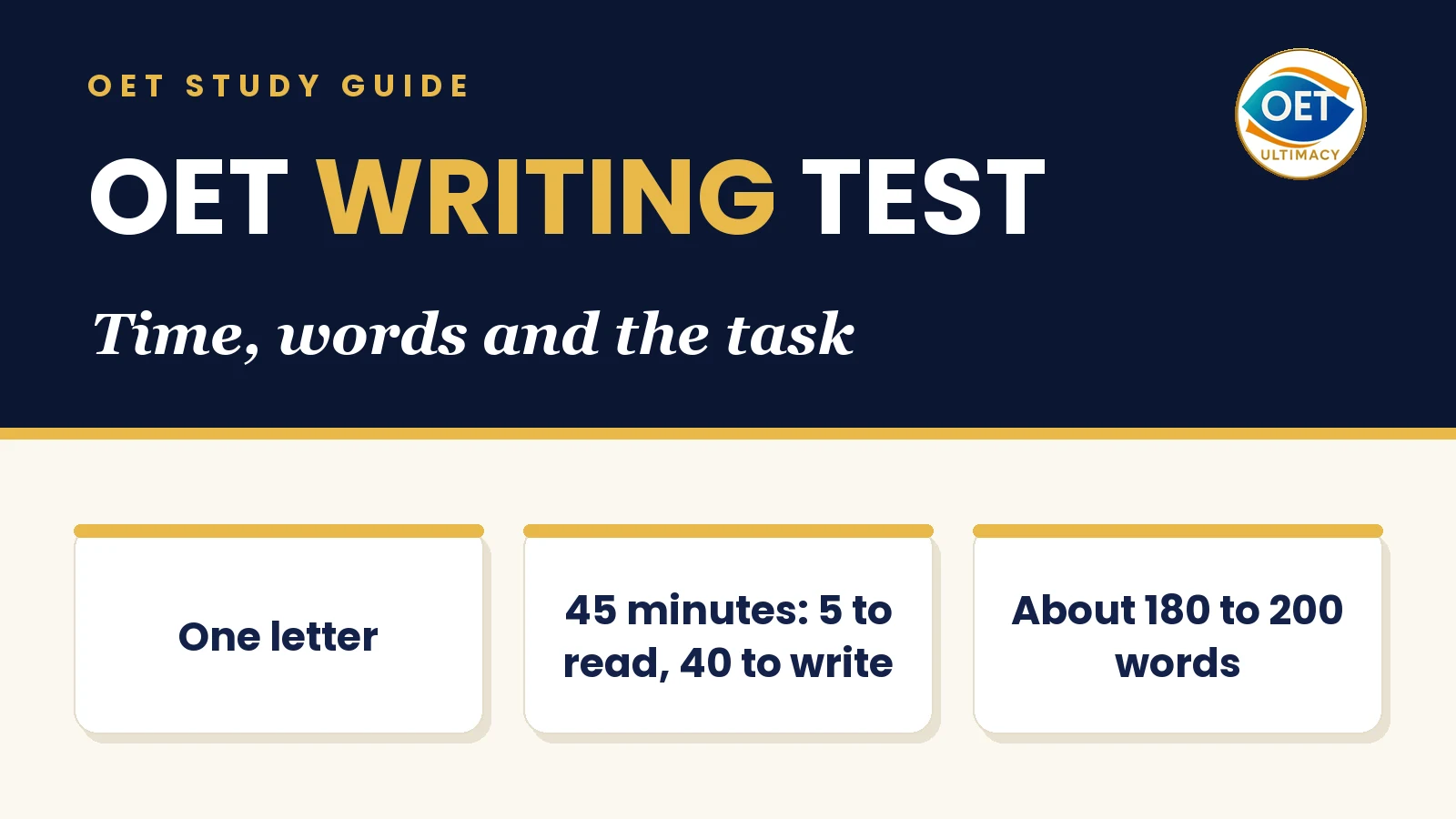
Short answer: The OET Writing test is a single task: you write one letter from a set of case notes. It lasts 45 minutes, made up of 5 minutes of reading time and 40 minutes of writing time, and OET's guide for the body of the letter is about 180 to 200 words. The task is written for your own profession and is most often a referral, discharge or transfer letter. Two OET assessors mark it against six criteria and you receive a score from 0 to 500, where grade B starts at 350.
What do you have to do in the OET Writing test?
Write one letter. The OET Test Handbook 2026 puts it in two sentences: "The Writing sub-test has one task. You write a letter to another healthcare professional, or to a person related to the patient's care, in response to a set of case notes outlining the patient's condition and need for further care or treatment."
Part A, Part B and Part C belong to Listening and Reading. The Handbook lists three parts for each of those and none for Writing, only the one task.
The Handbook lists what you are given: background information on the context, case notes or other documents from your profession, and the task instructions. The task tells you who you are writing to and why. OET's Writing guide gives this example of a task: "write a letter of referral to Dr Smith, an endocrinologist at City Hospital, for further management of Mrs Sharma's sugar levels" (Ultimate Guide to OET Writing). What the case notes contain, section by section, is covered in our guide to OET Writing samples.
How do the 45 minutes of OET Writing run?
In two blocks, and the rules change between them.
| Clock | Block | What you may do |
|---|---|---|
| 0 to 5 minutes | Reading time | Read the task and the case notes. You cannot circle, underline or write anything. |
| 5 to 45 minutes | Writing time | Plan, write and check the letter. You can consult the task and the case notes at any point. |
Sources: the OET Test Handbook 2026 for the timing, OET's post on reading time for the first block and the OET Writing page for the second, as of November 2026.
The reading-time rule is strict. OET's post says that if you even have a pen or pencil in your hand, an invigilator is likely to tell you to put it down. So the 5 minutes are for finding the reader and the request, and for deciding which notes matter to that reader.
OET sets no split of the 40 minutes. Its Writing guide suggests finishing "with a few minutes to spare" so you can read the letter through as the reader would. For rough work on paper, OET says to use the blank page of the answer booklet, because only what you write on the lined paper is assessed (Ultimate Guide to OET Writing). On computer you can plan at the top of the answer box, and OET reminds you to delete that planning before you submit (OET on letter layout).
Which type of letter will you get?
Most often a referral, a discharge or a transfer letter. OET's layout post says the task is "usually a referral, discharge, or transfer letter" (OET on letter layout), and the Handbook gives a referral letter as its example of the task type. OET's Writing guide also warns that "not all tasks ask you to write a referral letter", so read the task before you write "I am writing to refer".
The reader is another healthcare professional or, in the Handbook's words, "a person related to the patient's care". For some professions it can be the patient (Ultimate Guide to OET Writing), and OET's criteria say the wording then has to suit them, with less medical jargon (Writing assessment criteria).
The mix differs a great deal between professions. Here is our own count of the 91 Writing cases in our practice section in November 2026, which covers all 12 OET professions. The labels are ours, and this is a count of one practice library, not a statistic about the real test.
| Letter type (our label) | Cases out of 91 |
|---|---|
| Referral | 37 |
| Update | 20 |
| Transfer | 9 |
| Discharge | 6 |
| Urgent referral | 6 |
| Request | 5 |
| Advice | 4 |
| Response | 4 |
In that library, 13 of the 18 Medicine cases and 7 of the 14 Nursing cases are referrals or urgent referrals. Dietetics, Radiography, Speech Pathology and Occupational Therapy have no referral at all among their 23 cases: theirs are mostly update letters, with some transfers and replies to another professional. If you sit one of the smaller professions, practise on your own profession's tasks. A referral model from Medicine will prepare you for the wrong letter.
How many words should an OET letter be?
About 180 to 200 words in the body of the letter. OET calls this a guide, and its Writing page says there is "no automatic penalty for writing over or under the word range" (OET Writing).
The count does not cover the whole page. OET's layout post says "only the body paragraphs are counted, starting with the opening paragraph and excluding addresses and closing sentences" (OET on letter layout). So the reader's address and your polite last line sit outside the 180 to 200.
To see how small that is, here is one way 190 words could fall in a referral letter. The split is our own illustration, not an OET rule:
| Paragraph | Words |
|---|---|
| Opening: who the patient is and what you are asking for | 30 |
| The current problem and the findings | 70 |
| Background the reader needs: history and medication | 45 |
| The request, in detail | 45 |
| Total | 190 |
Forty minutes for 190 words is under five words a minute, so the clock leaves room to think. Most of the work is choosing: the case notes hold more than the letter needs, and OET's guide says not all of them will be relevant (Ultimate Guide to OET Writing). On paragraphs, the same guide says there is no limit and you should use as many as you need, and the layout post adds that a well-structured letter typically has three to five.
Write in full sentences. OET's guide says the reminders printed towards the end of the case notes include "expand the relevant notes into complete sentences" and "do not use note form".
Is the OET Writing test different for each profession?
Yes. Writing is one of the two sub-tests written for your profession (Speaking is the other). The Handbook says "Nursing candidates complete Nursing Writing tasks, and Radiography candidates complete Radiography Writing tasks", and it lists 12 professions: Dentistry, Dietetics, Medicine, Nursing, Occupational Therapy, Optometry, Pharmacy, Physiotherapy, Podiatry, Radiography, Speech Pathology and Veterinary Science.
What stays the same for everyone is the frame: one letter, 45 minutes and the same six criteria. Which sub-tests are shared by all professions is set out in Is OET the same for every profession?.
The test is also the same on paper and on computer. The Handbook says all delivery modes "use the same test format and specifications and are marked to the same standard". On paper you write by hand, in pen or pencil as you prefer, and on computer you type into an answer box (Ultimate Guide to OET Writing). Our OET paper vs computer guide compares the two for Writing.
How is the OET Writing test marked?
Two OET assessors read your letter and score it on six criteria: Purpose, Content, Conciseness and Clarity, Genre and Style, Organisation and Layout, and Language (OET Writing). The scores are converted to the 0 to 500 scale used for every sub-test. Grade B is 350 to 440 and C+ is 300 to 340 (OET Test Handbook 2026). Which grade you need depends on the body you are applying to; the table is in OET scores and grades.
Spelling counts inside the Language criterion (Writing assessment criteria). British and American spellings are both accepted, but OET says "consistency is key" (OET on letter layout). Our advice is to choose one style and keep it for the whole exam. A good daily drill for spelling is our OET Listening Part A section, where you hear healthcare words, type them and see every wrong letter straight away.
Each criterion, with a weak and a strong line for it, is in OET Writing criteria.
Where can you try the OET Writing test under real timing?
Start with OET's own sample tests for your profession. After those, OET Writing practice on our site has 91 cases across all 12 professions, which you can filter by profession and letter type. Each one runs like the computer-based test: the case notes open for 5 minutes with the answer box locked, then the box unlocks for 40 minutes with a live word count while the notes stay on screen. You can open one Medicine case before you decide on a subscription; the rest come with Ultimacy Premium.
Frequently asked questions
What is OET Writing?
OET Writing is the sub-test where you write one letter from a set of case notes about a patient. It lasts 45 minutes and is written for your own profession. The letter goes to another healthcare professional or to a person related to the patient's care, and it is usually a referral, discharge or transfer letter.
How many letters do you write in OET Writing?
One. The OET Test Handbook says the Writing sub-test has one task, and that task is a single letter. There is no second letter.
Is there a Part A, B and C in OET Writing?
No. Parts A, B and C exist in OET Listening and OET Reading only. OET Writing has one task with no parts and no separate questions.
How long is the OET Writing test?
It is 45 minutes in total: 5 minutes of reading time, then 40 minutes of writing time. During the reading time you cannot write, underline or circle anything.
How many words is the OET Writing letter?
OET's guide is about 180 to 200 words for the body of the letter. Addresses and the closing sentence are not counted. OET says there is no automatic penalty for writing more or less than the range.
Can you look at the case notes while you write?
Yes. OET says you can consult the task and the case notes at any point during the 40 minutes of writing. So you do not need to memorise them in the reading time.
Do all professions get a referral letter in OET Writing?
No. OET says the task is usually a referral, discharge or transfer letter, and its Writing guide warns that not all tasks ask for a referral. In our own practice library, some professions have no referral cases at all, so practise on tasks for your own profession.
Can you write the OET letter in pen?
On the paper test, yes. OET says you can complete the Writing test in either pen or pencil, depending on your preference. Your handwriting is not assessed, but the assessor must be able to read it.
OET Ultimacy is an independent OET preparation provider and is not affiliated with OET or Cambridge Boxhill Language Assessment. Test rules, fees and requirements can change, so always check oet.com and the body you are applying to.