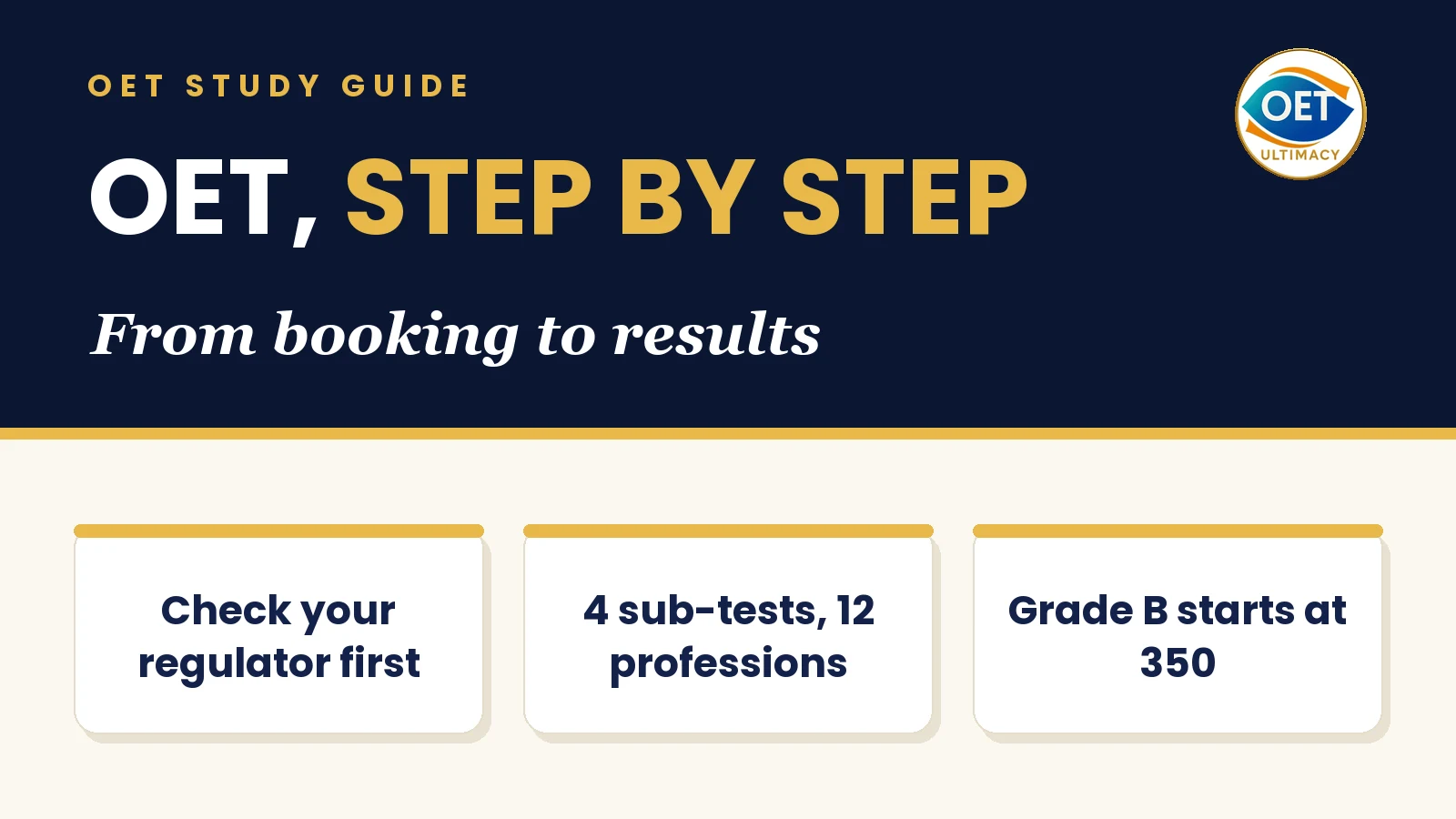
Short answer: OET is the English test for healthcare professionals, with four sub-tests (Listening, Reading, Writing and Speaking) and versions for 12 professions. The order that saves money and attempts is: confirm what your regulator asks for, choose a format and a date, learn the format of each sub-test, practise under real timing, sit the test, then compare your results with your regulator's rules. Each step below links to the guide that covers it in full.
OET in two lines
OET (the Occupational English Test) checks whether your English is good enough to work safely in a healthcare setting, and regulators in the UK, Ireland, Australia, New Zealand, the United States and other countries use it for registration. Each sub-test is scored from 0 to 500, and most regulators ask for around grade B (350) in each one. If you want the longer definition first, read What is OET?.
Step 1: What should you check before you pay for OET?
Your regulator's page, before anything else. The test is the same everywhere, but the rules for using a result are not, and a booking that ignores them can waste a full fee. Find these five things on the page of the body you are applying to:
- The grade or score it wants in each sub-test.
- The profession version it names. The GMC and ECFMG want Medicine, and the NMC wants Nursing.
- Whether it accepts the format you have in mind. The NMC and GMC accept OET@Home, while NMBI and AHPRA do not.
- Whether all your grades must come from one sitting. The GMC, NMBI and ECFMG want one sitting; the NMC and AHPRA allow two within 12 months, with all four sub-tests taken each time and no score in either sitting below the minimum each sets.
- How old a result may be when you apply. OET sets no expiry of its own; the authority that recognises the test decides.
Point 4 matters more than people expect. If your body wants one sitting, a strong Listening grade from an earlier attempt cannot be carried over, so you need to be ready in all four sub-tests on the same day. Every regulator's numbers are in one table in OET scores and grades, and the country guide covers which bodies accept OET at all.
Step 2: Which format, and when should you book?
Pick the format your regulator accepts, then the one that suits how you work. OET runs on paper at a venue, on computer at a venue, and as OET@Home. The questions and the marking are the same in all three; what changes is the delivery, for example where you take Speaking and whether you write your letter by hand or type it. OET paper vs computer compares them sub-test by sub-test.
Booking is done on oet.com, and it closes earlier than many candidates expect: 24 days before a paper test and 7 days before a computer or OET@Home test (as of November 2026). The fee is the same in every format almost everywhere, with the United States as the exception; OET exam fees has the figures and the retake rules. Book under the exact name on the ID you will bring, because OET checks that the ID matches the one you booked with.
Step 3: What is in each sub-test?
Two sub-tests are shared by all 12 professions, and two are written for yours.
| Sub-test | Time | What you do | Same for every profession? | Read next |
|---|---|---|---|---|
| Listening | About 40 minutes | 42 questions on consultations and workplace talks, heard once | Yes | OET Listening test |
| Reading | 60 minutes, Part A strictly 15 | 42 questions on healthcare texts | Yes | OET Reading mocks |
| Writing | 45 minutes (5 reading, 40 writing) | One letter written from case notes, for example a referral | No | OET Writing criteria |
| Speaking | About 20 minutes | Two role plays with an interlocutor, after a warm-up that is not marked | No | OET Speaking test |
Timings are from OET's own pages for Listening, Reading, Writing and Speaking. Listening and Reading are each marked out of 42, and a B typically needs about 30 correct answers. Writing and Speaking are marked by trained assessors against published criteria. If you are unsure which version to book, is OET the same for every profession? explains what changes.
Step 4: How should you prepare once you are booked?
Start by finding out where you stand, then spend most of your time on the gap. A timed Listening or Reading mock gives you a mark out of 42 that you can set against the B line. On our OET Listening mocks and OET Reading mocks, the stats panel shows your score next to 30/42, the usual line for a B, and 35/42, the target we set so you have room for a harder version on the day.
Dr Ahmed asks students to keep two points about spelling in mind for Listening Part A, the note-completion part. First, a misspelt word costs the mark: OET explained in one of its live sessions that a common word any healthcare professional should know, such as gallbladder, is marked wrong if it is misspelt by even one letter, and OET says Part A uses common, known words. Second, British and American spelling are both accepted, but OET asks you to keep to one style for the whole exam. The OET Listening Part A section has you hear Part A words and type them, with an instant spelling check.
For Writing, practise from case notes under the real 45 minutes. Five of the six Writing criteria depend on what you take from the notes and how you present it, so selection is worth timed practice. For Speaking, you need another person; finding an OET speaking partner explains how to get one quickly. If you want the weeks between now and your date laid out for you, the OET study planner turns your exam date into a day-by-day plan across all four sub-tests.
Step 5: What happens on exam day?
The day runs in a fixed order, and it differs a little by format:
- Paper at a venue: usually Listening, then Reading, then Writing, then Speaking, though in the Americas Speaking comes first. If your Speaking slot is later in the day you may leave after Writing, but you must be back at least 30 minutes early and pass the ID check again (OET test day guide).
- Computer at a venue: Listening, Reading and Writing are taken in one sitting at the venue, and Speaking is done online, either before or after those three.
- OET@Home: Listening, Reading and Writing in that order on your own computer, with an optional 10-minute break after Reading Part A.
Bring the original ID you booked with, because incorrect or alternative ID is not accepted. Bags, notes, study materials, phones and smartwatches are not allowed in the test room either. In every format, the first five minutes of Writing are reading time, and you cannot write, type or highlight until they end (OET paper vs computer).
Step 6: What do you do when your results arrive?
Check each sub-test against your regulator, one by one. OET says computer and OET@Home results can be ready within 48 hours of your last sub-test, and paper results about 12 days after the test date; you see them in your online profile on oet.com (results and scoring, as of November 2026).
If every grade meets your body's rules from Step 1, you send the result as your regulator asks. If one sub-test falls short, you can ask for a re-mark, resit part of the test, or sit the full test again, and Step 1 decides which of these your regulator accepts. A re-mark must be requested within 72 hours of your results, and OET scores and grades explains when it is worth asking. A resit of one to three sub-tests exists at most paper venues outside the US, only after you have sat the full test once, but the NMC, GMC, NMBI, AHPRA and ECFMG do not accept it, so for those bodies a retake means the full test again. OET exam fees sets out what each option costs.
Where can you start practising today?
The step you can take today is a timed mock. You can try your first OET Listening mock exam and your first OET Reading mock exam before you decide on a subscription, and the score tells you how far you are from the B line. Once you know your weakest sub-test, OET Writing practice and the OET Speaking cards cover the two profession-specific ones.
Frequently asked questions
What is the first thing to do if I want to take OET?
Open the page of the regulator or body you are applying to and note the scores, the profession version, the formats it accepts and whether it needs one sitting. Only then choose a format and book on oet.com. Booking first and checking later is how candidates end up with a result their regulator cannot use.
Do I have to take all four OET sub-tests on the same day?
On paper, the four sub-tests normally run on one day, with Speaking last except in the Americas. On computer at a venue, Listening, Reading and Writing are taken together and Speaking is done online before or after them. Check the timetable OET sends for your booking.
What should I bring on OET test day?
Bring the original ID you used to book OET, because a different document is not accepted. Phones, smartwatches, bags, notes and study materials must stay out of the test room. Your venue's email lists any local rules.
Where do I see my OET results?
In your online profile on the OET website. OET says computer and OET@Home results can be ready within 48 hours of finishing, and paper results about 12 days after the test date.
Are there free official OET sample tests?
Yes. OET publishes sample tests on its website for OET on paper and OET on computer or OET@Home. Sit one under the real timing so you see the format before your first mock.
OET Ultimacy is an independent OET preparation provider and is not affiliated with OET or Cambridge Boxhill Language Assessment. Test rules, fees and requirements can change, so always check oet.com and the body you are applying to.